
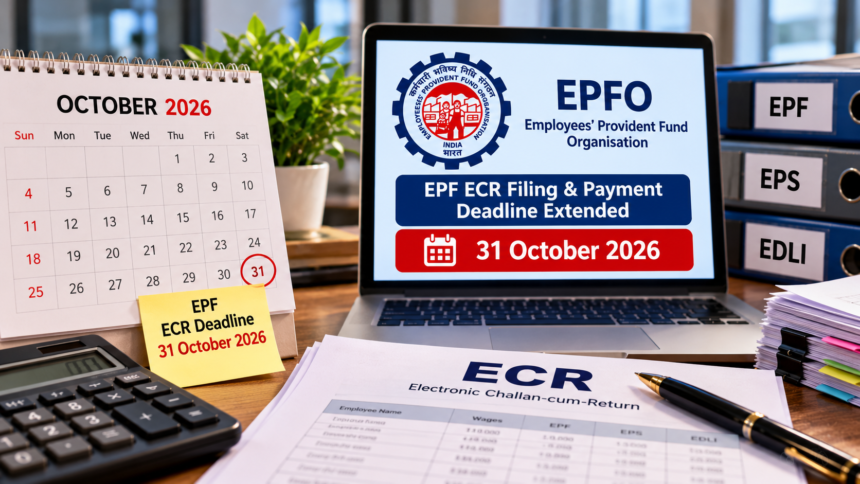
Employers now have until October 31, 2026, to file the Electronic Challan-cum-Return (ECR) and deposit statutory Provident Fund (PF) contributions for September 2026. The deadline was originally October 15 but was extended following the Employees’ Provident Fund Organisation’s (EPFO) revision of the EPF wage ceiling from ₹15,000 to ₹25,000 per month, effective September 17, 2026.
The revised wage ceiling requires employers to review their payroll systems, employee eligibility records and contribution calculations. Businesses must ensure that their payroll processes reflect the applicable rules and that all required contributions are reported and deposited within the extended deadline.
What Employers Must Check Before the EPF Deadline
The Electronic Challan-cum-Return contains employee-wise wage and contribution information for the Employees’ Provident Fund (EPF), Employees’ Pension Scheme (EPS) and Employees’ Deposit Linked Insurance (EDLI).
Employers should verify the relevant wage details and confirm that employee and employer contributions have been calculated correctly. They should also reconcile payroll records with the information being reported in the ECR to reduce the risk of errors or compliance issues.
Timely filing and payment are particularly important for establishments reviewing their payroll arrangements following the revised wage ceiling.
How the Revised EPF Wage Ceiling May Affect Contributions
The impact of the increase from ₹15,000 to ₹25,000 will depend on how an employer currently calculates PF contributions.
Employers applying the statutory wage ceiling: Establishments calculating EPF contributions at 12% of wages, subject to the applicable ceiling, may see the maximum employee contribution increase from ₹1,800 to ₹3,000 per month. The employer’s contribution will continue to be governed by the applicable EPF and EPS allocation rules.
Employers contributing on actual PF wages: Organisations already calculating contributions at 12% of employees’ actual PF wages may see limited changes or no significant change in contribution amounts. However, they should still review payroll settings and ensure that their calculations comply with the applicable statutory requirements.
Who May Become Eligible for Mandatory EPF Coverage?
The revised wage ceiling may bring eligible new employees earning more than ₹15,000 and up to ₹25,000 per month within mandatory EPF coverage, subject to the applicable membership conditions.
New employees earning above ₹25,000 who are not already EPF members may remain outside mandatory coverage if they qualify as excluded employees under the relevant rules. Existing EPF members generally continue their membership when they change jobs.
Employers should therefore review each employee’s eligibility rather than relying solely on salary figures when determining coverage.
Key Steps Before October 31, 2026
With the extended deadline approaching, employers should verify employee eligibility, reconcile payroll records and check the accuracy of EPF, EPS and EDLI contribution details. They should also confirm that the ECR is filed and the applicable contributions are deposited within the prescribed period.
Careful verification and timely compliance can help businesses minimise filing errors and avoid unnecessary administrative or compliance-related difficulties under the revised framework.
Disclaimer: This article is intended for general informational purposes only and should not be considered legal, tax or financial advice. Employers should consult the latest official EPFO notifications and applicable statutory provisions to confirm contribution calculations, membership eligibility and ECR filing requirements. Rules and implementation details should be verified through official sources before taking action.