
Paying school fees online has become a convenient option for many parents. UPI, debit cards and credit cards allow families to complete payments without visiting a bank or school office. However, additional charges imposed by some schools and payment gateways can increase the final amount payable.
These extra costs, often described as convenience fees, have raised questions about which payment method is the most economical for school fee payments. According to information shared by UPI on X, the merchant generally bears the Merchant Discount Rate (MDR), although parents may have to pay a convenience fee in certain circumstances.
UPI School Fee Payments: What Charges Apply?
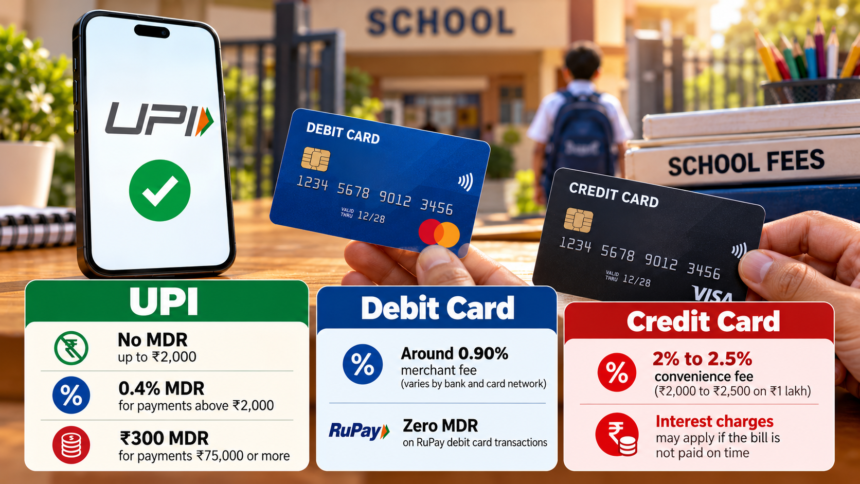
UPI allows parents to transfer money directly from their bank accounts to a school’s account. The article’s reported guidelines, effective October 15, specify that merchant payments of up to ₹2,000 attract no MDR, while payments above ₹2,000 are subject to an MDR of 0.4%.
For transactions of ₹75,000 or more, the reported MDR charge is ₹300.
However, parents should distinguish between MDR, which is generally a merchant-side charge, and a convenience fee that a payment platform may collect from the customer. The actual cost depends on the payment service and the applicable terms.
Debit Card Payments: How Much Can They Cost?
When parents pay school fees using a debit card, the money is deducted directly from their bank accounts. Schools may pay processing charges to their payment service providers for accepting these transactions.
The reported merchant fee for debit card payments is around 0.90%, although the rate can vary depending on the bank and card network.
RuPay debit card transactions are covered by a zero-MDR policy, as stated in the provided information. Parents should nevertheless check whether the school or payment gateway applies any separate fee before completing a transaction.
Credit Card School Fee Payments May Cost More
Credit cards allow parents to pay school fees without an immediate deduction from their bank accounts. Instead, the amount is added to the credit card statement and must be repaid according to the billing terms.
However, some payment platforms charge a convenience fee of 2% to 2.5% for school fee transactions made using credit cards. On a payment of ₹1 lakh, this would amount to an additional ₹2,000 to ₹2,500.
Parents should also remember that failing to pay the credit card bill by the due date may result in interest charges, depending on the card’s terms and conditions.
Which Payment Method Should Parents Choose?
The most economical option depends on the school’s payment arrangements and the charges displayed at checkout.
UPI may be convenient for direct bank transfers, while debit cards deduct money immediately from the linked account. Credit cards can provide additional time to pay, but convenience fees and potential interest charges may increase the overall cost.
Before confirming a school fee payment, parents should check the final payable amount, review any processing or convenience fees, and compare the available payment methods. This can help them avoid unnecessary expenses.
Disclaimer: This article is intended for general informational purposes only. Payment charges and transaction rules may vary depending on the payment provider, bank, card network and school. The fee figures mentioned are based on the information supplied and should be verified against current official guidelines and the charges displayed before making a payment.