

The Employees’ Provident Fund (EPF) rules have undergone a significant change in 2026, with the monthly salary threshold for mandatory PF membership increasing from ₹15,000 to ₹25,000, according to the information provided. The revision could bring more employees under the social security framework and affect how employers determine PF eligibility and manage contributions.
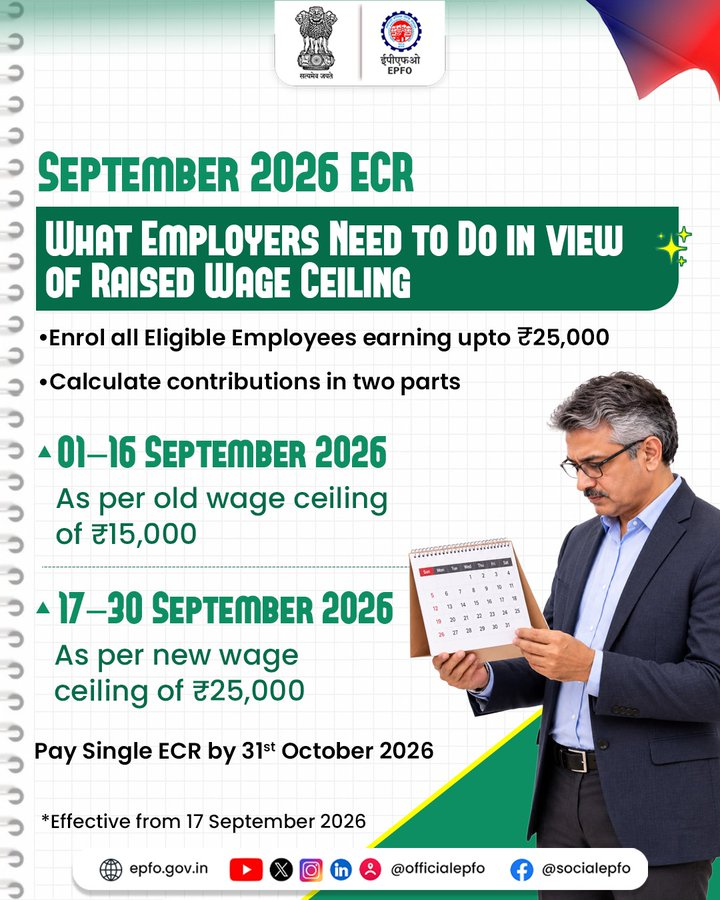
For September 2026, employers have also been instructed to account for two different salary-limit periods. In addition, companies must submit the Electronic Challan-cum-Return (ECR) for September by the revised deadline of October 31.
EPF Salary Limit Increased from ₹15,000 to ₹25,000
The Central Government has increased the salary threshold for mandatory EPF membership from ₹15,000 to ₹25,000 per month, with the change taking effect on October 17, 2026.
The revised limit is intended to extend social security coverage to employees who were previously outside mandatory PF membership because their salaries exceeded the earlier threshold. Employees earning above ₹15,000 but up to ₹25,000 may now qualify under the revised eligibility criteria, subject to the applicable EPF membership rules.
The change may also provide eligible employees with access to pension and insurance benefits linked to the EPF framework.
How PF Contributions Will Be Calculated for September 2026
September 2026 requires employers to distinguish between two periods when calculating PF contributions. According to the information provided, the salary threshold of ₹15,000 applies from September 1 to September 16, while the revised threshold of ₹25,000 applies from September 17 to September 30.
For an employee whose PF-eligible salary exceeds the applicable threshold, the calculation must account for the relevant period rather than treating the entire month under a single salary limit.
For example, in a 30-day month, the salary corresponding to the first 16 days would be ₹8,000 when calculated against a monthly salary of ₹15,000. For the remaining 14 days, the corresponding amount would be approximately ₹11,667 when calculated against a monthly salary of ₹25,000.
Employers should apply the relevant EPFO instructions and contribution rules when processing employee records for the month.
Employee and Employer PF Contribution Rates
Under the standard EPF contribution structure, employees and employers each contribute 12% of the applicable PF wages, subject to the relevant rules and wage limits.
For an employee with a basic salary of ₹25,000, a 12% contribution amounts to ₹3,000. The employee’s contribution is deducted from salary, while the employer makes a separate contribution. The employer’s share is allocated between the Employees’ Provident Fund (EPF) and the Employees’ Pension Scheme (EPS), as applicable under the rules.
The actual amount deposited into each component depends on the applicable contribution provisions and the employee’s eligibility.
September ECR Filing Deadline Extended to October 31
Employers must file the Electronic Challan-cum-Return (ECR) for September 2026. This online filing contains employee salary details and the corresponding contributions towards EPF, EPS and the Employees’ Deposit Linked Insurance (EDLI) scheme.
The ECR enables employers to report the relevant employee information and contributions through a consolidated electronic filing process.
According to the information provided, the Employees’ Provident Fund Organisation (EPFO) has extended the September ECR filing deadline from October 15 to October 31, 2026.
Employers should review their payroll records, verify employee eligibility under the revised salary threshold and complete the required filing within the applicable deadline.
Disclaimer: This article is for general informational purposes and is based on the information provided about EPF rules for September 2026. Salary thresholds, membership eligibility, contribution calculations and filing deadlines should be verified against the latest official EPFO notifications and applicable regulations. Employees and employers should consult the relevant official guidance before making decisions or processing PF contributions.