
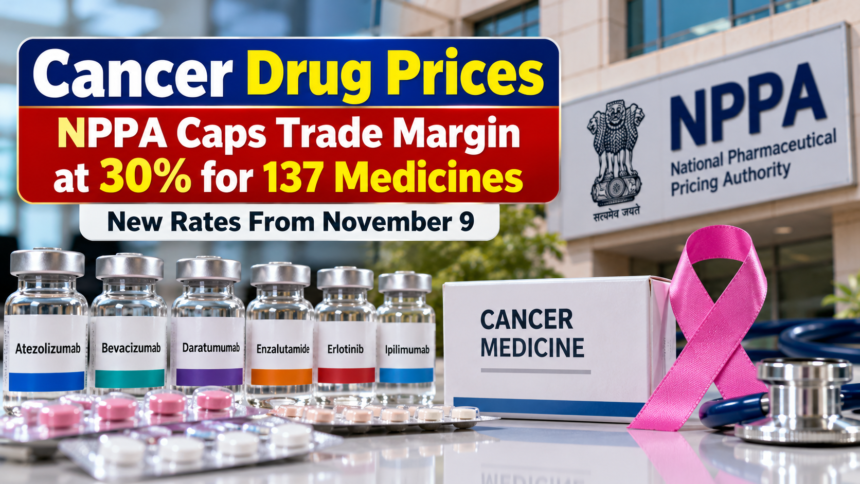
India’s National Pharmaceutical Pricing Authority (NPPA) has introduced a 30% trade margin cap on 137 commonly used cancer medicines to help regulate their retail prices. The revised prices will take effect on November 9, according to the supplied information.
The list was recommended by a specialised committee of the Union Health Ministry and includes medicines such as Atezolizumab, Bevacizumab, Daratumumab, Enzalutamide, Erlotinib, Ipilimumab and Lapatinib. Keytruda, an immunotherapy medicine, is not included in the list.
The restriction applies regardless of a medicine’s strength, dosage form or method of administration, including tablets, injections and combination formulations.
How Will the New Cancer Medicine Price Rules Work?
The 30% trade margin limit is calculated on the Maximum Retail Price (MRP), excluding Goods and Services Tax (GST). According to the NPPA’s explanation, this corresponds to a markup of 42.86% on the amount received by the stockist or distributor.
Under the revised framework, manufacturers selling medicines above the applicable new MRP must reduce their prices accordingly. The revised MRP will be calculated using the price at which stockists or distributors purchased the medicines by March 2026.
If a medicine had no sales during March 2026, its price will be determined using sales data from April 2025 to March 2026, excluding government sales.
Manufacturers may continue to increase prices annually where permitted under the Drugs (Prices Control) Order (DPCO), provided they comply with the prescribed trade-margin limit.
The rules will also cover formulations launched after March 31, 2026, if they contain any of the listed medicines.
Production and Supply Requirements for Manufacturers
The NPPA has directed manufacturers to maintain existing production levels to ensure that cancer medicines remain available to patients.
Companies wishing to change their average monthly production must obtain approval from the authority. Manufacturers planning to discontinue production or imports must notify the NPPA at least six months in advance.
Where medicines are supplied directly to hospitals or medical institutions, these establishments will be treated as stockists or distributors for the purpose of calculating the MRP. The calculation will use the relevant invoice information provided by the manufacturer.
Manufacturers are also permitted some flexibility in the quantity of free medicines distributed through Patient Assistance Programs. However, they must maintain complete and accurate records of such supplies.
NPPA Monitoring and Penalties for Non-Compliance
Manufacturers must notify both the NPPA and the relevant state drug controller of any MRP changes within seven days of the order’s publication.
The authority can conduct audits, seek additional information and take steps to verify whether companies are complying with the revised requirements. Failure to follow the rules may result in action under the DPCO, including the recovery of amounts charged in excess of the permitted prices.
Hospitals and medical institutions, which play an important role in supplying anti-cancer medicines, are responsible for monitoring the applicable MRPs and reporting suspected violations to the NPPA.
State drug controllers will oversee compliance by manufacturers, dealers, hospitals and medical institutions to ensure that the pricing requirements are followed.
Disclaimer
This article is intended for general informational purposes only and is based on the information provided about the NPPA’s cancer medicine pricing measures. The applicable prices, implementation dates and regulatory requirements should be verified through the latest official NPPA notifications and relevant government orders. This article does not constitute medical, pharmaceutical or financial advice. Patients should consult qualified healthcare professionals regarding treatment and medication choices.