
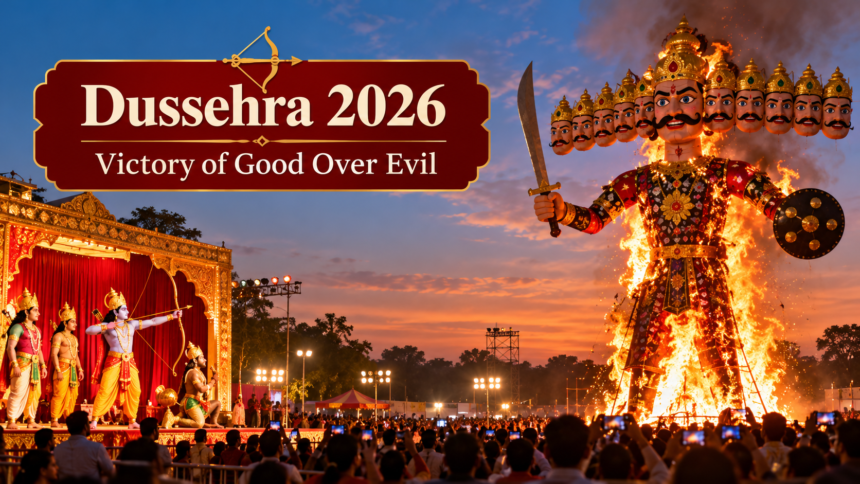
New Delhi: Dussehra, also known as Vijayadashami or Dasara, is one of the major Hindu festivals celebrating the victory of good over evil. The occasion is marked by Ramlila performances, the burning of Ravana’s effigies and prayers to the divine. However, the festival’s significance extends beyond these familiar celebrations, drawing on two important traditions: Lord Rama’s victory over Ravana and Maa Durga’s defeat of Mahishasura.
Observed on the tenth lunar day of the bright fortnight of Ashwin, Dussehra carries different meanings across India. In many northern regions, the festival is closely linked to the Ramayana, while several eastern and southern traditions emphasise the triumph of the Goddess. Both narratives highlight the importance of righteousness, courage and the restoration of balance.
Why Is Dussehra Celebrated in India?
Dussehra symbolises the victory of righteousness, or dharma, over destructive forces. Its central message is that arrogance, injustice and the misuse of power can ultimately lead to downfall.
In North India, the festival commemorates Lord Rama’s victory over Ravana, the king of Lanka who abducted Sita. In Bengal, Vijayadashami marks the conclusion of Durga Puja and celebrates Maa Durga’s triumph over Mahishasura. Mysuru Dasara in Karnataka also honours Goddess Chamundeshwari and her victory over the demon.
Although the celebrations differ from one region to another, they share a common theme: the defeat of evil and the restoration of righteousness.
Lord Rama and Ravana: The Story Behind Dussehra
According to the Ramayana, Ravana abducted Sita and took her to Lanka. Lord Rama, accompanied by his brother Lakshmana and supported by Hanuman and the vanara army, launched a battle against Ravana to rescue her.
The conflict ended with Rama defeating Ravana, bringing his rule to an end and symbolising the triumph of righteousness.
This episode is remembered during Dussehra through traditional Ramlila performances, which recreate important events from the Ramayana. The celebrations often conclude with the burning of Ravana’s effigy.
Ravana is also portrayed in Hindu traditions as a powerful ruler, a learned scholar and a devotee of Lord Shiva. However, his decision to abduct Sita and his refusal to correct his actions ultimately lead to his defeat. His story illustrates that knowledge and strength cannot justify wrongdoing when they are used without moral responsibility.
Maa Durga’s Victory Over Mahishasura
Another important tradition associated with Vijayadashami centres on Maa Durga’s battle against Mahishasura, a powerful demon who threatened the gods and the cosmic order.
According to the Devi Mahatmya, the combined divine energies of the gods manifested as Goddess Durga. Riding a lion and carrying celestial weapons, she fought Mahishasura and ultimately defeated him.
Maa Durga represents Shakti, or divine feminine power. Her victory symbolises the restoration of balance and the strength required to overcome destructive forces.
This tradition is particularly significant during Durga Puja in Bengal, which concludes on Vijayadashami. Goddess Durga also holds a central place in Mysuru Dasara, where she is worshipped as Chamundeshwari.
Why Are Ravana’s Effigies Burned on Dussehra?
The burning of Ravana’s effigy, commonly known as Ravan Dahan, is one of the most widely recognised Dussehra traditions in North India. Public celebrations often feature effigies of Ravana, Meghnad and Kumbhakarna, which are set alight after performances depicting events from the Ramayana.
The ritual represents the defeat of evil and the victory of righteousness. It also brings communities together through cultural performances, storytelling and festive gatherings.
However, Ravan Dahan is not observed everywhere. In several regions, Vijayadashami is marked through Goddess worship, traditional ceremonies, royal processions or the immersion of Durga idols.
What Is the Spiritual Significance of Dussehra Today?
The stories associated with Dussehra continue to offer lessons about personal conduct and responsibility. Lord Rama’s victory highlights the importance of following dharma, even when circumstances are difficult. Maa Durga’s triumph represents courage and the determination to confront destructive forces.
The festival also encourages reflection on the consequences of pride and the misuse of authority. Knowledge, achievement and strength become meaningful when accompanied by humility and a sense of responsibility.
As Navratri concludes and Vijayadashami arrives, devotees celebrate these enduring values through prayers, rituals and community gatherings.
Ultimately, Dussehra is more than a commemoration of two mythological victories. Through the stories of Lord Rama and Maa Durga, it renews the message that righteousness, courage and accountability are essential to overcoming injustice.
Disclaimer
This article is intended for general informational and educational purposes. It summarises Hindu religious traditions, mythological narratives and regional customs associated with Dussehra and Vijayadashami. Interpretations, rituals and celebrations may vary across communities and traditions. Readers are encouraged to consult relevant religious texts or local traditions for further understanding.