
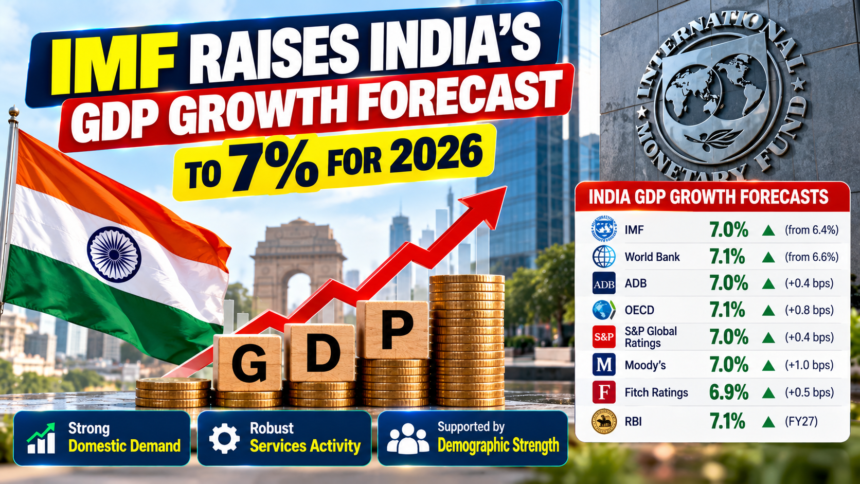
The International Monetary Fund (IMF) has raised its forecast for India’s economic growth in 2026 to 7%, up from its earlier projection of 6.4% announced in July. The upward revision reflects stronger-than-expected economic activity, supported by steady domestic demand and robust performance in the services sector.
The latest estimate highlights India’s continuing economic momentum despite rising global crude oil prices and geopolitical tensions. Just a week earlier, Reserve Bank of India (RBI) Governor Sanjay Malhotra projected that the Indian economy would grow by 7.1% in the financial year 2026–27 (FY27).
In an update to its flagship World Economic Outlook report, the IMF said India’s improved outlook reflects sustained economic activity and growing signs of stronger long-term growth potential. It also highlighted favourable demographic trends, an expanding domestic market and ongoing structural reforms as factors supporting the country’s economic prospects.
Rising Crude Oil Prices Pose a Challenge
The improved GDP outlook comes at a time when international crude oil prices have been rising amid the US-Iran conflict. According to data from the Petroleum Ministry, the average price of crude oil paid by Indian refiners has reached $127 per barrel, its highest level since the West Asia crisis began in late February.
Higher oil prices can put pressure on India’s import bill and increase costs across the economy. Nevertheless, the IMF’s latest assessment indicates that strong domestic demand and services activity continue to support the country’s growth outlook.
India’s GDP Growth Forecasts Revised Upward by Major Agencies
Several international organisations and rating agencies have recently increased their projections for India’s economic growth. Their latest estimates point to a broadly positive outlook for the country.
| Organisation | GDP Growth Forecast | Previous Estimate or Revision |
|---|---|---|
| World Bank | 7.1% | Revised upward from 6.6% |
| IMF | 7.0% | Increased by 0.6 percentage points |
| Asian Development Bank (ADB) | 7.0% | Increased by 0.4 percentage points |
| OECD | 7.1% | Increased by 0.8 percentage points |
| S&P Global Ratings | 7.0% | Increased by 0.4 percentage points |
| Moody’s Ratings | 7.0% | Increased by 1 percentage point |
| Fitch Ratings | 6.9% | Increased by 0.5 percentage points |
| Reserve Bank of India (RBI) | 7.1% | Forecast for FY2026–27 |
The revisions reflect growing confidence in India’s economic performance, although the estimates cover different forecasting periods and may be based on different assumptions.
IMF Upgrades Growth Outlook for Germany and the UK
The IMF has also become more optimistic about the economic prospects of several developed economies. Germany’s projected growth rate for 2026 has been raised to 1.3%, an increase of 0.7 percentage points compared with the July forecast.
The United Kingdom’s growth estimate has also been revised upward, from 1% to 1.3%. Meanwhile, the IMF now expects advanced economies collectively to grow by 2.1% in 2026, compared with its earlier projection of 1.7%.
These upward revisions indicate an improved outlook for developed economies compared with the previous assessment.
Emerging Markets Face a More Moderate Outlook
In contrast, the IMF has slightly lowered its growth forecast for emerging markets and developing economies. The group is now expected to expand by 3.7%, compared with the earlier estimate of 3.8%.
The revised outlook reflects expectations of slower economic growth in some major emerging economies, including China, Russia and Brazil. Their performance could weigh on the broader growth rate of developing economies.
Overall, the IMF’s latest projections present a stronger outlook for India than previously anticipated, supported by domestic demand, services activity and structural reforms. However, rising crude oil prices and changing global economic conditions remain important factors to watch.
Disclaimer: This article is intended for general informational purposes only and is based on the economic forecasts and figures provided in the source material. GDP projections are estimates and may change as economic conditions evolve. Readers should consult the latest official publications from the IMF, RBI and other relevant institutions for updated information. The article should not be treated as financial or investment advice.