
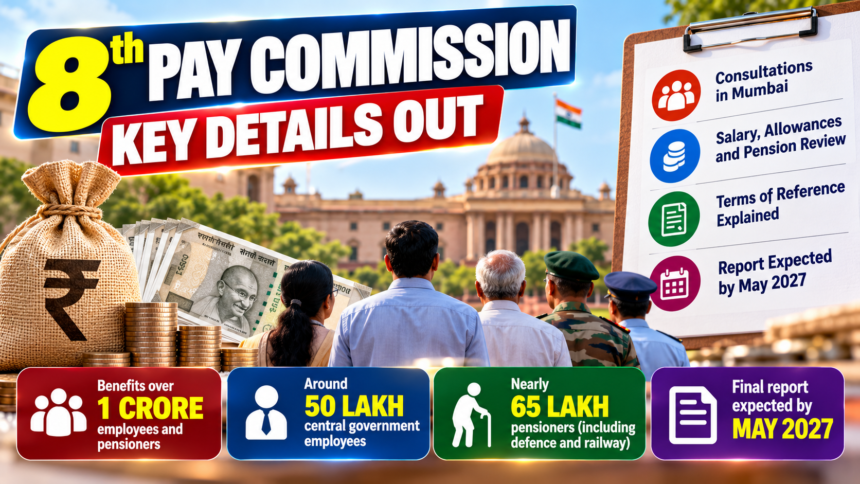
The 8th Central Pay Commission (CPC) is reviewing issues related to the salaries, allowances and pensions of central government employees. The commission is holding consultations with employee unions, pensioner associations, federations and other stakeholders before preparing its recommendations. Meetings are also scheduled in Mumbai to gather views from eligible representatives.
The proposed revisions could affect more than one crore people, including approximately 50 lakh central government employees and nearly 65 lakh pensioners. This includes serving and retired personnel associated with the defence and railway sectors.
Pay commissions are generally constituted by the Central Government at intervals of around 10 years to examine employee compensation, retirement benefits and related financial matters. The recommendations of the 8th Pay Commission will be considered by the government before any changes are implemented.
Who Are the Members of the 8th Pay Commission?
The commission is headed by former Supreme Court Justice Ranjana Prakash Desai. Its other members are Pankaj Jain, a former IAS officer serving as Member-Secretary, and Professor Pulak Ghosh, a Professor of Finance and a member of the Economic Advisory Council to the Prime Minister.
The panel is responsible for examining the existing pay and pension structure and recommending changes based on its assessment of employee requirements, economic conditions and government finances.
8th Pay Commission Terms of Reference: What Will the Panel Examine?
The Terms of Reference (ToR), approved by the Union Cabinet, define the commission’s responsibilities and the areas it must consider while preparing its report.
The commission is a temporary body comprising a Chairperson, a part-time Member and a Member-Secretary. It has been given 18 months from its constitution to submit its recommendations, although interim reports may be submitted if required.
While preparing its proposals, the panel must consider several financial and administrative factors, including:
- The country’s economic situation and the need for responsible government spending.
- The availability of funds for development projects and welfare programmes.
- The financial implications of non-contributory pension schemes.
- The potential impact of its recommendations on state government finances, as states often adopt central pay commission recommendations with modifications.
- Existing salary structures, benefits and working conditions in Central Public Sector Undertakings and the private sector.
These considerations are intended to help the commission balance employee welfare with the government’s financial responsibilities.
Salary, DA, HRA and Pension: What Changes Are Expected?
One of the commission’s main responsibilities is to examine whether changes to employee compensation are necessary and financially feasible. Its review covers basic pay, the pay matrix, allowances, retirement benefits and other facilities available to government employees.
The panel is expected to examine the following areas:
Pay structure and allowances: The commission will review salary levels and existing allowances, including Dearness Allowance (DA), Dearness Relief (DR) and House Rent Allowance (HRA). It will also consider whether allowances should be rationalised to reduce unnecessary complexity and meet current requirements.
Performance and productivity: The panel will examine existing bonus schemes and consider improvements that could encourage better performance. It will also recommend general principles and financial parameters for incentive schemes linked to productivity and achievement.
Recruitment and accountability: The proposed pay structure is expected to take into account the need to attract skilled professionals to government service while encouraging efficiency, responsibility and accountability.
Pension and retirement benefits: The commission will review Death-cum-Retirement Gratuity provisions and pension-related matters for employees covered by the National Pension System (NPS), including the Unified Pension Scheme (UPS), as well as employees outside the NPS framework. It will make recommendations based on the applicable provisions and requirements.
The final outcome will depend on the commission’s findings and the government’s decisions after reviewing its report.
When Will the 8th Pay Commission Submit Its Report?
The 8th Pay Commission was constituted on November 3, 2025, and has 18 months to complete its work under the stated timeline. This places the expected reporting period around May 2027.
The precise date on which recommendations will be made public has not been confirmed. Any earlier announcement would depend on the commission’s progress and official decisions.
The submission of the report will not automatically mean that revised salaries and pensions will take effect immediately. The Central Government must first examine the recommendations and decide which proposals to approve and how to implement them.
Based on previous pay commission timelines, the full implementation process could take another two to three years after recommendations are submitted. Consequently, any changes proposed in 2027 could take until 2029 or 2030 to be fully implemented, although this remains an estimate rather than a confirmed schedule.
Disclaimer: This article is intended for general informational purposes only and does not constitute official government advice. The commission’s recommendations, salary revisions, allowance changes, pension provisions and implementation dates remain subject to official decisions. Employees and pensioners should refer to government notifications and announcements from the 8th Central Pay Commission for confirmed information.