
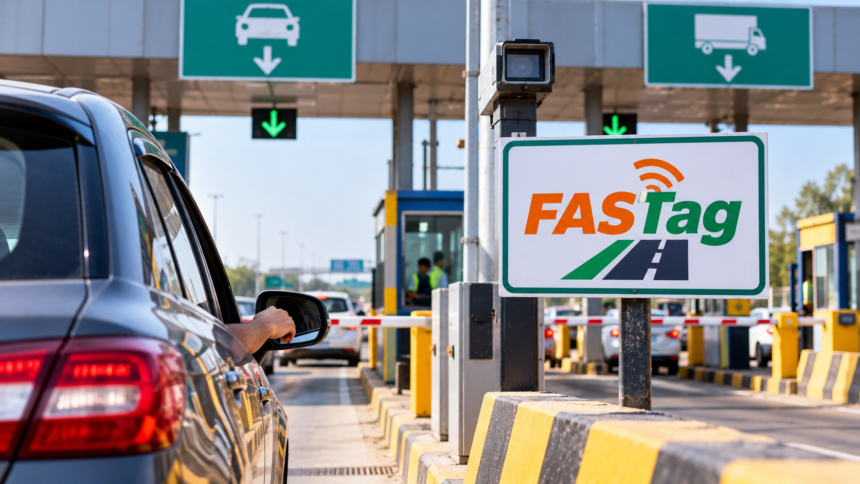
FASTag users often wonder how much money they need to keep in their accounts to pass through highway toll plazas without delays. The National Highways Authority of India (NHAI) removed the mandatory minimum balance requirement for FASTag accounts in February 2021. However, drivers still need to ensure that sufficient funds are available to cover applicable toll charges.
The earlier minimum balance requirement was intended to ensure that money remained available in the account after toll payments. Following the change, there is no universal minimum balance amount prescribed by NHAI for all FASTag users. Nevertheless, maintaining an adequate balance can help prevent payment-related problems during highway journeys.
What Is the Minimum Balance Required in FASTag?
There is no standard minimum balance that every vehicle owner must maintain in a FASTag account under the NHAI rule described above.
Before the change, issuing banks and other FASTag providers could require users to maintain a threshold amount, generally around ₹150 to ₹200, in addition to the security deposit where applicable.
After the mandatory threshold requirement was removed in February 2021, users no longer had to maintain a fixed minimum amount simply to keep their FASTag account active.
However, drivers should not assume that having no minimum balance requirement means they can travel without sufficient funds. Toll deductions must still be covered, and the status of the FASTag account can affect whether a transaction is completed successfully.
Keeping around ₹100 or more in the account may serve as a practical precaution, although the amount needed will depend on the toll charges along the route.
When Did NHAI Remove the FASTag Minimum Balance Rule?
NHAI removed the mandatory minimum balance requirement for FASTag accounts in February 2021.
Previously, certain issuing agencies required users to maintain a threshold balance to help ensure that toll payments could be processed. The change eliminated the common requirement to retain a fixed amount across all vehicles.
Vehicle owners should still check the terms and conditions of their issuing bank or FASTag provider. Account status, available funds and other applicable conditions can affect toll transactions.
Why Can a FASTag Be Blacklisted?
A FASTag may be blocked or blacklisted for several reasons, including issues related to its balance, account information or vehicle classification.
Common reasons include:
- Insufficient funds: An exhausted or negative balance can cause payment problems and may affect FASTag status, depending on the applicable rules.
- Incomplete KYC: Failure to complete required Know Your Customer verification or update details may result in restrictions.
- Incorrect vehicle category: A FASTag registered under the wrong vehicle class, such as using a car category for a truck, can lead to problems.
- Violation of issuing-bank requirements: Failure to comply with applicable account conditions or other requirements set by the issuing bank or relevant authority may result in restrictions.
Vehicle owners should check their FASTag status and resolve any outstanding issues with their issuing bank or service provider before travelling.
How to Avoid FASTag Problems on Highways
Drivers can reduce the risk of toll payment difficulties by checking their account balance before starting a journey. They should also ensure that their FASTag is active, their vehicle details are correct and all required KYC procedures have been completed.
If a FASTag is blocked or a toll payment fails, contacting the issuing bank or service provider can help identify the cause and explain the steps needed to restore normal use.
Although a fixed minimum balance is no longer universally mandatory under the NHAI rule, keeping enough money in the account remains a useful precaution for a smooth highway journey.
Disclaimer
This article is intended for general informational purposes only and should not be treated as official financial or regulatory advice. FASTag requirements, account restrictions and procedures may vary according to the issuing bank, service provider and applicable regulations. Readers should verify the latest guidelines through NHAI or their FASTag issuer before making decisions based on this information.