
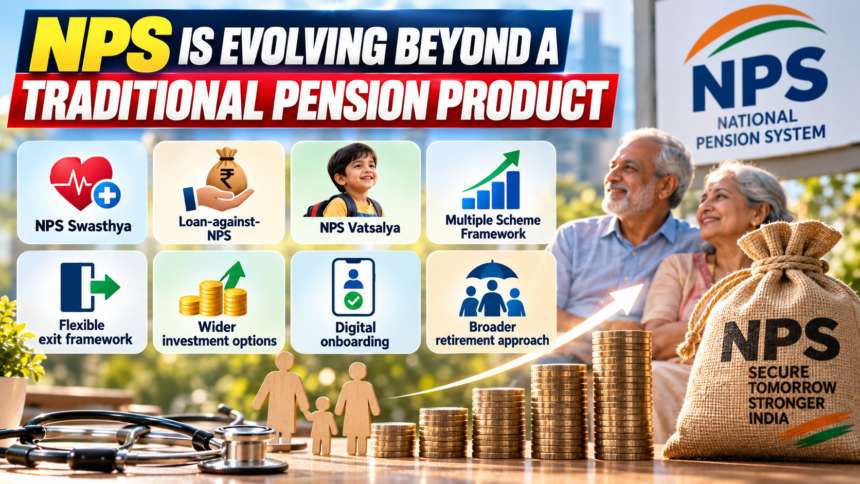
The National Pension System (NPS) is gradually expanding beyond its traditional role as a retirement savings scheme, with new developments focusing on healthcare expenses, short-term financial needs and greater investment flexibility. The changes reflect a broader approach to retirement planning, where financial security involves more than simply building a pension corpus.
Speaking to Business Today, Rajesh Khandagale, Principal Officer at PFRDA and KFin Technologies, said the NPS ecosystem is increasingly considering retirement as an extended phase of life that requires support for different financial needs rather than focusing only on pension payouts.
Among the key developments are NPS Swasthya, a proposed loan-against-NPS facility, NPS Vatsalya and the Multiple Scheme Framework. Together, these initiatives point towards a retirement planning model that considers savings, healthcare requirements, investment choices and access to funds.
NPS Swasthya: Bringing Healthcare into Retirement Planning
Healthcare expenses can become a major financial challenge after retirement. Unexpected medical bills may force retirees to use savings that were originally accumulated to support them throughout their later years.
NPS Swasthya seeks to explore how healthcare-related financial requirements can be addressed within the NPS framework.
“NPS Swasthya is an interesting development because it explores how health related financial support can be integrated into the NPS framework,” Khandagale said.
The initiative was initially introduced as a Proof of Concept under the Pension Fund Regulatory and Development Authority’s (PFRDA) Regulatory Sandbox Framework. This approach allows the relevant ecosystem to test the concept, understand subscribers’ needs and assess operational arrangements before considering wider implementation.
The initiative comes amid growing attention to healthcare costs and longer life expectancy. While accumulating retirement savings remains important, individuals also need to consider how medical expenses could affect their financial position over an extended retirement period.
Loan Against NPS May Help Subscribers Meet Short-Term Needs
Another proposed development aims to address the need for emergency funds without disrupting long-term retirement investments.
According to Khandagale, an upcoming loan-against-NPS facility is expected to allow subscribers to meet short-term financial requirements while keeping their core retirement corpus invested and growing.
Such a facility could offer subscribers another way to manage immediate financial needs while protecting savings intended for retirement. However, the exact terms and operating conditions of the facility will determine how subscribers can use it.
The proposed loan facility, alongside the focus on healthcare expenses, reflects a wider shift in retirement planning. The emphasis is gradually moving beyond accumulating money for the future towards considering the financial challenges people may face during retirement.
NPS Vatsalya, Multiple Scheme Framework and Flexible Exits
The expansion of the NPS ecosystem also includes initiatives designed to provide greater flexibility at different stages of an individual’s financial journey.
NPS Vatsalya extends the retirement savings concept to the early stages of life. Meanwhile, the Multiple Scheme Framework gives subscribers greater choice in how they invest within the NPS system.
Changes to the exit framework are also intended to provide more flexibility when subscribers access their retirement savings.
According to Khandagale, these developments reflect a broader approach to retirement planning that covers the accumulation of savings, investment choices, income requirements and healthcare needs.
The accompanying overview highlights the key developments and their implications for NPS subscribers.
| Development | What it means for NPS subscribers |
|---|---|
| NPS Swasthya | Brings healthcare-related financial needs into retirement planning. |
| Loan-against-NPS | The proposed facility could offer short-term liquidity while keeping the core retirement corpus invested. |
| NPS Vatsalya | Extends retirement savings to the early stages of an individual’s financial journey. |
| Multiple Scheme Framework | Provides subscribers with greater investment choice within NPS. |
| Flexible exit framework | Offers greater flexibility in accessing retirement wealth at exit. |
| Wider investment options | Expands the NPS investment universe while retaining prescribed limits and oversight. |
| Digital onboarding | NPS Tatkal enables new subscribers to complete onboarding in 20–30 seconds, reducing the time and effort required to enter the system. |
| Broader retirement approach | The evolving ecosystem addresses savings accumulation, investment choices, income needs and healthcare. |
NPS Moves Towards a Broader Retirement Financial Ecosystem
These developments could change how subscribers view the National Pension System as part of their long-term financial planning. Traditionally, the primary focus has been on accumulating a retirement corpus and generating pension income. The expanding framework is increasingly considering other requirements, including healthcare costs, investment flexibility and access to funds.
For subscribers, this broader approach could make retirement planning more closely aligned with the financial challenges associated with a longer life after employment.
The extent of these benefits will depend on the implementation and terms of individual initiatives. Nevertheless, the direction of development suggests that NPS is moving towards a wider retirement financial ecosystem rather than remaining solely a pension savings product.
Disclaimer: This article is for informational purposes only and does not constitute financial, investment or retirement-planning advice. The availability, eligibility criteria and terms of NPS initiatives may vary or change as policies are implemented. Subscribers should check official PFRDA and NPS documentation and consult a qualified financial adviser before making decisions about retirement savings or accessing their funds.