
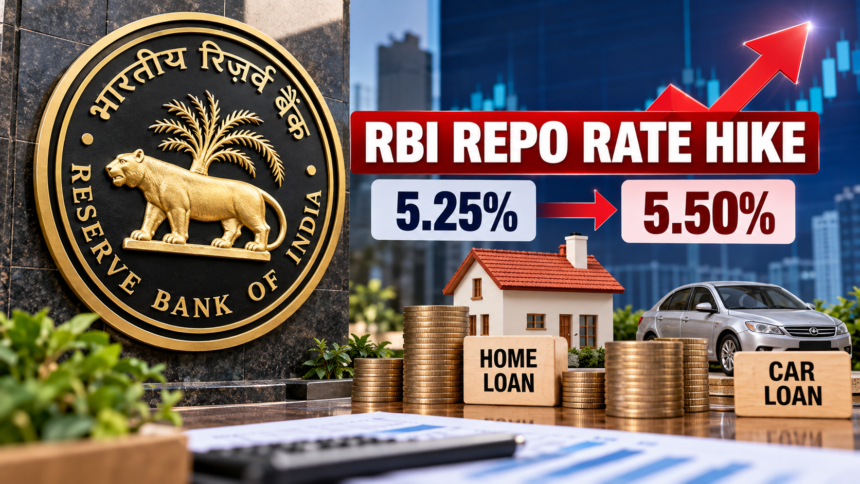
New Delhi: The Reserve Bank of India (RBI) has increased the repo rate by 25 basis points, taking it from 5.25 per cent to 5.50 per cent. The decision was announced by RBI Governor Sanjay Malhotra after the three-day Monetary Policy Committee (MPC) meeting.
The rate increase could have an impact on home loans, car loans and other floating-rate borrowings. Depending on how banks transmit the hike, some borrowers could see their interest rates and EMIs rise in the coming months. The RBI has said that controlling inflation remains a key reason behind the latest decision.
West Asia Conflict and Rising Crude Prices
Addressing the MPC decision, Governor Sanjay Malhotra highlighted the ongoing conflict in West Asia and the rise in crude oil prices. Higher energy costs can add to inflationary pressures and may also push up food prices.
Against this backdrop, the RBI has moved to increase the policy rate, with inflation management remaining an important priority.
Along with the repo rate, the central bank has also raised other policy rates. The Standing Deposit Facility (SDF) rate has been increased by 25 basis points from 5.00 per cent to 5.25 per cent.
The Marginal Standing Facility (MSF) rate has also been raised by 25 basis points, moving from 5.50 per cent to 5.75 per cent.
Fourth MPC Meeting of the Year
This is the fourth MPC meeting of the year. During the previous meetings held in April, June and August, the RBI had kept the repo rate unchanged at 5.25 per cent.
The latest 25-basis-point increase comes amid concerns over inflation and higher crude oil prices. The RBI has also changed its monetary policy stance from ‘neutral’ to ‘calibrated tightening’, indicating a greater focus on containing inflation.
A higher repo rate generally increases the cost of borrowing for banks, which can eventually affect lending rates for customers. As a result, borrowers with floating-rate loans could face higher interest costs, while fixed-rate loans are generally less directly affected.
What Is the Repo Rate?
The repo rate is the interest rate at which the RBI lends short-term funds to commercial banks.
When the central bank raises the repo rate, borrowing costs for banks can increase. Banks may then pass some or all of this increase on to customers through higher lending rates. Conversely, a reduction in the repo rate can make borrowing cheaper.
This is why changes in the repo rate are closely watched by home loan, car loan and other floating-rate borrowers.
RBI Inflation and GDP Projections
The RBI expects inflation to increase from 4.3 per cent to 4.4 per cent in financial year 2027. CPI-based inflation is estimated to remain in the range of 5 per cent to 5.2 per cent.
Despite the monetary tightening, the central bank continues to project economic growth. GDP growth is expected to remain between 6.7 per cent and 7.1 per cent.
For the second quarter, the projected GDP growth range is 6.4 per cent to 7.2 per cent. Growth is expected to remain between 6.5 per cent and 6.9 per cent in the third quarter, followed by a projection of 6.8 per cent for the fourth quarter.
Disclaimer: The information and projections mentioned in this article are based on the details provided in the source material and are intended for general informational purposes only. RBI policy decisions, inflation estimates, GDP projections and loan interest rates may change based on economic conditions and future policy actions. Borrowers should check with their respective banks or financial institutions for the actual impact on their loans and EMIs.