
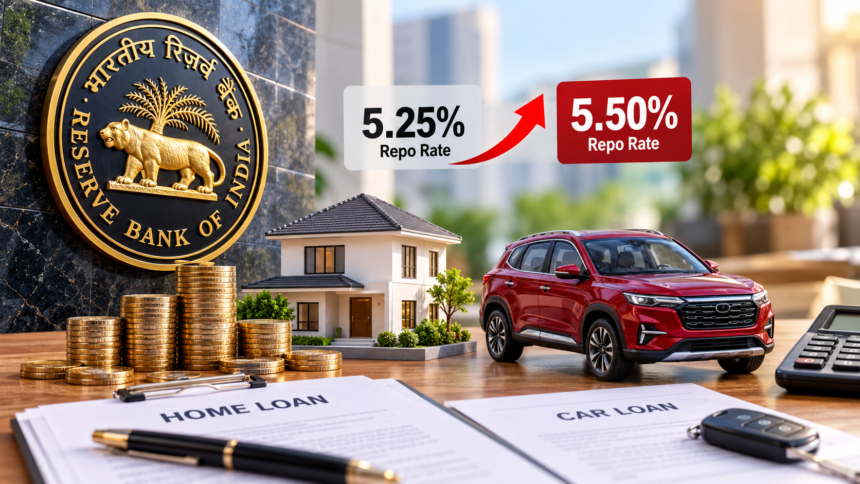
Kolkata: The Reserve Bank of India (RBI) has raised the repo rate by 25 basis points, taking it from 5.25 per cent to 5.50 per cent. The move could increase borrowing costs for customers with floating-rate loans, particularly home and car loans.
If banks pass on the entire 0.25 percentage point increase to borrowers, monthly EMIs could rise. For example, the EMI on a ₹50 lakh home loan could increase by around ₹817 per month, while a ₹10 lakh car loan could become costlier by about ₹117 per month.
However, the actual impact will depend on the loan amount, existing interest rate, remaining tenure, benchmark and the terms followed by the lender. This is the first repo rate increase by the RBI since February 2023.
₹50 Lakh Home Loan: EMI Could Rise by ₹817
Consider a ₹50 lakh home loan taken for 25 years at an interest rate of 7.50 per cent. At this rate, the monthly EMI works out to approximately ₹36,950.
If the lender passes on the full repo rate increase and raises the loan interest rate to 7.75 per cent, the EMI could increase to around ₹37,766.
That means the borrower would pay approximately ₹817 more every month. If the higher rate remains applicable throughout the loan tenure, the overall repayment burden would also increase substantially.
What About a ₹1 Crore Home Loan?
The impact becomes larger as the loan amount increases. For a ₹1 crore home loan with a 20-year tenure, an increase in the interest rate from 8.50 per cent to 8.75 per cent could push the monthly EMI from approximately ₹86,782 to ₹88,371.
This represents an increase of around ₹1,589 every month, or approximately ₹19,068 over a year.
Car Loan EMI Could Also Increase
The impact on car loans would generally be smaller in absolute terms because the loan amount and tenure are usually lower.
For instance, consider a ₹10 lakh car loan for five years at an interest rate of 9 per cent. The EMI would be approximately ₹20,758.
If the interest rate rises to 9.25 per cent after the repo rate hike, the EMI could increase to around ₹20,875. The monthly increase would therefore be about ₹117, translating into an additional annual outgo of approximately ₹1,404.
Which Loans Will Be Affected?
The repo rate increase can have a more direct and quicker impact on floating-rate loans linked to an external benchmark such as the repo rate. Home loans linked to such benchmarks may therefore see changes in their interest rates relatively quickly, depending on the lender’s transmission of the rate hike.
Loans linked to other benchmarks may not reflect the increase immediately. Fixed-rate loans are generally not directly affected by changes in the repo rate during the fixed-rate period.
With floating-rate borrowing becoming common, existing borrowers should check their loan agreement, benchmark, reset frequency and lender’s revised interest rate to understand how the RBI’s latest decision could affect their monthly EMI.
Disclaimer: The EMI figures mentioned in this article are illustrative calculations based on the loan amounts, interest rates and tenures stated in the examples. Actual EMIs may vary depending on the lender, benchmark, reset terms, remaining loan tenure and other applicable conditions. Borrowers should contact their respective bank or financial institution for the exact impact on their loan.