
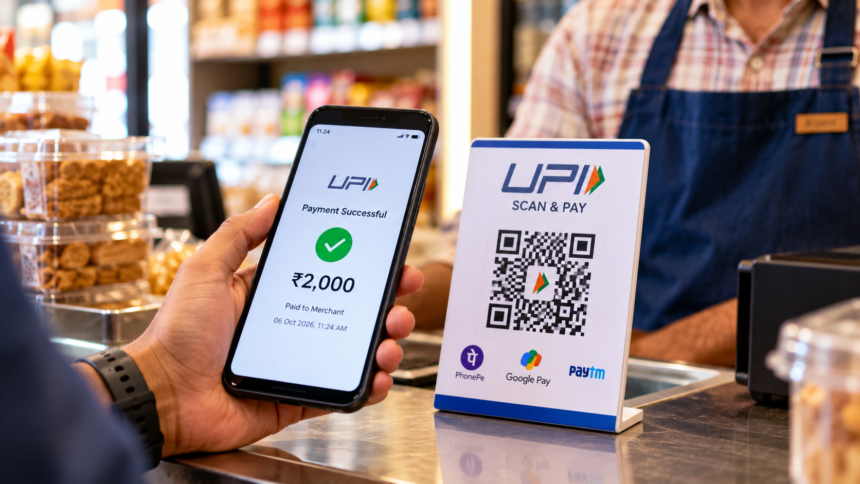
UPI MDR: New rules related to the Merchant Discount Rate (MDR) on UPI transactions are set to come into effect from October 15. Under the revised structure announced by the National Payments Corporation of India (NPCI), a 0.4% MDR will apply to Person-to-Merchant (P2M) UPI transactions above ₹2,000.
The new framework also sets a maximum MDR of ₹300 for transactions worth ₹75,000 or more. However, the same rate will not apply to every category of merchant. Certain sectors, including railways, telecom, insurance and fuel, will have a fixed MDR of ₹5 on eligible transactions.
Why Will Some Sectors Pay Only ₹5 MDR?
According to the Finance Ministry, transactions above ₹2,000 in categories such as railways, telecom, insurance, fuel and certain utility-related services will attract a flat ₹5 MDR, regardless of the transaction value.
These sectors typically handle large volumes of transactions, while some also operate with controlled prices or relatively limited margins. Applying a 0.4% charge to every eligible transaction could increase the cost of digital payment acceptance significantly.
The fixed ₹5 structure is therefore intended to keep payment-related costs under control in these essential service categories. It is also aimed at supporting digital payments without adding substantial costs to services used by consumers regularly.
How Much Can Merchants Save on a ₹2,000 UPI Payment?
Under the standard 0.4% MDR, a ₹2,000 transaction would result in an MDR of ₹8. In sectors covered by the ₹5 fixed charge, the merchant would instead pay ₹5, resulting in a ₹3 difference on that transaction.
The break-even point between the two structures is ₹1,250, since 0.4% of ₹1,250 equals ₹5.
However, the revised MDR applies only to eligible P2M transactions above ₹2,000. The difference becomes more significant as the transaction value increases. For example, a ₹10,000 payment would attract ₹40 under a 0.4% MDR, whereas the applicable charge for a merchant covered by the ₹5 category would remain ₹5.
Can Merchants Recover MDR From Customers?
MDR is primarily a charge associated with the merchant side of a digital payment transaction and is not intended to be imposed directly on customers as a separate UPI fee.
The government has also advised banks to ensure that merchants do not directly transfer the new UPI charges to customers. However, merchants still have to account for the cost of accepting digital payments as part of their overall business expenses.
As a result, individual businesses may choose to absorb the cost or adjust other aspects of their pricing, discounts or customer benefits to manage the additional expense.
Disclaimer
This article is intended for general informational purposes and is based on the UPI MDR rules and details provided in the source material. Payment rules, charges and applicable guidelines may be revised by the concerned authorities from time to time. Readers and merchants should verify the latest information through official NPCI, government or banking sources before making financial or business decisions.