
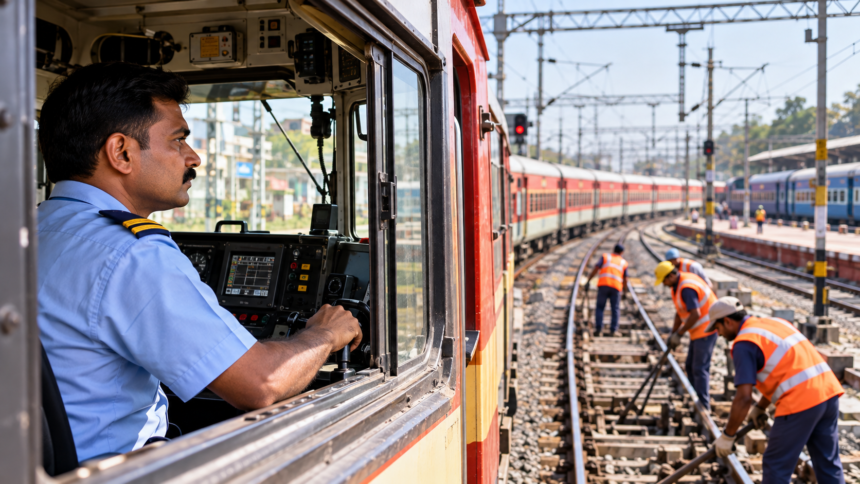
8th Pay Commission 2026: Discussions around the 8th Pay Commission have increased expectations among government employees regarding salaries, allowances and other benefits. At the same time, railway employee unions have raised several workplace issues before the Railway Board, including duty hours, overtime payments, travelling allowance and the workload of trackmen.
During a recent Railway Board meeting, employee representatives gave particular attention to the long working hours of loco pilots and other running staff. Shiv Gopal Mishra, General Secretary of the All India Railwaymen’s Federation, raised concerns over employees being required to remain on duty for extended periods.
Why Are Loco Pilots Working Beyond the 9-Hour Limit?
Shiv Gopal Mishra questioned why loco pilots are sometimes required to work for 14, 16 or even 17 hours when the prescribed duty limit is nine hours.
According to the union, extending working hours because of operational requirements places additional pressure on employees. The union also linked excessive duty periods with concerns about the safety of railway operations, particularly when running staff are required to continue working for unusually long hours.
The issue has become an important part of the broader discussion surrounding the working conditions of railway employees, alongside matters related to the 8th Pay Commission.
Railway Unions Question Delay in TA and OT Payments
The meeting also focused on delays in the payment of Travelling Allowance (TA) and Overtime (OT) to railway employees.
Shiv Gopal Mishra pointed out that the Railway Board had stated that around 95 per cent of the railway budget, amounting to approximately ₹2.90 lakh crore, had already been spent. Against this backdrop, the employee union questioned why TA and OT payments were not being released on time despite employees continuing to perform their duties.
Allowances and additional payments form an important part of an employee’s overall compensation, making these issues relevant to the wider discussion around the 8th Pay Commission.
Union Seeks Lower Workload for Trackmen
The union also raised concerns about the workload of trackmen. It has demanded that trackmen should not be required to cover more than 12 kilometres in a day.
At present, trackmen may cover distances of up to 20 kilometres. The union has asked the Railway Board to reduce this limit, citing the workload involved in their duties.
Excessive Duty Hours Raise Safety Concerns
Concerns were also raised over the working hours of running staff, which includes train crew. While employees may sometimes work for 11 to 12 hours due to operational requirements, the union said that some workers are being required to remain on duty for as long as 17 hours.
According to the union, such extended duty periods can place significant pressure on employees and raise concerns about the safety of railway operations.
Railway Employees Seek Focus Beyond Salary
The Railway Board meeting highlighted that railway employees’ demands extend beyond salary revisions under the 8th Pay Commission. Working hours, overtime payments, travelling allowances, trackmen’s workload and operational safety are also key concerns.
Employee unions are seeking attention to these workplace issues along with discussions related to pay, allowances and other aspects of employee compensation.
Disclaimer
This article is based on the information provided regarding discussions between railway employee representatives and the Railway Board. The demands, statements and issues mentioned are subject to official decisions and applicable railway regulations. Readers should refer to official Railway Board or government announcements for confirmed updates regarding duty hours, allowances, overtime payments and the 8th Pay Commission.