
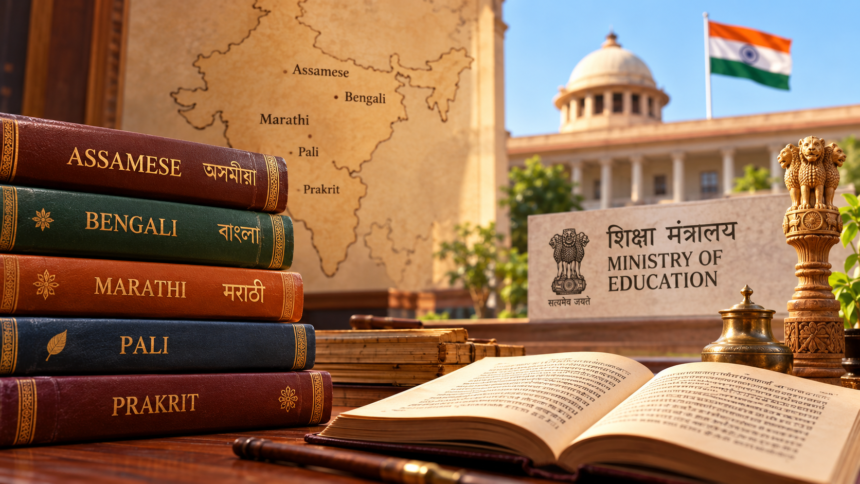
The Ministry of Education has approved the establishment of five Centres of Excellence dedicated to the study of India’s classical languages. The Department of Higher Education has cleared the proposal to create specialised centres focusing on Classical Assamese, Classical Bengali, Classical Marathi, Classical Pali and Classical Prakrit.
The initiative is aimed at strengthening academic research and creating dedicated institutional support for the study, preservation and promotion of these languages and their literary traditions.
Five Universities to Host the Centres
The new Centres of Excellence will be established at five institutions across different parts of the country. Tezpur University in Assam will host the centre for Classical Assamese, while Visva-Bharati University in West Bengal will focus on Classical Bengali.
The Centre for Classical Marathi will be established at Deccan College Post-Graduate and Research Institute in Pune. The Central University of Odisha will host the centre dedicated to Classical Pali, while the Central University of Gujarat will establish the centre for Classical Prakrit.
Focus on Research, Preservation and Digitisation
The new centres will provide an institutional platform for advanced academic research into the selected classical languages. Their work will also focus on preserving and digitising linguistic and literary heritage associated with these traditions.
Another key objective will be to support the wider dissemination of knowledge related to the classical languages, helping expand academic engagement with their linguistic and literary heritage.
Strengthening the Study of Classical Languages
The establishment of these five Centres of Excellence is expected to strengthen the institutional framework for research and preservation of India’s classical languages.
By creating dedicated centres at established higher education institutions, the initiative will provide greater academic support for research, documentation, preservation and wider study of these languages.
Disclaimer
The information in this article is based on the details provided in the source material. The article is intended for general informational purposes and does not add any independent interpretation beyond the information supplied.