
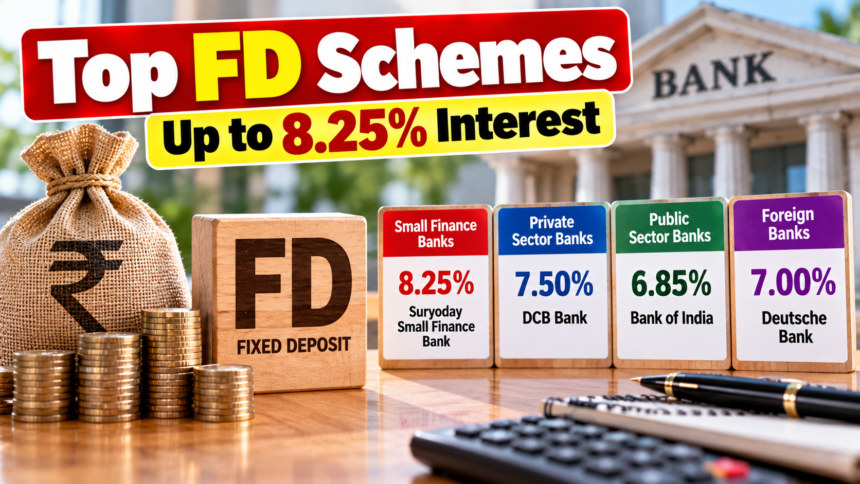
Fixed deposits remain a popular option for people looking for relatively predictable returns on their savings. Interest rates vary from one bank to another and also depend on the selected tenure, so choosing the right combination can make a difference to the final maturity amount.
Small finance banks generally offer some of the higher FD rates in the market, while private, public sector and foreign banks also provide different rates across various maturity periods. The rates mentioned below are maximum rates and may apply only to specific tenures or deposit categories.
Small Finance Banks Offering High FD Interest Rates
Among small finance banks, the rates mentioned in the source data are:
- Equitas Small Finance Bank: Up to 8.00%
- ESAF Small Finance Bank: Up to 8.00%
- Suryoday Small Finance Bank: Up to 8.25%
- Jana Small Finance Bank: Up to 8.00%
- Ujjivan Small Finance Bank: Up to 7.80%
- Shivalik Small Finance Bank: Up to 8.00%
- Utkarsh Small Finance Bank: Up to 8.10%
Current published rate cards show that these headline rates are linked to particular maturities. For example, Utkarsh Small Finance Bank lists 8.10% for a 666-day FD for regular customers, while Jana Small Finance Bank lists 8.00% for deposits with a tenure above two years and up to three years.
Suryoday Small Finance Bank’s current website also shows that FD interest rates vary according to the selected deposit product and tenure, with rates subject to change.
Private Sector Banks: FD Interest Rates
The private sector banks listed in the source data offer maximum FD rates as follows:
- DCB Bank: Up to 7.50%
- Bandhan Bank: Up to 7.45%
- IndusInd Bank: Up to 7.00%
- Axis Bank: Up to 6.50%
- HDFC Bank: Up to 6.50%
- ICICI Bank: Up to 6.50%
- IDBI Bank: Up to 6.55%
The actual rate applicable to an FD depends on factors such as tenure, deposit amount and customer category. For example, the August 2026 DCB Bank rate card shows a maximum regular-customer rate of 7.50% for selected maturities.
Public Sector and Foreign Bank FD Rates
According to the source data, the maximum rates offered by selected public sector banks are:
- Bank of India: Up to 6.85%
- Punjab & Sind Bank: Up to 6.85%
- Bank of Baroda: Up to 6.75%
- Central Bank of India: Up to 6.75%
- Bank of Maharashtra: Up to 6.65%
- Indian Bank: Up to 6.65%
- State Bank of India: Up to 6.45%
- Punjab National Bank: Up to 6.60%
For foreign banks, the listed rates are:
- Standard Chartered Bank: Up to 6.60%
- Deutsche Bank: Up to 7.00%
- HSBC Bank: Up to 5.50%
Bank of India’s published 2026 rate card, for example, shows different rates across maturity periods, highlighting why investors should check the exact tenure before opening an FD.
What to Check Before Investing in an FD
The highest advertised interest rate should not be the only factor considered when selecting an FD. Investors should compare the applicable tenure, premature withdrawal conditions and the amount that will actually be received at maturity.
Depositors should also understand the protection available under the Deposit Insurance and Credit Guarantee Corporation (DICGC). Eligible bank deposits, including fixed deposits, are insured up to ₹5 lakh per depositor per bank, covering principal and interest, subject to the applicable rules. Deposits held at different banks receive separate insurance coverage.
For larger amounts, spreading deposits across different banks can therefore provide separate insurance limits, while the choice of FD tenure should match the investor’s liquidity requirements.
Disclaimer
This article is for general informational purposes only and should not be considered investment advice. FD interest rates, applicable tenures, withdrawal rules and other bank terms can change without prior notice. Before investing, check the latest rate card and terms directly with the concerned bank and consider your own financial requirements and risk profile.