
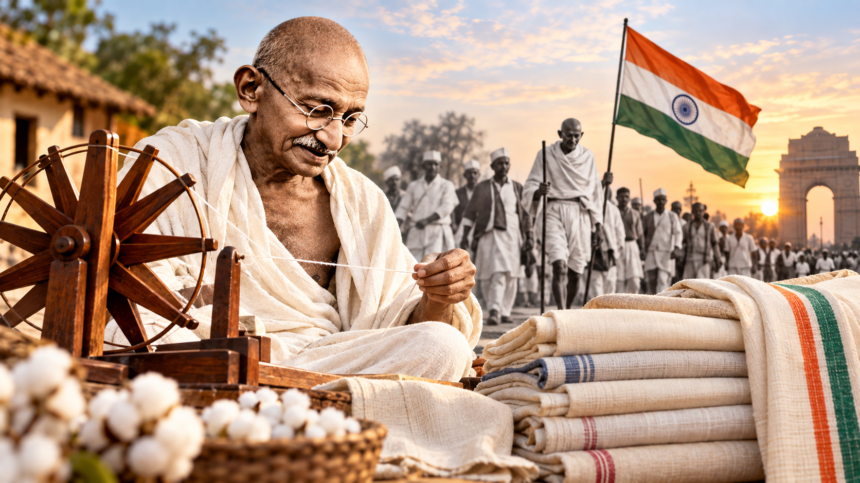
New Delhi: Khadi became far more than a traditional fabric during India’s freedom movement. Under Mahatma Gandhi’s leadership, hand-spun cloth became closely linked with the ideas of Swadeshi, economic independence and self-reliance.
At a time when British-made textiles had gained a strong presence in Indian markets, traditional spinners and weavers faced growing pressure, while the country became increasingly dependent on imported goods. Gandhi encouraged Indians to reject foreign cloth, use the charkha to spin yarn and choose locally produced khadi.
The movement gave the Swadeshi idea a visible place in everyday life while also promoting employment opportunities in rural communities. On Gandhi Jayanti 2026, khadi remains an important part of the history of India’s freedom struggle and Gandhi’s vision of a self-reliant society.
Khadi and the Boycott of British Textiles
The widespread use of British-manufactured textiles affected traditional Indian spinning and weaving communities during colonial rule. Gandhi urged people to boycott imported cloth and make their clothing choices part of the Swadeshi movement.
Wearing locally produced fabric therefore became more than a personal choice. It was also a way for people to participate in economic resistance against colonial dependence.
Charkha, Swadeshi and Rural Employment
The charkha became one of the most recognisable symbols associated with Gandhi’s approach to self-reliance. He encouraged people to spin their own yarn and support the production of cloth within Indian communities.
Gandhi also viewed hand-spinning as a way to create additional livelihood opportunities in villages. Khadi production could support rural workers, artisans and women while preserving traditional skills and giving greater importance to manual labour.
His economic vision was not simply about replacing British-owned mills with Indian-owned factories. Instead, he promoted decentralised production, with economic activity spread across villages rather than concentrated in large industrial centres.
Khadi as the “Livery of Freedom”
Khadi gradually became a visible expression of participation in the freedom movement. Gandhi referred to it as the “livery of freedom”, connecting the simple fabric with Swadeshi, economic independence and the wider pursuit of swaraj.
Its plain appearance also allowed people from different economic and social backgrounds to adopt it as a shared symbol. While wearing khadi did not erase the deep caste and class divisions present in society, it provided a common form through which people could express solidarity with the freedom movement.
A Lasting Symbol of Self-Reliance
Khadi eventually came to represent several of Gandhi’s central ideas at the same time — economic independence, rural employment, local production and resistance to colonial economic control.
The act of spinning yarn and wearing hand-spun cloth connected everyday choices with a larger national movement. For Gandhi, this was part of a broader vision in which ordinary people could contribute directly to economic and social change.
Khadi’s role in India’s freedom struggle therefore went well beyond clothing. It became an everyday expression of Swadeshi, collective participation and the idea of building a more self-reliant society.
Disclaimer: This article is intended for general historical and educational information. Historical interpretations may vary across sources, and readers interested in further study should refer to reliable archival and academic material.