
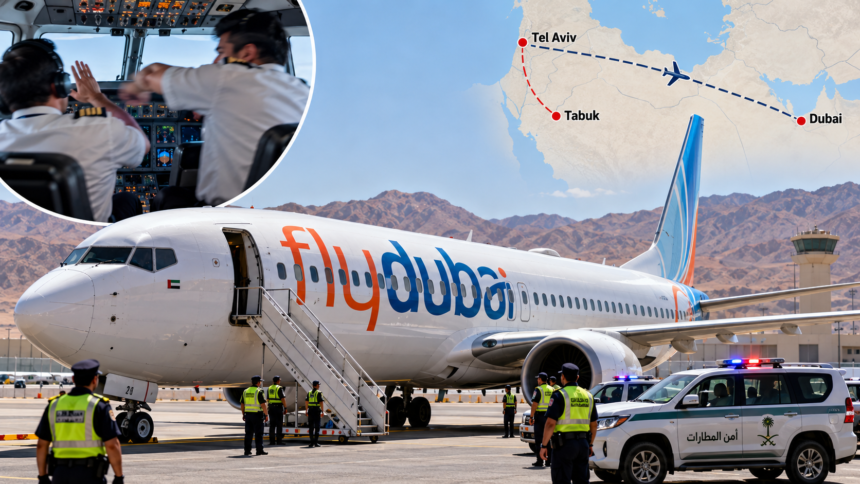
A serious incident aboard Flydubai flight FZ1073, travelling from Dubai to Tel Aviv, has raised questions about pilot screening, cockpit security and aviation safety procedures after an altercation between the two pilots forced the aircraft to make an emergency landing in Saudi Arabia.
Indian Captain Smit Machchhar was injured during the confrontation but managed to open the cockpit door, allowing passengers and crew members to intervene. Israeli Prime Minister Benjamin Netanyahu praised Machchhar for his actions and described him as a “true hero” for helping prevent what he said could have become a catastrophic midair disaster.
The UAE has launched an investigation into the incident. UAE Attorney General Hamad Saif al-Shamsi said investigators would collect information and evidence to establish what happened, determine the circumstances and examine whether there was any connection to terrorist activity, advance planning or outside direction.
What Happened on Flydubai Flight FZ1073?
The emergency unfolded roughly two and a half hours after the flight departed Dubai. At around 8:44am local time, the aircraft transmitted an emergency signal.
According to Israeli officials, the aircraft rapidly lost altitude, falling from about 33,000 feet (10,000 metres) to 17,000 feet (5,000 metres) in around one minute. Netanyahu said one pilot had attacked and stabbed the other before allegedly attempting to bring the aircraft down.
Despite being injured, Machchhar was able to activate the cockpit door release. Passengers and crew then entered the cockpit and helped overpower the other pilot, according to reports. The aircraft was subsequently diverted and landed safely in Tabuk, northwestern Saudi Arabia, about an hour later. Both pilots were injured and received medical treatment.
The Saudi authorities later returned the pilots to the UAE with an Emirati security team, according to Saudi Arabia’s Interior Ministry. The investigation into the circumstances and motive remains ongoing.
What Is Known About the Co-Pilot?
Details surrounding the alleged attacker have remained limited, although more information has emerged since the incident. Reuters reported that the co-pilot was Omani, while authorities have continued investigating the circumstances behind the confrontation and the possible motive.
Israeli officials initially raised the possibility of a terrorist motive, while Netanyahu said it was too early to reach a final conclusion about whether the incident was deliberate or linked to Iran. The UAE investigation is examining these possibilities rather than treating them as established facts.
The incident has also prompted questions about how the co-pilot was cleared to operate a commercial flight and whether existing screening procedures could identify problems that may develop after a pilot has already been approved to fly.
How Are Commercial Pilots Screened?
Flydubai is a UAE-based airline, and its certification and operational oversight fall under the UAE’s General Civil Aviation Authority (GCAA). EASA has said that responsibility for the operator’s certification and safety management rests with the GCAA, including requirements concerning flight personnel and their ability to operate safely.
GCAA regulations require professional pilots to meet licensing, aircraft-rating, medical and language-proficiency requirements. Its flight-crew licensing rules include requirements for appropriate flight experience, skill tests, a Class 1 medical certificate for airline transport pilots and ICAO English-language proficiency.
Aviation analyst Saj Ahmad of StrategicAero Research told Al Jazeera that pilot screening can include security, financial and mental-health checks. However, he noted that such assessments represent a particular point in time and cannot necessarily determine whether an individual might later develop problems that affect their behaviour at work or in the cockpit.
The incident has therefore renewed discussion around the limits of existing screening systems. While pilots undergo licensing, medical and recurrent training requirements, identifying a sudden change in an individual’s behaviour or intentions remains a difficult challenge.
Questions Around Security for Flights to Israel
The incident has also raised questions about security procedures for pilots operating flights into Israel.
Israeli media reported claims, citing Transport Minister Miri Regev, that an agreement with the UAE requires pilots holding passports from countries with diplomatic relations with Israel to operate flights landing there. However, this claim has not been independently confirmed by Al Jazeera.
Israel’s Ministry of Transport Security Department says its responsibilities include security screening of international flights entering or landing in Israel and arranging security procedures for air transport operations. Its publicly described responsibilities do not specifically mention routine individual background checks of commercial pilots or cabin crew.
With the UAE investigation still underway, several important questions surrounding the incident—including the alleged motive and whether existing screening procedures were sufficient—remain under examination.
Disclaimer: This article is based on information and official statements available at the time of publication. Details surrounding the Flydubai FZ1073 incident remain under investigation and may change as authorities release additional findings. Allegations and statements attributed to officials or other sources should not be treated as final conclusions until the investigation is completed.