
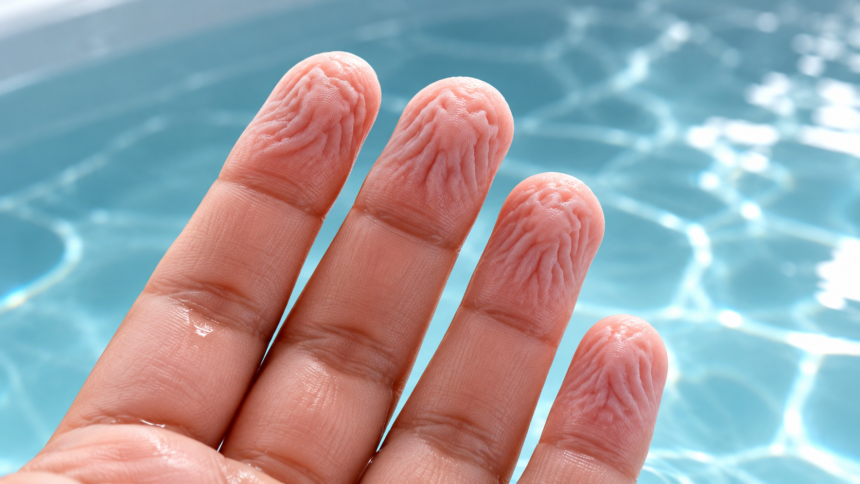
For years, it was widely believed that fingers become wrinkled after prolonged exposure to water because the skin absorbs moisture and swells. However, scientists have found that water-induced wrinkling is not simply a result of absorption. Instead, it is an active response controlled by the nervous system.
When the hands remain submerged for some time, the sympathetic nervous system causes tiny blood vessels in the skin to constrict. This reduces the volume of tissue beneath the skin on the fingertips, causing the outer layer to fold inward and create the familiar ridges and grooves.
Scientists have also proposed that this temporary change may have served an evolutionary purpose, helping early humans and primates maintain a better grip on wet objects and surfaces.
Why Do Fingers Get Wrinkly in Water?
After the hands have been underwater for an extended period, neural signals trigger changes beneath the skin. Rather than the fingertips simply swelling because they have absorbed water, the tissue beneath the outer layer becomes slightly smaller.
This reduction in tissue volume causes the skin surface to fold, creating the ridges and valleys commonly known as “pruney” fingers. A similar effect can occur on the toes and other areas of hairless skin.
Do Fingers Wrinkle Because They Absorb Water?
The idea that wrinkled fingers are caused by the skin soaking up water is a common misconception. While the outermost layer of dead skin, known as the stratum corneum, can absorb some water, this alone does not explain the formation of wrinkles.
Instead, the process involves a response from the nervous system and changes in the small blood vessels beneath the skin.
What Happens Beneath the Skin?
The process involves several connected physiological responses. Prolonged immersion activates the sympathetic nervous system, which sends signals to small blood vessels in the fingertips.
These vessels, including structures known as glomus bodies, constrict in response to the nerve signals. The resulting reduction in blood flow decreases the volume of tissue beneath the skin. Since the surface area of the outer skin does not shrink in the same way, it folds inward and produces temporary wrinkles.
This mechanism is particularly noticeable in glabrous, or hairless, areas such as the fingertips, palms, toes and soles of the feet.
Why Might Wrinkled Fingers Have an Evolutionary Purpose?
Scientists have proposed that water-induced wrinkling may have provided an advantage to early humans and primates. The grooves created on the fingertips can be compared to the tread pattern on a tyre.
When a wrinkled fingertip presses against a wet surface, the grooves may help channel water away from the contact area, allowing more of the skin to maintain contact with the surface. This could potentially have made it easier to grip wet objects.
The idea remains an evolutionary hypothesis explaining why the nervous system actively produces this response during prolonged water exposure.
Why Do Wrinkled Fingers Return to Normal?
Water-induced wrinkles are temporary. Once the hands are removed from the water and begin to dry, the sympathetic nervous system no longer maintains the signals that cause the blood vessels to constrict.
Blood flow in the affected tissues returns to normal, restoring the tissue volume beneath the skin. As a result, the fingers gradually become smooth again, generally within around 10–20 minutes.
Pruney fingers therefore illustrate the close relationship between the skin and the nervous system. Rather than being caused simply by water entering the skin, the familiar wrinkles are produced by an active physiological response that may have helped our ancestors maintain their grip in wet environments.