
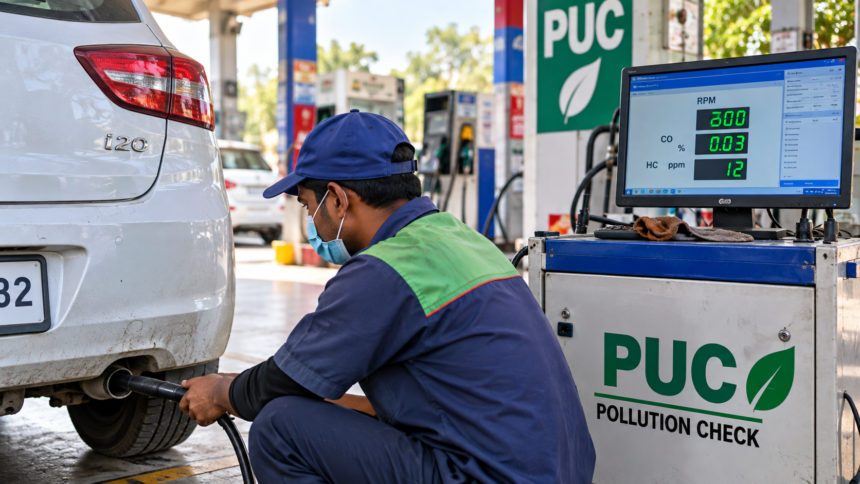
PUCC Rules: Authorities and the transport department are preparing to tighten pollution-related regulations across Delhi-NCR from October 1. Under the new rule, fuel stations in Delhi, Noida, Ghaziabad, Gurugram and Faridabad will not provide petrol or diesel to vehicles without a valid Pollution Under Control Certificate (PUCC).
With the new system in place, vehicle owners need to be careful while getting their pollution certificates renewed. A mistake during the testing process could result in incorrect online records, problems with the validity of the certificate or a fine of up to Rs 10,000.
1. Do Not Get a PUCC From an Unauthorized Centre
One of the most important things is choosing an approved pollution testing centre. Getting a certificate from an unauthorized or unregistered facility can create problems because the vehicle details may not be properly uploaded to the government’s online system.
Vehicle owners should therefore use only pollution testing centres that are officially authorized by the Transport Department.
2. Check the Official Testing Fee
Some vehicle owners may end up paying more than the prescribed pollution testing fee simply because they are unaware of the official charges.
Pollution testing fees are fixed according to the vehicle and fuel type, including petrol, diesel and CNG vehicles. Owners should pay only the applicable official charge and ask the operator for a computer-generated receipt as proof of payment.
3. Verify the PUCC Online After the Test
Getting a physical pollution certificate is not enough. Vehicle owners should also check whether the updated PUCC details have been uploaded to the online system.
After the test, check the vehicle number through the mParivahan or eChallan app and confirm that the latest PUCC information is visible. If the certificate is not properly reflected online, it could create difficulties during a traffic check.
4. Keep an Eye on the RPM Reading
During the pollution test, the vehicle’s engine is accelerated and the RPM reading appears on the testing computer. Vehicle owners should pay attention to the testing process and ensure that the operator follows the required procedure.
For accurate emission measurement, the probe must be correctly positioned in the vehicle’s exhaust while the engine is being revved. Incorrect testing can affect the recorded pollution reading.
5. Make Sure the Number Plate Is Clearly Visible
The current pollution testing process uses a digital system connected to a live camera. The vehicle’s registration plate needs to be clearly visible to the camera during the test.
Owners should position their vehicle properly so that the number plate is not covered, blurred or hidden. A clear image of the registration plate is required for the system to generate the certificate.
Disclaimer
This article is intended for general informational purposes and is based on the information provided regarding PUCC rules and pollution testing procedures. Vehicle owners should verify the latest requirements, fees and enforcement guidelines with the concerned Transport Department or other official authorities, as rules and procedures may change.