
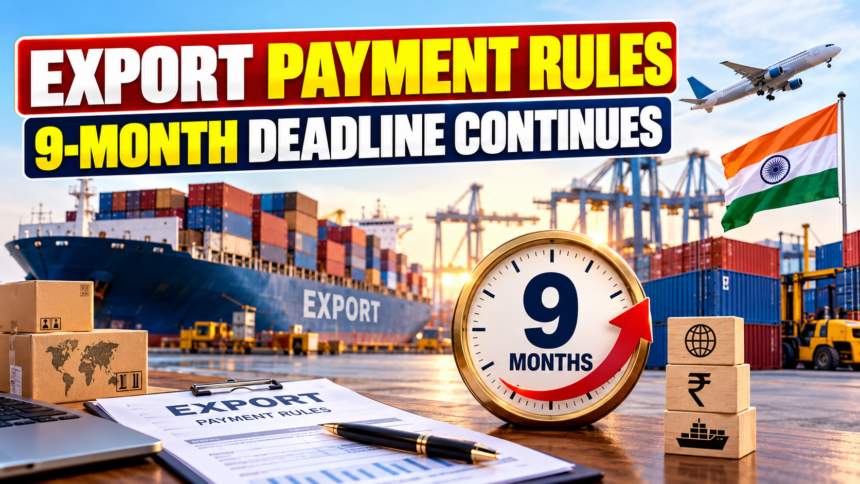
Indian exporters will continue to operate under a nine-month deadline for receiving and repatriating export proceeds from October 1, 2026. A recent amendment by the Reserve Bank of India (RBI) has removed the proposed 15-month realisation period that was scheduled under the new export framework.
For eligible exports invoiced or settled in Indian rupees, the applicable period will be 12 months.
The RBI amended the Foreign Exchange Management (Export and Import of Goods and Services) Regulations, 2026, on September 22. The amendment was published in the Official Gazette on September 24 and will take effect from October 1, 2026.
What Changes for Exporters From October 1?
Under the amended framework, most export proceeds must be realised and repatriated within nine months of the applicable starting date.
For goods exports, the nine-month period will be counted from the date of shipment. For services, it will begin from the invoice date. Goods sold from a warehouse located outside India will have a nine-month period starting from the date of sale.
Project exports will continue to follow the payment terms specified in the relevant contract.
The amendment also changes the special timeline for exports invoiced or settled in Indian rupees. The period has been reduced from 18 months to 12 months.
| Export Category | Earlier October 2026 Framework | From October 1, 2026 |
|---|---|---|
| Most goods exports | 15 months from shipment | 9 months from shipment |
| Services exports | 15 months from invoice date | 9 months from invoice date |
| Goods sold from overseas warehouse | 15 months from sale | 9 months from sale |
| Exports invoiced or settled in INR | 18 months | 12 months |
| Project exports | Contractual payment terms | Contractual payment terms |
Authorised Dealer (AD) banks will continue to monitor export proceeds and follow up with exporters within the applicable period. Where an overseas payment is delayed for genuine reasons, an AD bank can grant an extension after examining the explanation provided by the exporter.
What Does the 9-Month Rule Mean for Businesses?
The revised timeline is particularly relevant for exporters that offer longer credit periods to overseas customers. Companies may need to keep closer track of outstanding invoices, payment schedules and receivables to ensure that export proceeds are received within the permitted period.
The change does not directly affect ordinary consumer transactions such as bank accounts, card payments or household bills. Its immediate impact is on businesses receiving payments from customers outside India.
According to an official trade release dated September 15, 2026, India’s merchandise and services exports were estimated at $82.68 billion in August 2026, representing a 25.41% increase compared with August 2025. The services export figure was an estimate because the latest available services data at that time covered July 2026.
For exporters, timely reconciliation of shipping records and incoming payments will remain important. Identifying delayed receipts early can give businesses more time to communicate with overseas buyers and approach their AD bank if an extension becomes necessary.
Why Has the Export Payment Timeline Changed?
The export realisation period has been revised several times in recent years.
On November 13, 2025, the applicable period under the then-existing rules was increased from nine months to 15 months. The Federation of Indian Export Organisations welcomed the change on November 14, 2025, including the additional time provided for receiving export payments.
The rules were changed again on June 5, 2026, when the existing period was reduced from 15 months back to nine months. This meant exporters were already working with a nine-month requirement before the October framework was due to take effect.
Separately, consolidated regulations issued on January 13, 2026, were scheduled to come into force on October 1 with a 15-month period for most exports and an 18-month period for eligible transactions involving Indian rupees.
The September 22 amendment removes this difference before the new framework begins. As a result, the general nine-month period will continue from October 1, while eligible INR transactions will have a 12-month window.
What Happens If Export Payments Remain Unpaid?
The rules also contain provisions for prolonged non-realisation of export proceeds.
If export payments remain unrealised for more than one year beyond the original due date or an extension approved by an AD bank, subsequent exports must be made against full advance payment or an irrevocable Letter of Credit.
Industry representatives had raised concerns in June over the broader implications of such provisions, including the possibility of restrictions affecting future exports even when the default relates to a particular overseas buyer.
Meanwhile, the government has continued export-finance support through the Export Promotion Mission, which was approved on November 12, 2025. The mission has an outlay of ₹25,060 crore for FY2025-26 to FY2030-31. Its Niryat Protsahan component includes trade-finance measures such as interest subvention, export factoring and collateral support.
For exporters, the key change from October 1 is therefore the continuation of the nine-month general realisation period rather than the previously proposed return to 15 months. Eligible INR transactions will have 12 months, while project exports will continue to follow their contractual payment schedules.
FAQs
What is the export payment deadline from October 1, 2026?
For most goods and services exports, proceeds generally need to be realised within nine months. The starting point depends on the type of export transaction.
Does the nine-month period apply to services exports?
Yes. For services, the nine-month period generally begins from the invoice date.
Can an exporter receive an extension if a foreign buyer delays payment?
Yes. An Authorised Dealer bank may extend the period after reviewing the reasons provided by the exporter and being satisfied with the explanation.
Is the October 2026 rule reducing an existing 15-month deadline to nine months?
No. The existing regulations had already returned to a nine-month period through the June 5, 2026 amendment. The September amendment prevents the October framework from restoring the 15-month period.
What happens when export proceeds remain unpaid for an extended period?
If the proceeds remain unrealised for more than one year beyond the due date or an approved extension, subsequent exports are subject to the advance-payment or irrevocable Letter of Credit requirement.
Disclaimer
This article is provided for general informational purposes and does not constitute financial, legal, tax or business advice. Regulatory requirements, export rules and official timelines may be amended by the relevant authorities. Exporters should verify the latest RBI notifications and consult their Authorised Dealer bank or a qualified professional regarding requirements applicable to their specific transactions.