
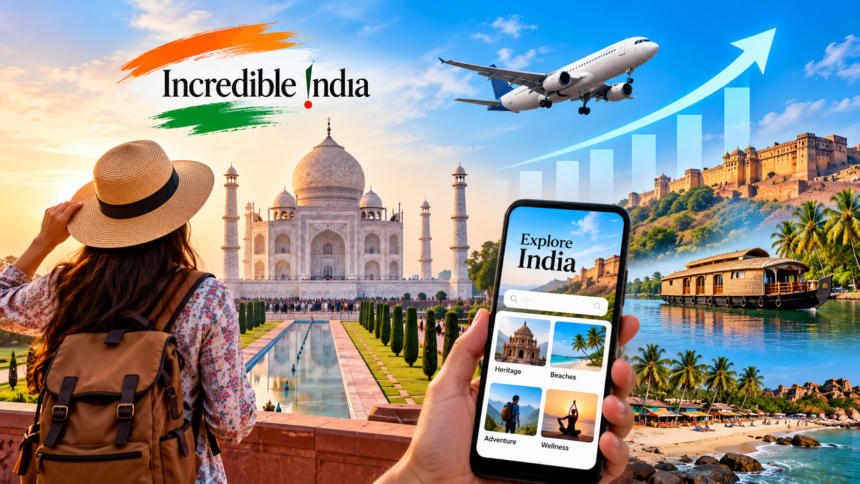
India’s tourism industry is becoming an increasingly important contributor to the country’s economy and employment. The sector contributed 5.22% to India’s GDP and supported 8.46 crore jobs during 2023-24, according to the government.
Ahead of World Tourism Day 2026, the government highlighted the growing role of digital technology and artificial intelligence (AI) in transforming the way people plan, access and experience travel. Technology is being used to make tourism more personalised, accessible and convenient.
World Tourism Day will be observed on September 27 with the theme “Digital Agenda and Artificial Intelligence to Redesign Tourism.” The theme puts digital innovation and AI at the centre of discussions about the future development of tourism.
Tourism Activity Rises Sharply
India has recorded significant growth in tourism activity in recent years. Domestic tourist visits increased from 67.7 crore in 2021 to 428.55 crore in 2025.
Foreign tourist visits also rose during the same period, reaching 2.53 crore in 2025 compared with 0.1 crore in 2021. Tourism-related foreign exchange earnings increased from ₹63,978 crore in 2021 to ₹2,76,831 crore in 2025.
The government expects the continued expansion of tourism, supported by digital services and improved connectivity, to further strengthen the sector’s contribution to economic activity and employment.
AI and Digital Platforms Transform Tourism
Digital services are becoming an important part of India’s tourism ecosystem. The government’s e-Visa facility, which was initially available to citizens of 43 countries when launched in 2014, has now expanded to 172 countries. Travellers can enter India through 88 international ports under the facility.
Around 78% of visas are currently issued electronically, while approximately 95% of e-Visa applications are processed within 72 hours.
The upgraded Incredible India Digital Platform also offers virtual experiences covering areas such as culture, heritage, adventure, food, wellness, arts and crafts and rural tourism. Its AI-based features include real-time weather information, city exploration tools and access to tourism-related services.
The Ministry of Tourism is also preparing to introduce the National Digital Tourism Stack, an open digital public infrastructure initiative designed to make tourism products and destinations easier to discover, access and trust.
Another initiative, Dekho Apna Desh 2.0, will focus on promoting lesser-known destinations and encouraging a more balanced distribution of tourist traffic across different parts of the country.
New Airports and Helipads to Improve Connectivity
Alongside its digital expansion, the government is also focusing on physical infrastructure to improve access to tourism destinations.
Under the Modified UDAN scheme covering 2026-27 to 2035-36, an approved outlay of ₹28,840 crore includes plans for the development of 100 airports and 200 modern helipads.
The infrastructure expansion is aimed at improving air connectivity and making more tourism destinations accessible to travellers. Together with digital initiatives, these measures are expected to support the continued development of India’s tourism ecosystem.
Disclaimer: This article is intended for general informational purposes and is based on the government information and figures provided in the source material. Tourism statistics, infrastructure plans, digital initiatives and implementation timelines may change as new data or government decisions are announced. Readers should refer to official government sources for the latest information.