
India’s Unified Payments Interface (UPI) has become a major part of everyday digital payments, allowing consumers and businesses to transfer money quickly without relying on cash. Its widespread adoption has also helped establish India as a significant player in the global digital payments space.
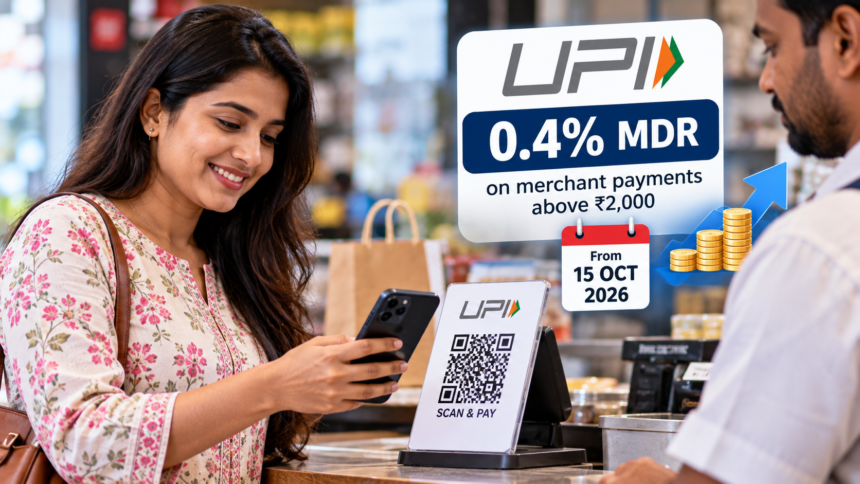
However, the UPI payment system is set to undergo an important change from October 15, 2026. A Merchant Discount Rate (MDR) of 0.4% will apply to specified person-to-merchant (P2M) UPI transactions above ₹2,000. The change marks a shift from the zero-MDR framework that has supported UPI merchant payments since 2020.
What Will Change Under the New UPI MDR Rules?
The new framework does not introduce a charge on every UPI transaction. Person-to-person (P2P) transfers will continue to remain free, regardless of the amount involved. Merchant payments of up to ₹2,000 will also remain outside the MDR framework.
For specified P2M transactions above ₹2,000, an MDR of 0.4% will apply. For transactions of ₹75,000 or more, the charge will be capped at ₹300 per transaction. The MDR is a payment-processing charge within the merchant payment ecosystem rather than a tax collected directly by the government.
The new arrangement is intended to create a more sustainable financial model for the UPI ecosystem as transaction volumes continue to expand. The broader payments network requires continued investment in infrastructure, security, fraud prevention and customer services.
Why Merchants Are Concerned
The biggest question surrounding the new MDR is how businesses will respond to the additional payment-processing cost.
The All India Petroleum Dealers Association has sought an exemption for petrol pumps, arguing that fuel retailers operate with relatively narrow margins. Concerns have also emerged among other businesses that higher payment costs could influence their preferred payment methods.
A LocalCircles survey involving more than 32,000 merchants and businesses across 242 districts found that only 17% of respondents were willing to absorb a 0.4% MDR on UPI payments above ₹2,000. Meanwhile, 41% said they would not bear any MDR, while 9% reported that they did not accept UPI payments.
These findings indicate significant resistance among surveyed businesses, although the survey does not establish how many merchants will actually reduce or stop accepting UPI payments once the new framework takes effect.
Will Customers Have to Pay the MDR?
The MDR is designed as a merchant-side charge, rather than a direct fee on consumers. The government has directed banks and payment service providers to ensure that the cost is not passed on to customers.
However, the effect on businesses could still influence payment practices. Merchants dealing with higher operating costs could review discounts, pricing strategies or the payment methods they encourage. The extent of any such changes will depend on competition, margins, enforcement and customer behaviour.
UPI’s zero-cost structure has been an important factor in its widespread adoption among consumers and merchants. The revised framework attempts to retain free person-to-person transfers and smaller merchant payments while introducing a charge for specified higher-value transactions.
As October 15 approaches, the key issue will be how merchants respond to the new MDR and whether the revised funding model can support the continued development of UPI without affecting its widespread acceptance and convenience.
Disclaimer: This article is intended for general informational purposes and is based on the UPI MDR framework and information available at the time of writing. The applicable MDR, exemptions, caps and transaction categories may vary according to the relevant rules and future updates. Readers and merchants should verify the latest information with NPCI, their bank or payment service provider before making decisions based on these details.