
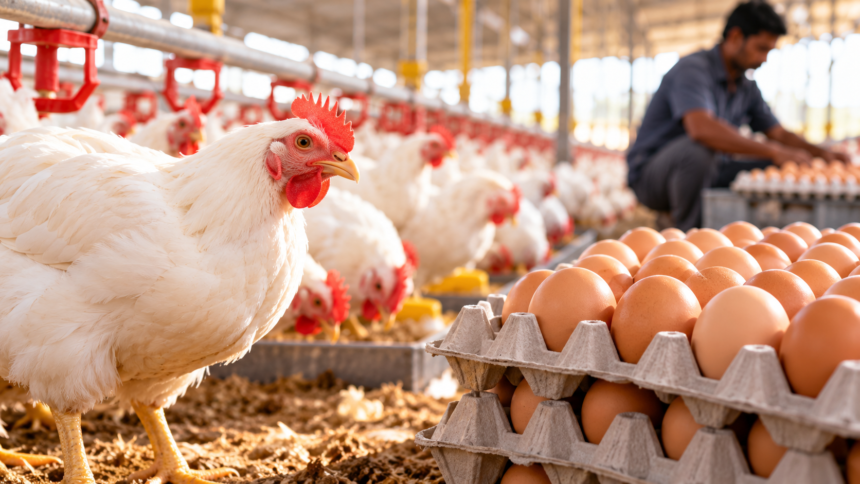
Poultry farming can provide income through two main business models—raising chickens for meat and keeping hens for egg production. Both models have their own investment requirements, operating cycles and earning potential.
For people looking to start a small business with limited capital, poultry farming can be considered as an option. With an investment of around ₹2 lakh, a small-scale setup can be started, depending on the type of poultry farming chosen.
Broiler Farming: Selling Chickens for Meat
Broiler farming involves raising chickens specifically for meat. These birds grow quickly and generally reach a weight of around 2 to 2.5 kg within approximately one and a half months.
A typical broiler cycle lasts around 45 days. Once the birds reach market weight, they can be sold and a new batch can be started. This allows farmers to repeat the production cycle several times during the year.
Compared with layer farming, broiler farming requires comparatively less initial investment and offers a faster turnover of capital.
Egg Farming: Regular Income From Layers
The second model is layer farming, where hens are raised primarily for egg production. Hens generally begin laying eggs at around 18 to 20 weeks of age and can continue producing eggs for approximately one and a half years.
Since eggs can be collected and sold every day, layer farming can provide a regular source of cash flow. Once the hens become less productive, they can also be sold for meat, creating an additional source of income.
However, the initial investment is somewhat higher because the birds have to be maintained and fed for several months before egg production begins.
How to Start Poultry Farming With ₹2 Lakh
People entering the poultry business for the first time can also consider contract broiler farming. Under this arrangement, companies such as Suguna and Venky provide chicks and feed and purchase the chickens once they are ready for the market. This model can reduce some of the risks involved and allow farmers to begin with a relatively smaller investment.
With approximately ₹2 lakh, a farmer can set up a shed for around 500 to 600 broiler chickens. About ₹80,000 may be allocated for the shed, while another ₹80,000 can be used for chicks, feed and medicines. The remaining ₹40,000 can be retained as working capital.
A broiler generally reaches around 2 kg after 45 days. If 500 chickens are raised, their combined weight would be around 1,000 kg. Based on the figures provided, the estimated net profit after expenses is around ₹25,000 per batch.
With around six 45-day cycles in a year, the estimated annual income could reach approximately ₹1.5 lakh.
Egg Farming Investment and Earnings
For layer farming, the birds need to be raised for around five months before they start producing eggs. With an investment of approximately ₹2 lakh, around 300 layer hens can be raised.
Around ₹1 lakh may be required for constructing the shed and cages, while approximately ₹90,000 can be spent on feed and vaccinations during the five-month rearing period.
Once production begins, 300 hens are expected to produce around 250 eggs per day. After deducting feed expenses, the stated profit is approximately ₹1.50 per egg. Based on these figures, selling 250 eggs a day generates around ₹370 in daily income, or approximately ₹11,000 per month.
According to the figures provided, egg sales alone can generate around ₹1.30 lakh annually. After approximately one and a half years, the older hens can also be sold, potentially generating another ₹40,000.
For a ₹2 lakh investment, experts cited in the original information suggest that broiler farming can provide faster capital rotation because each production cycle lasts only around 45 days. This allows the investment to be used across multiple cycles during the year. Egg farming, meanwhile, generally requires a larger flock—around 1,000 to 15,000 birds—to generate substantial returns.
Disclaimer: The investment, production, income and profit figures mentioned in this article are based on the assumptions and estimates provided in the source information. Actual poultry farming costs and earnings can vary depending on feed prices, chick prices, mortality, disease management, labour, market prices and other operating expenses. Readers should assess local market conditions and seek appropriate professional or veterinary advice before starting a poultry farming business.