
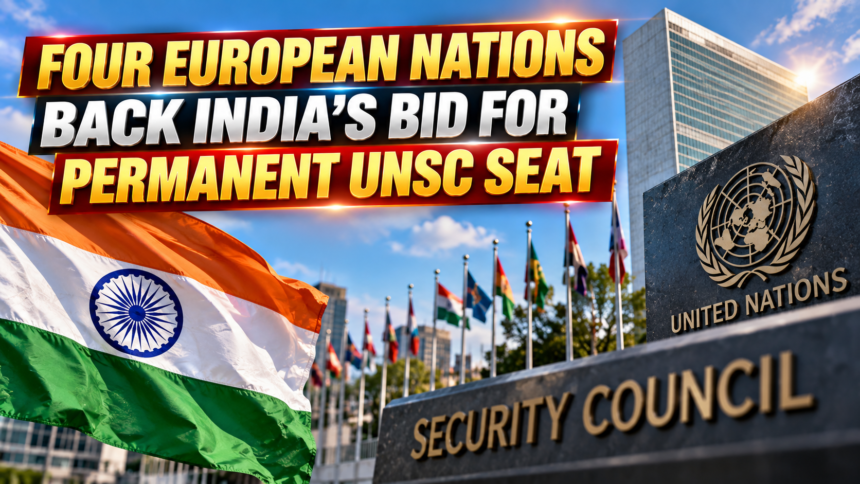
India’s long-running campaign for a permanent seat on the United Nations Security Council (UNSC) received fresh support from four Central European countries during the 81st UN General Assembly in New York.
Hungary, Poland, Slovakia and the Czech Republic, which make up the Visegrad Group (V4), backed India’s bid during the first V4-India Foreign Ministers’ Meeting. Slovak Foreign Minister Juraj Blanár said the four V4 countries supported India having a permanent place on the Security Council.
The meeting also focused on strengthening relations between India and the four Central European countries. External Affairs Minister S. Jaishankar described the gathering as a “new historic occasion” and said the sides had agreed to hold annual foreign ministers’ meetings and establish an annual business forum.
Why Does India Want a Permanent UNSC Seat?
The UN Security Council currently has 15 members, including five permanent members — China, France, Russia, the United Kingdom and the United States — along with 10 members elected for two-year terms.
India has repeatedly called for changes to the Council’s structure, arguing that its composition should better reflect contemporary global realities. The country has also highlighted its population, economic significance and long-standing contribution to UN peacekeeping as part of its case for a permanent role.
India has been elected to the Security Council eight times, with its most recent two-year term covering 2021 and 2022.
For New Delhi, reform is broader than simply adding one new permanent member. India has supported expansion in both the permanent and non-permanent categories of the Council. The Ministry of External Affairs has also identified Security Council reform and permanent membership for India as long-standing priorities.
India’s Support From Major Powers and the G4
India’s permanent membership proposal has received support from several countries, including the United States, the United Kingdom, France and Russia, according to the Ministry of External Affairs.
New Delhi is also part of the G4 grouping with Brazil, Germany and Japan. The four countries have worked together on Security Council reform and support expansion in both permanent and non-permanent categories.
The G4 has also maintained that there should not be a separate sub-category of permanent members. In recent UN discussions, the group has proposed that new permanent members should ultimately have the same responsibilities and obligations as existing permanent members, while showing flexibility on the timing of veto rights during negotiations.
China, Veto and the Challenges of UNSC Reform
The five existing permanent members have veto powers, making the question of veto rights one of the central issues in discussions over Security Council reform. The UN maintains a record of vetoes cast by the five permanent members.
India has argued that expanding the Council only in the non-permanent category would not address what it considers the structural imbalance in the institution. In recent UN negotiations, India has reiterated that new permanent members should also have veto rights for as long as the existing veto system remains in place.
At the same time, there is no single agreed model for expanding the Council. Issues such as the number of additional members, regional representation and the future of veto powers remain part of the ongoing intergovernmental negotiations.
What Does V4 Support Mean for India?
The backing from Hungary, Poland, Slovakia and the Czech Republic adds four more countries to the group supporting India’s permanent membership bid. However, the V4 endorsement does not by itself change the formal process for reforming the Security Council.
Changes to the Council require broad agreement among UN member states and amendments to the UN Charter, making international consensus essential.
The V4-India meeting also covered cooperation in technology and innovation, defence, space, connectivity and people-to-people relations. The sides exchanged views on international developments, including the Ukraine conflict and the situation in the Gulf.
Jaishankar said India and the V4 countries would work towards stronger political, economic and defence cooperation, with annual foreign ministers’ meetings and an annual business forum forming part of the new framework.
Disclaimer: This article is based on publicly available statements and information concerning India’s UN Security Council reform efforts and the V4-India meeting. Support expressed by individual countries does not guarantee any particular outcome of the ongoing UN reform process. The final structure and membership of the Security Council depend on negotiations among UN member states and the required Charter procedures.