
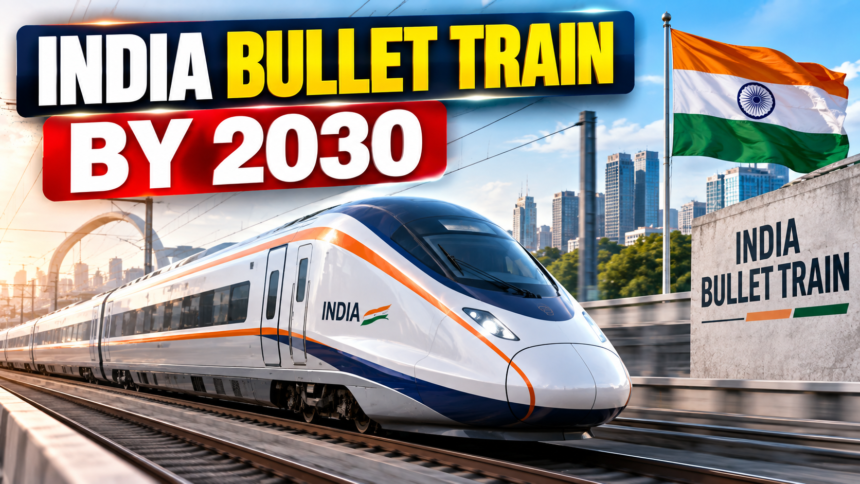
New Delhi: India is preparing to develop its own high-speed bullet trains with a design speed of 350 kmph by 2030. The proposed B35 trains are expected to be comparable to Japan’s next-generation E10 series, which is also scheduled to enter production in 2030.
The development plan has been linked to the revised cost approval for the Mumbai-Ahmedabad High-Speed Rail (MAHSR) project. The Union Cabinet has approved a revised project cost of more than ₹2 lakh crore, almost twice the original estimate prepared in 2015. Nearly ₹1 lakh crore of the cost increase is expected to be supported through the government Budget.
The Railway Ministry has already started work on the indigenous B35 train concept. Japan had indicated in December 2024 that production of its existing E5 series would gradually be phased out. According to the reported Cabinet proposal, Japan plans to begin production of the E10 series in 2030, with the trains expected to be ready for operations by 2034. The possibility of operating E10 trains on the Mumbai-Ahmedabad corridor will be considered once they become available.
Why Has the Bullet Train Project Cost Increased?
The revised cost has risen sharply from the earlier estimate of around ₹1.1 lakh crore. According to the Railway Ministry, several major components have contributed to the increase.
Land acquisition expenses have risen more than three times to around ₹19,700 crore. Infrastructure expenditure has increased by nearly 50%, taking the total to more than ₹1 lakh crore. Spending on trains and signalling systems has also increased by around 100% compared with the estimates prepared in 2015.
The MAHSR corridor covers around 508 km and is being developed with technical and financial assistance from Japan. The project includes 12 planned stations between Mumbai and Ahmedabad.
B28 Trains Will Operate First
Before the next-generation B35 trains are introduced, the Mumbai-Ahmedabad corridor will initially operate with indigenous B28 trainsets.
The B28 trains have a design speed of 280 kmph, while their maximum operating speed is expected to be 249 kmph. The current project cost, excluding the future Japanese trains, works out to around ₹399 crore per kilometre.
BEML has received a contract to manufacture 32 B28 trains. Two prototype trainsets are expected to be ready for trial runs during the first quarter of 2027. BEML also disclosed on Friday that it had received a separate contract worth ₹5,400 crore to manufacture 15 additional B28 trains.
India to Develop Its Own Train Control System
Alongside the indigenous trains, India is also working on its own high-speed railway signalling and train-control system called the Bharat Train Control System (BTCS).
The system is being developed for Indian operating conditions and is intended to manage aspects such as train speeds, the distance between trains and safety. Its development follows the broader push to establish indigenous technology for future high-speed rail corridors.
The Mumbai-Ahmedabad project is currently India’s first dedicated high-speed rail corridor. Government information states that the 508-km corridor has a design speed of up to 350 kmph and an operational speed of 320 kmph.
Disclaimer
This article is based on information reported by news organisations and details available from government and railway-related sources. Project costs, train-development plans, timelines and operational arrangements may change as work progresses. Readers should refer to official announcements for the latest updates.