
Baking soda and baking powder are two of the most commonly used ingredients in baking. Both help cakes, breads and other baked foods become lighter and softer, but they work in different ways.
Although they may look similar, the two ingredients cannot always be used interchangeably. Choosing the wrong one, or using the wrong quantity, can affect how well a cake rises, its texture and even its taste.
How Does Baking Soda Work?
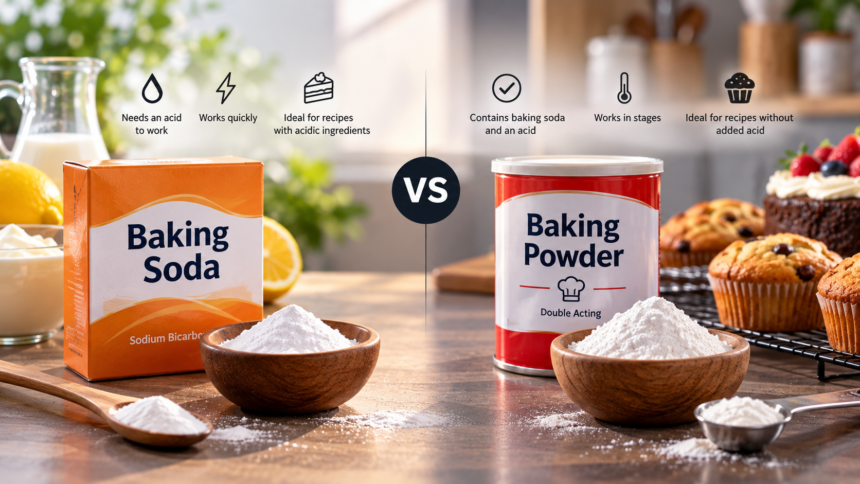
Baking soda is pure sodium bicarbonate. Unlike baking powder, it needs an acidic ingredient to produce the reaction required for a bake to rise.
Common acidic ingredients that can activate baking soda include curd or dahi, buttermilk, lemon juice and brown sugar. When baking soda comes into contact with an acid and moisture, it produces carbon dioxide gas. The gas forms bubbles in the batter, helping it expand.
The reaction happens quickly, which is why recipes containing baking soda generally need to be placed in the oven soon after the ingredients are mixed.
What Is Baking Powder?
Baking powder already contains the ingredients needed to create a rising reaction. It is generally made using baking soda, an acid and a stabilising ingredient such as cornstarch.
Because the acid is already present, baking powder can be used in recipes that do not contain enough acidic ingredients to activate baking soda on its own.
There are two main types of baking powder. Single-acting baking powder begins reacting when it comes into contact with moisture. Double-acting baking powder reacts in two stages—once when it becomes wet and again when exposed to heat in the oven.
Can You Substitute Baking Soda for Baking Powder?
Baking soda and baking powder can sometimes be substituted, but the quantities need to be adjusted carefully.
Baking soda is considerably stronger than baking powder. As a general measurement in the supplied recipe guidance, 1 teaspoon of baking soda is equivalent to about 3 teaspoons of baking powder.
However, changing the ingredient without considering the recipe’s acidity can affect the final result. Using too much baking soda can give baked food a bitter or soapy flavour, while excessive baking powder may leave a metallic aftertaste.
For the best texture, rise and flavour, it is important to follow the ingredient and measurement specified in the recipe rather than assuming baking soda and baking powder are the same.