
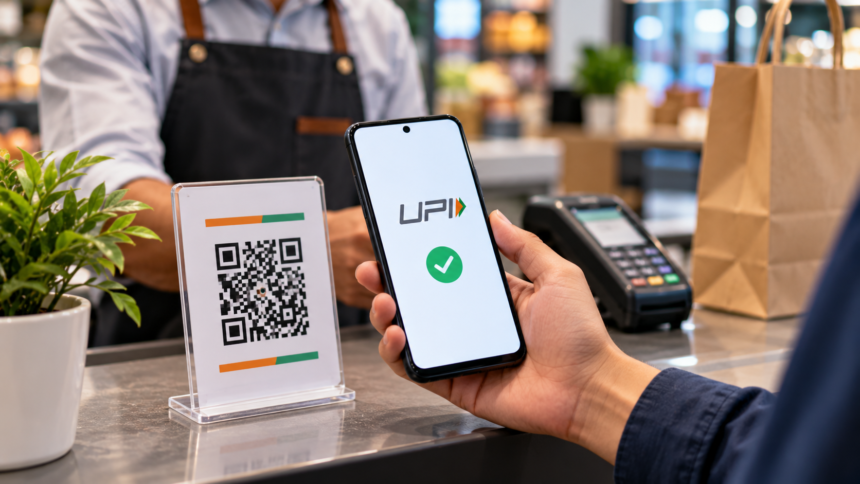
The introduction of a Merchant Discount Rate (MDR) on certain UPI transactions has changed the payment-cost structure for merchants. However, according to the framework cited by Motilal Oswal Financial Services (MOFSL), the stated MDR for eligible UPI merchant payments remains below the indicative rates charged on credit and debit card transactions.
Under the cited framework, standard UPI P2M transactions above ₹2,000 carry an MDR of 0.40%. Credit cards, by comparison, have indicative MDR rates of 1.5–2.5%, while debit cards can attract charges of up to 0.90%.
UPI vs Credit Cards: What Does a Merchant Pay?
For standard P2M UPI transactions between ₹2,000 and ₹75,000, the MDR is 0.40%. For transactions of ₹75,000 or more, the same rate applies, but the charge is capped at ₹300.
This cap becomes important for larger payments. For example, a ₹10,000 UPI transaction at 0.40% results in an MDR of ₹40. A credit-card payment at 1.5–2.5% would attract ₹150–₹250, while a debit-card payment at a rate of up to 0.90% could cost as much as ₹90.
| Payment Method | Indicative MDR | MDR on ₹10,000 | MDR on ₹1 Lakh |
|---|---|---|---|
| UPI – Standard P2M | 0.40% | ₹40 | ₹300* |
| Credit Card | 1.5–2.5% | ₹150–₹250 | ₹1,500–₹2,500 |
| Debit Card | Up to 0.90% | Up to ₹90 | Up to ₹900 |
| UPI – Capital Markets | 0.02% | ₹2 | ₹20 |
| UPI – Essential Sectors | ₹5 flat | ₹5 | ₹5 |
*The standard UPI P2M MDR is capped at ₹300 for transactions of ₹75,000 or more. Card rates are the indicative figures cited in the MOFSL report.
Why the ₹300 UPI Cap Matters
The difference becomes more noticeable as the payment value increases. At ₹1 lakh, a 0.40% MDR would normally work out to ₹400, but the UPI charge is limited to ₹300 under the stated cap.
For the same ₹1 lakh transaction, the indicative credit-card MDR cited by MOFSL would be ₹1,500–₹2,500, while a debit-card transaction could attract up to ₹900.
Certain sectors also receive special UPI rates. Payments above ₹2,000 involving railways, telecom, insurance, fuel, agricultural inputs and utility services carry a flat ₹5 MDR instead of the standard percentage-based charge. On a ₹10,000 payment, that works out to an effective rate of 0.05%.
Capital Market Payments Have a Lower MDR
UPI transactions related to capital-market services have a separate, lower MDR structure. Payments involving mutual funds, securities, stockbrokers and dealers carry an MDR of 0.02%, subject to a ₹300 cap.
At this rate, a ₹10,000 payment would result in an MDR of ₹2, while a ₹1 lakh transaction would attract ₹20.
Most Everyday UPI Payments Remain Free
The MDR framework does not cover every UPI transaction. Person-to-person (P2P) payments continue to carry 0% MDR, while merchant transactions up to ₹2,000 also remain free.
Eligible small merchants under the P2PM framework can also continue to receive zero-MDR treatment on inward UPI receipts up to ₹1 lakh per month, even when an individual payment is above ₹2,000.
MOFSL estimates that around 4% of UPI transactions by volume could attract MDR. However, because these payments tend to have higher values, they could represent around 15–20% of UPI merchant gross merchandise value (GMV).
Overall, the figures cited in the report show that UPI and card payments continue to have different merchant-cost structures. The 0.40% standard UPI MDR, the ₹300 cap and the special rates for essential services and capital-market transactions create different cost outcomes depending on the payment amount and category.