
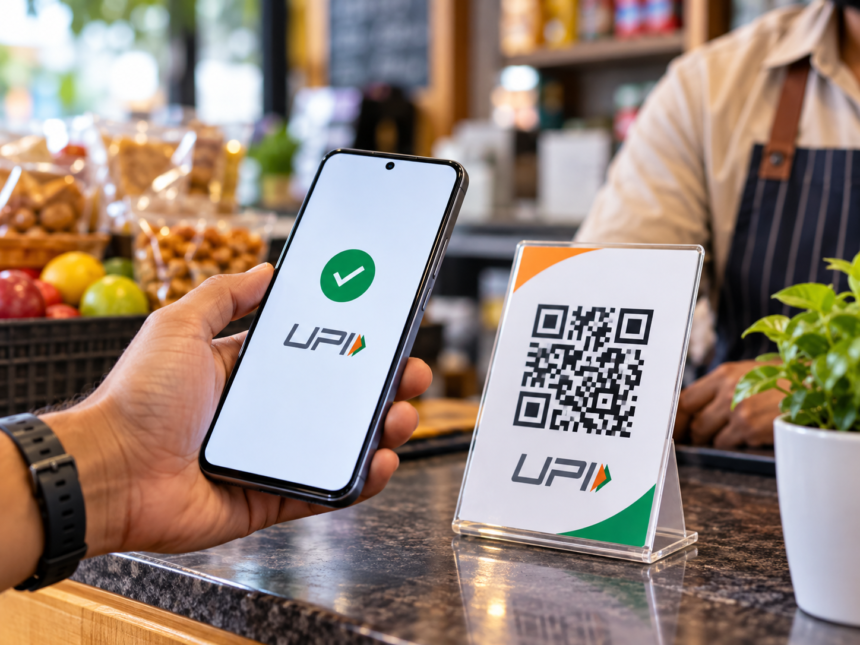
The government has clarified that person-to-person (P2P) UPI payments will continue to remain completely free, regardless of the amount transferred. The clarification comes under the revised UPI framework introduced under the Payment and Settlement Systems Act, 2007. The Ministry of Finance said the new framework will also leave around 96% of person-to-merchant (P2M) transactions unaffected.
This means users can continue sending money to friends and family through UPI without paying a transaction or platform fee. Payments to merchants up to ₹2,000 will also remain outside the new MDR structure. The revised framework is scheduled to take effect from October 15, 2026.
UPI Payments to Friends and Small Merchants
For everyday users, there is no change in the cost of P2P UPI transfers. Whether the amount is small or large, P2P payments will continue to carry no charge.
Merchant payments of up to ₹2,000 will also remain free. In addition, small merchants covered under the P2PM framework will continue to receive payments without MDR. Merchants receiving up to ₹1 lakh per month through eligible UPI QR codes remain covered by this zero-MDR provision.
The Ministry of Finance has also clarified that MDR is not a tax collected by the government or NPCI. Instead, the amount is distributed among participants in the payment ecosystem, including banks and payment application providers.
0.4% MDR on Selected Merchant Payments
Under the revised framework, eligible P2M UPI transactions above ₹2,000 will attract an MDR of 0.4%. The charge will be capped at ₹300 for transactions of ₹75,000 or more.
For example, a ₹3,000 merchant payment would attract an MDR of ₹12 at the 0.4% rate, while a ₹50,000 transaction would result in an MDR of ₹200. Once the transaction reaches ₹75,000, the maximum MDR will be ₹300.
The government has said banks should ensure that merchants do not pass this MDR cost on to customers. UPI app providers will also not be permitted to add separate platform or hidden charges under the framework.
Special Rates for Essential and Financial Services
Some categories will follow a separate MDR structure. Payments above ₹2,000 in sectors such as railways, telecom, insurance, fuel and agriculture inputs will attract a flat MDR of ₹5 per transaction. These categories account for a significant share of merchant-payment activity, according to the government.
Transactions involving mutual funds, securities, stock brokers and dealers will have a lower MDR of 0.02%, with the charge capped at ₹300 per transaction.
Small Merchants to Remain Outside MDR
The revised framework continues to provide protection for small businesses operating under the P2PM category. Merchants receiving up to ₹1 lakh per month through eligible UPI QR transactions will remain exempt from MDR.
The government has said the majority of merchant transactions will not be affected by the new framework. It also plans to set aside 5% of total MDR collections for a dedicated fund aimed at supporting UPI adoption among small merchants and expanding digital payments in rural and semi-urban areas.
For consumers, the key point remains unchanged: person-to-person UPI transfers will continue to be free, while the new MDR primarily applies to specified merchant payments above ₹2,000.