
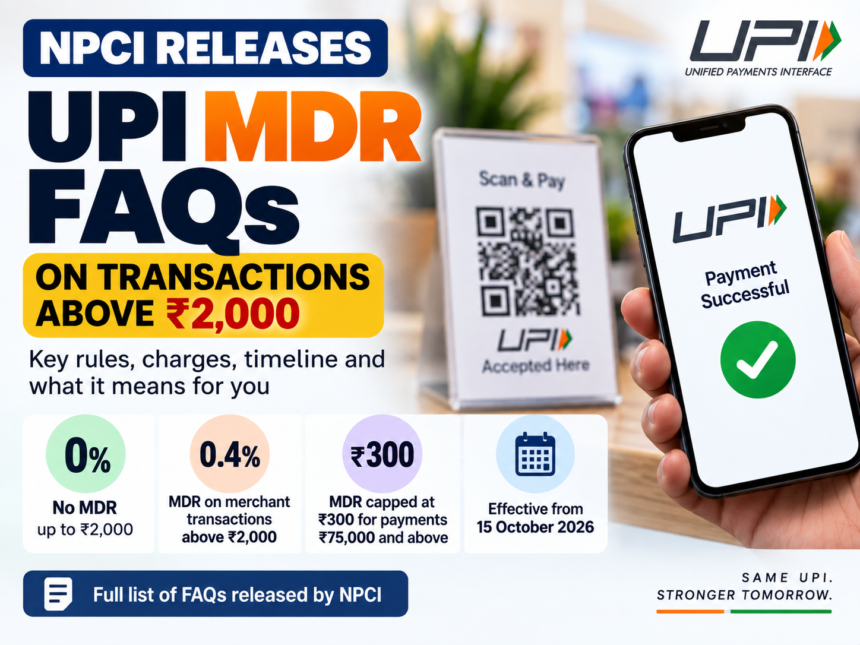
The National Payments Corporation of India (NPCI) on September 15 released a detailed set of frequently asked questions (FAQs) explaining the proposed Merchant Discount Rate (MDR) on UPI transactions above Rs 2,000.
The revised MDR provisions are yet to take effect. NPCI said there will be no MDR on UPI or RuPay card transactions below Rs 2,000. Under the new framework, a 0.4 per cent MDR will apply to eligible Person-to-Merchant (P2M) UPI transactions above Rs 2,000, while Person-to-Person (P2P) payments will remain free.
For transactions of Rs 75,000 and above, the MDR will be capped at Rs 300 per transaction. The charge will apply on the merchant side rather than being collected from consumers.
Why NPCI Is Introducing MDR on Higher-Value UPI Payments
NPCI said UPI now handles billions of transactions every month, requiring continuous investment in infrastructure resilience, cybersecurity, innovation and customer support. The MDR collected will remain within the UPI ecosystem to support these requirements.
According to NPCI, the proposed UPI MDR is considerably lower than the charges generally associated with other payment instruments. Standard credit card MDRs typically range from 1.5 per cent to 2.5 per cent, while debit card MDRs can be capped at up to 0.90 per cent.
The 0.4 per cent UPI MDR will therefore apply only above the Rs 2,000 threshold, while transactions up to that amount will remain outside the charge.
NPCI said more than 95 per cent of UPI P2M transactions are small-value payments of up to Rs 2,000 and will not be affected.
The finalized MDR framework will come into effect from October 15, 2026. The timeline is intended to give acquiring banks, payment aggregators, fintech applications and corporate accounting platforms sufficient time to modify their software and billing systems.
NPCI said the framework follows an approach that prioritises accessibility, scale and financial inclusion, while aligning UPI with sustainable economic models used by digital payment systems globally.
The UPI and Services Steering Committee, headed by NPCI, will determine operational parameters, fee distribution arrangements and category-specific MDR caps.
Small Merchants to Continue With Zero MDR
A dedicated fund is proposed to support digital payment infrastructure and merchant expansion, particularly in Tier 3 to Tier 6 centres, including the northeastern states, Jammu and Kashmir and Ladakh. In Tier 1 and Tier 2 centres, notified Central Government schemes such as PM SVANidhi and PM Vishwakarma may also be covered.
The fund is expected to provide financial assistance to acquiring banks and payment aggregators for merchant onboarding and encourage higher UPI usage among existing small merchants, especially in rural areas and smaller centres.
NPCI said the detailed framework for the fund will be finalised in consultation with the Reserve Bank of India (RBI) within the next three months.
The organisation said government incentives and subsidies helped accelerate early digital payment adoption but were not designed as a permanent mechanism for covering the industry’s operating costs. Industry estimates cited by NPCI put the annual cost of UPI operations, including server bandwidth, fraud prevention, technical support and related infrastructure, at around Rs 20,000 crore.
NPCI said a threshold-based commercial model can provide a more predictable source of funding for continued investment in technology and infrastructure.
The organisation also said a sustainable revenue structure could encourage more fintech startups and technology companies to enter the payments market. According to NPCI, a commercial model could allow smaller companies to develop specialised payment solutions and compete alongside larger technology firms.
Revenue from MDR could also support cybersecurity measures, including AI-based fraud detection, encryption upgrades and other security infrastructure.
As of 2026, UPI payment services are live in 11 foreign countries. NPCI said a financially sustainable domestic ecosystem can further strengthen India’s position in digital financial infrastructure.
UPI processed 2,451 crore transactions worth Rs 29.9 lakh crore in August 2026 alone. NPCI said the scale of these transactions highlights the need for significant physical infrastructure, telecommunications capacity, cybersecurity systems and banking technology to maintain the network.
Consumers Will Continue to Use UPI Free of Cost
The proposed MDR will not create a transaction fee for ordinary UPI users. Consumers will continue to make UPI payments without paying any charge.
P2P transactions, including transfers between friends, family members and an individual’s own linked bank accounts, will also remain free regardless of the amount, subject to permitted transaction limits.
UPI application providers will not be allowed to impose platform fees or other charges on payments made through UPI.
Consumers scanning QR codes at local shops, markets and street vendors will also not be charged for making payments. The customer-facing portion of the QR payment remains free.
There will be no monthly quota or transaction-volume limit on free UPI payments for individual users. Daily limits imposed by banks and NPCI, generally ranging from Rs 1 lakh to Rs 5 lakh depending on the transaction category, are security and risk-management measures rather than commercial fee thresholds.
NPCI also said consumers should rely on official information from the Ministry of Finance, RBI, NPCI and Press Information Bureau (PIB) rather than unverified messages or social media reports.
UPI Mandates and AutoPay transactions used for recurring payments such as utility bills, OTT subscriptions and recurring investments will not attract the prescribed MDR transaction charge.
P2PM Small Merchants and QR Codes
Small vendors covered by the Person-to-Person Merchant (P2PM) framework will continue to receive UPI payments with zero MDR. The category covers small merchants receiving up to Rs 1 lakh per month through UPI QR payments directly into their bank accounts.
The P2PM framework is designed to support small and unorganised businesses by allowing eligible micro-merchants to accept digital payments without commercial MDR deductions.
Existing QR codes, QR stands and soundboxes will continue to work. Small merchants will not need to replace or re-register their existing QR infrastructure because of the revised MDR framework.
Receiving a payment above Rs 2,000 does not automatically make an eligible P2PM merchant liable for MDR. The merchant’s account classification determines whether the transaction falls under the exemption.
Acquiring banks and payment service providers monitor transaction activity under the P2PM category. A merchant receiving more than Rs 1 lakh in UPI inward payments for three consecutive months is formally shifted to the P2M category.
Zero MDR also applies to QR payments accepted by eligible P2PM merchants in rural and semi-urban areas. The framework is intended to encourage digital payment adoption among small businesses beyond major urban centres.
GST registration will not be required for a small merchant to qualify for the zero-MDR protection under the P2PM category. Eligibility is based on the applicable monthly collection threshold and bank-account categorisation.
MDR for Large Merchants and Special Categories
For large commercial merchants, the standard MDR on eligible P2M transactions above Rs 2,000 will be 0.4 per cent. Payments of Rs 75,000 and above will have a maximum MDR of Rs 300 per transaction.
For example, a Rs 3,000 transaction would attract an MDR of Rs 12, while a Rs 50,000 transaction would result in an MDR of Rs 200. A Rs 1 lakh payment, which would otherwise generate an MDR of Rs 400 at 0.4 per cent, will instead be subject to the Rs 300 cap.
The framework can be illustrated as follows:
| Amount paid to merchant | Applicable MDR | MDR paid by merchant |
|---|---|---|
| Rs 2,000 | — | Rs 0 |
| Rs 3,000 | 0.40% | Rs 12 |
| Rs 50,000 | 0.40% | Rs 200 |
| Rs 75,000 and above | Fixed Rs 300 | Rs 300 |
Merchants will not be permitted to transfer MDR charges to UPI customers. Consumers will continue to pay the listed price for goods and services.
Certain sectors will follow a separate flat-rate structure. Transactions above Rs 2,000 involving railways, telecom services, insurance, fuel and agriculture inputs, among other specified categories, will attract an MDR of Rs 5 per transaction.
The government said these Industry Program categories account for nearly 17 per cent of UPI P2M transaction volume and approximately 46 per cent of UPI merchant transaction value.
For insurance payments above Rs 2,000, the flat MDR will be Rs 5. Fuel payments above Rs 2,000 at petrol pumps will also follow the Rs 5 rate, while fuel payments below Rs 2,000 will have zero MDR.
Public utility payments, including electricity, municipal water and piped natural gas, will similarly attract a flat Rs 5 MDR when the transaction exceeds Rs 2,000. Payments below the threshold will remain at zero MDR.
Educational payments, including school fees, university fees and institutional entrance examination payments, will also fall under the designated Industry Program category. Payments up to Rs 2,000 will remain free, while transactions above that level will benefit from applicable flat-fee structures or capped processing rates.
Capital Market Transactions
A separate MDR structure will apply to capital market transactions involving mutual funds, securities, stockbrokers and dealers.
Under this category, the MDR will be 0.02 per cent of the transaction value, subject to a maximum cap of Rs 300. The framework covers regulated entities such as asset management companies, SEBI-registered stockbrokers, securities dealers and investment platforms.
It applies to UPI payments for equity purchases, debt-market investments, mutual fund purchases and broker wallet top-ups.
Credit-Linked UPI Payments
The proposed MDR provisions apply specifically to direct account-to-merchant UPI payments.
Credit-linked UPI transactions, including RuPay credit cards connected to UPI and pre-sanctioned bank credit lines, will continue to operate under separate rules applicable to credit products. These transactions involve credit provided by issuing banks and therefore follow the relevant credit-card guidelines.