
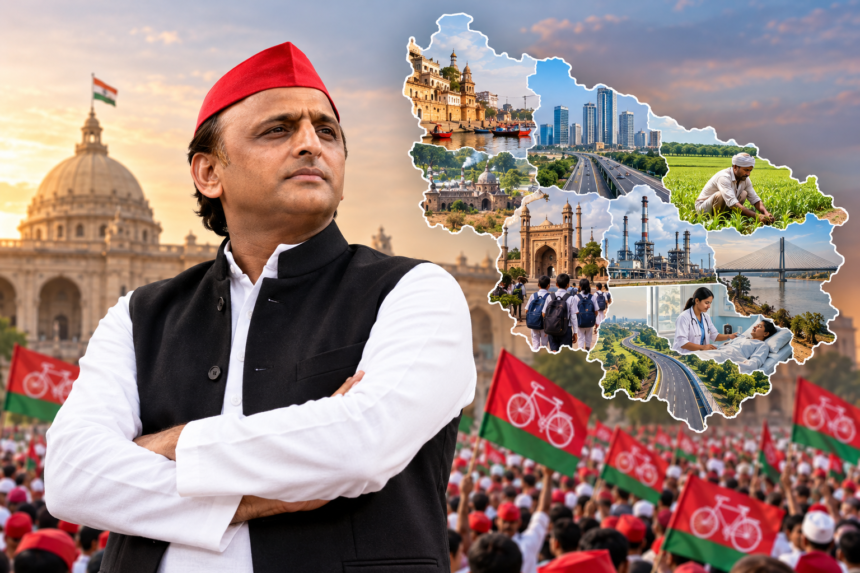
Can one election manifesto truly capture the different political, economic and social concerns of all of Uttar Pradesh? Samajwadi Party chief Akhilesh Yadav appears to believe that the answer is no.
Ahead of the 2027 Uttar Pradesh Assembly elections, the SP is planning an unusual electoral exercise: along with a broader state manifesto, the party intends to prepare separate manifestos for all 75 districts of Uttar Pradesh.
Akhilesh Yadav announced the plan on September 10, signalling a shift from the traditional approach of presenting voters across the state with a largely common set of promises.
The proposed district-wise manifestos will focus on local problems, development priorities, employment opportunities and the aspirations of residents.
The underlying political message is straightforward: Uttar Pradesh may vote in a single Assembly election, but the challenges faced by its people can vary dramatically from one district to another.
Why Is the SP Moving Beyond a Single Manifesto?
Uttar Pradesh is one of India’s most socially, economically and geographically diverse states. Its 75 districts have very different economic activities, demographic compositions and development requirements.
For instance, the priorities of a rapidly urbanising and industrialised region such as Gautam Buddh Nagar may be very different from those of an agriculture-dependent district in Bundelkhand.
Similarly, districts in Purvanchal have long dealt with concerns surrounding migration, employment and infrastructure, while parts of western Uttar Pradesh have strong links to agriculture, sugar production and industry.
Political equations can also change significantly between neighbouring districts.
The SP’s proposed strategy is therefore aimed at understanding local concerns instead of assuming that a single statewide promise will have the same impact everywhere.
Under the exercise, district-level party workers are expected to identify major local problems, incomplete or neglected projects, potential employment opportunities and issues that residents want addressed.
An earlier party exercise had also sought to compile detailed information about social, economic and developmental concerns across different parts of the state.
Political analyst Dr Shashikant Pandey, Head of the Department of Political Science at Dr Bhimrao Ambedkar University, Lucknow, views the move as an effort to make the SP’s electoral campaign more closely connected to Uttar Pradesh’s diversity.
According to him, a district-level manifesto can shift the political discussion from broad state-level themes towards issues that voters experience in their daily lives.
From PDA Politics to a Focus on Local Problems
The timing of the strategy is significant for the Samajwadi Party.
In the 2024 Lok Sabha elections, the SP emerged as the largest party in Uttar Pradesh, winning 37 of the state’s 80 seats. The BJP secured 33 seats, while the Congress won six.
A major component of the SP’s campaign was its PDA strategy—Pichhada, Dalit and Alpsankhyak—which was aimed at expanding the party’s social base beyond its traditional Muslim-Yadav support.
However, the political requirements of the 2027 Assembly election are different.
National issues and central leadership can have a major influence during Lok Sabha elections, whereas Assembly elections often bring governance closer to the everyday concerns of voters.
Issues such as roads, electricity, irrigation, schools, healthcare, employment, farmers’ concerns and local infrastructure can become particularly important at the state level.
The district manifesto initiative could allow the SP to combine its broader PDA strategy with specific local concerns.
Dr Pandey said the exercise could also provide the party with valuable political feedback. Rather than merely producing 75 separate documents, the process could help the SP understand what voters across different districts actually want.
It could simultaneously give local party organisations a more specific agenda around which to build their election campaign.
Uttar Pradesh’s Caste Equation Varies From District to District
Another important factor behind the strategy is the state’s complex caste arithmetic.
The influence and population of different OBC communities, Dalit groups, upper castes and minority communities are not evenly distributed across Uttar Pradesh. Their political importance can differ substantially depending on the region and individual constituency.
A single statewide manifesto has limited scope to address all these variations.
District-specific manifestos could give the SP more room to highlight issues that have greater relevance to particular communities and regions, while continuing to operate within the party’s larger statewide framework.
This could become especially important as Akhilesh Yadav attempts to consolidate the broader social support associated with the PDA strategy.
The challenge, however, will be to maintain a common political identity while addressing different expectations in different parts of the state.
What Could Feature in the 75 District Manifestos?
The proposed documents are expected to concentrate on practical and locally relevant issues, rather than simply repeating promises from the main state manifesto.
Party workers have reportedly been asked to identify five major problems in each district, along with incomplete development projects and potential avenues for creating local employment.
Some of the broad areas likely to receive attention include:
- Education and healthcare
- Employment and industry
- Farmers and artisans
- Roads and other infrastructure
- Tourism and connectivity
- Local economic development
The priorities could vary according to the character of each district.
A tourism-oriented district, for example, could place greater emphasis on tourist infrastructure, connectivity and local employment. An agriculture-heavy area could instead focus on irrigation, procurement, storage, farmers’ income and agro-based industries.
The approach could also help the SP move away from generic job-creation promises and identify employment opportunities linked specifically to local economies.
Youth and Women Could Be Key to the 2027 Campaign
The SP’s preparations for the 2027 election also suggest an effort to broaden its appeal among young voters, women and people connected to the IT sector.
Issues affecting Gen-Z and Gen-Alpha are increasingly entering the party’s political conversation, particularly employment, education and competitive examinations.
Other emerging priorities include measures to prevent paper leaks and efforts to strengthen Lucknow’s IT ecosystem.
A district-focused manifesto could allow these issues to be presented differently depending on local conditions.
For example, the expectations of young people in Lucknow, Noida or Kanpur may be significantly different from those of youth in smaller towns and rural districts in eastern Uttar Pradesh.
Understanding those differences could help the SP make its campaign more locally relevant.
Is the SP Challenging the BJP’s Development Narrative?
The district-wise manifesto plan also comes against the backdrop of increased BJP outreach across Uttar Pradesh.
Chief Minister Yogi Adityanath has visited more than 44 of the state’s 75 districts since May and has launched or laid foundation stones for development projects worth more than ₹38,000 crore across 115 Assembly constituencies.
These projects cover areas such as roads, schools, hospitals, water and electricity, tourism and skill development.
The two parties could therefore be approaching local development from different directions.
While the BJP can showcase government projects and completed development work directly before voters, the SP is seeking to present a political roadmap based on district-level demands.
As a result, local development could become an important battleground in the 2027 Uttar Pradesh election.
Dr Pandey believes that the success of the SP’s strategy will ultimately depend on how seriously the party implements it.
Simply producing 75 documents will not be enough. The promises will need to be specific, realistic and measurable, while also reflecting genuine concerns among residents.
The Biggest Challenge: Turning 75 Manifestos Into One Coherent Vision
The SP’s biggest test will be balancing localisation with a clear statewide political agenda.
Preparing separate manifestos for every district could help the party address highly specific concerns, but it could also create inconsistencies if local promises conflict with broader state-level policies.
The effectiveness of the strategy will therefore depend on the quality of the consultation process and whether the party can translate the information gathered at the district level into credible electoral commitments.
Politically, however, the experiment gives Akhilesh Yadav a new way to frame the 2027 contest.
Instead of asking voters only who should govern Uttar Pradesh, the SP could pose a much more local question:
What will an SP government specifically do for your district?
With 403 Assembly constituencies set to determine the next government in Uttar Pradesh, that localised approach could become an important part of the SP’s campaign strategy.
The proposed 75-manifesto model also reflects the party’s broader evolution. The SP appears to be trying to bring together its PDA social coalition, youth outreach, local grievances and district-specific development priorities under one electoral strategy.
Whether that hyper-local approach can translate into votes in 2027 will ultimately depend on how effectively the party turns local concerns into promises that voters consider both relevant and credible.