
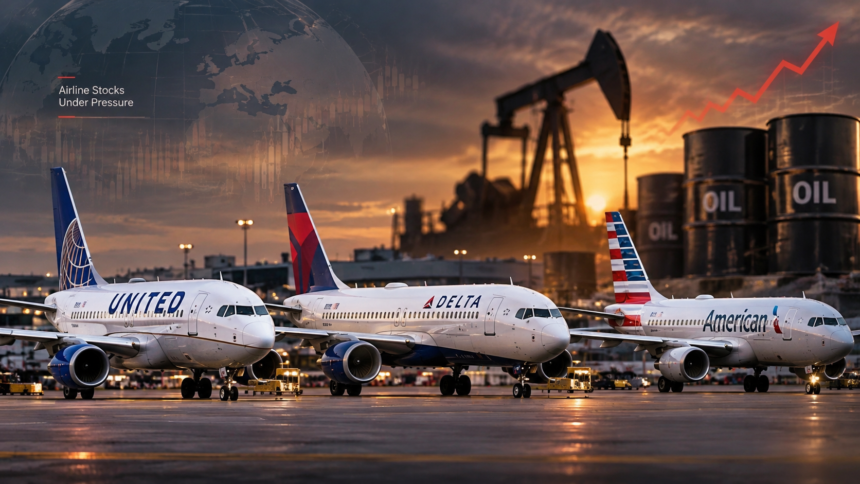
Airline stocks are coming under renewed pressure as surging oil prices raise concerns about higher fuel expenses and weaker profit margins. Barclays has lowered its price targets for United Airlines (UAL), Delta Air Lines (DAL), and American Airlines (AAL), although the brokerage continues to maintain Overweight ratings on all three stocks.
The latest revisions come as crude oil prices climb above $100 a barrel, creating another challenge for airlines that are already dealing with elevated operating costs. Barclays believes the near-term earnings outlook could remain under pressure, but stronger airline revenues may eventually translate into better margins if energy prices retreat.
All three major U.S. airline stocks ended last week lower, with their shares falling between 0.3% and 1.4%.
Barclays Lowers UAL, DAL and AAL Price Targets
Barclays analyst Brandon Oglenski reduced his price target for United Airlines to $160 from $175. The target for Delta Air Lines was lowered to $95 from $105, while American Airlines was cut to $14 from $19.
Despite these reductions, Barclays retained its Overweight rating on each airline.
According to Oglenski, the primary reason for the lower targets is the recent increase in energy prices. Higher jet fuel costs can quickly put pressure on airline margins, particularly when fuel prices rise faster than carriers can offset them through ticket prices.
However, Barclays remains constructive on the airlines’ longer-term prospects. Oglenski argued that investors should pay more attention to continued revenue growth instead of focusing too heavily on temporary movements in fuel prices.
The analyst believes airlines could have greater structural margin potential if energy prices eventually return to levels seen before the current geopolitical crisis. In that scenario, lower fuel expenses combined with stronger revenue could provide a meaningful boost to profitability.
Airline Stocks Face Renewed Fuel-Cost Pressure
The latest price-target cuts arrive during a challenging period for the airline sector. United, Delta and American have all suffered double-digit declines since August as investors have become increasingly concerned about the impact of rising jet fuel prices on profitability.
While passenger demand has remained relatively resilient, higher fuel expenses could reduce the benefits airlines receive from strong travel demand and improving yields.
American Airlines has experienced the sharpest decline among the three over this period, while United and Delta have also struggled compared with the broader stock market.
In the latest trading action, United Airlines stock was up about 0.03% overnight, while Delta Air Lines and American Airlines each fell around 0.7%.
BTS Data Shows Fuel Expenses Recently Improved
Government data provides a somewhat mixed picture of the airline industry’s fuel situation.
According to recently released Bureau of Transportation Statistics (BTS) data, U.S. scheduled-service airlines spent approximately $5.89 billion on fuel in July. That represented a 1.8% decline from the $5.99 billion spent in June.
Interestingly, airlines consumed 3.8% more fuel in July, yet their average fuel price declined during the month. The average cost per gallon dropped 5.4% sequentially to $3.40.
That monthly improvement, however, does not mean fuel costs have returned to normal.
The average price was still 45.4% higher than the $2.34 per gallon recorded in July 2025. This year-over-year increase continues to create a significant cost burden for airlines and could weigh on earnings if elevated prices persist.
Middle East Tensions Keep Oil Prices Elevated
Geopolitical developments are adding another layer of uncertainty to the airline industry’s cost outlook.
The ongoing U.S.-Iran confrontation and continued risks surrounding the Strait of Hormuz have raised concerns about global oil supplies. The waterway is a critical route for international oil shipments, meaning any disruption could push crude prices even higher.
Oil has recently crossed the $100-per-barrel threshold for the first time since May.
At the time of writing, Brent crude futures were trading around $107.20 per barrel, up approximately 2.5%, while West Texas Intermediate (WTI) crude had climbed 2.44% to about $102.49.
For airlines, a sustained rise in crude prices is particularly important because jet fuel represents one of the industry’s largest variable expenses.
Strong Revenue Growth Could Support Airline Margins
Despite the fuel-cost challenges, United Airlines, Delta Air Lines and American Airlines all reported revenue growth during the second quarter of fiscal 2026.
That growth could provide some protection against higher operating expenses. If passenger demand and pricing remain strong while oil prices eventually moderate, airlines could see meaningful margin improvement.
This is also why Barclays has maintained its Overweight ratings despite cutting the price targets. The brokerage appears to view the current fuel-related weakness as more of a near-term headwind than evidence of a permanent deterioration in the airlines’ earnings potential.
UAL, DAL and AAL Stock Performance
Performance among the three airlines has varied considerably so far this year.
- United Airlines (UAL): down about 1%
- American Airlines (AAL): down approximately 15%
- Delta Air Lines (DAL): up around 15%
The figures highlight the different investor views surrounding the three carriers, with Delta continuing to outperform while American has faced considerably stronger selling pressure.
Retail Investors Remain Positive on United and Delta
Retail investor sentiment also differs across the three airline stocks.
On Stocktwits, sentiment toward United Airlines and Delta Air Lines remained bullish, while sentiment surrounding American Airlines was neutral.
The contrasting sentiment suggests that retail investors remain relatively confident in the long-term outlook for United and Delta, even as higher oil prices create short-term concerns.
Bottom Line for UAL, DAL and AAL Investors
Barclays’ latest price-target reductions highlight how quickly rising oil prices can change the near-term outlook for airline stocks. Higher fuel expenses are likely to remain a key risk for United, Delta and American as long as crude prices remain above $100 a barrel.
Still, the broader picture is not entirely negative. Strong revenue growth and resilient travel demand could help airlines absorb some of the cost pressure. If energy prices eventually decline, the combination of lower fuel expenses and higher revenue could create an opportunity for margins to expand.
For investors, the key factors to watch will be crude oil prices, jet fuel costs, passenger demand, airline yields and revenue growth. These indicators will likely determine whether the current fuel-price pressure remains a temporary setback or becomes a more significant threat to airline profitability.