
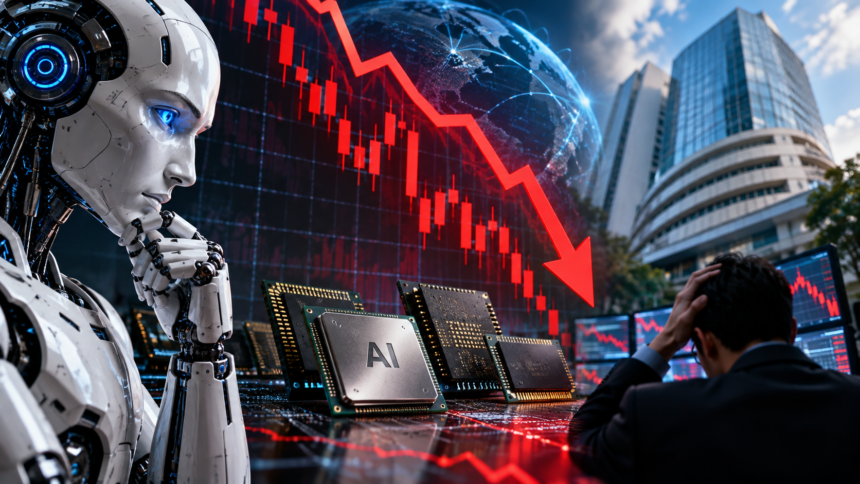
AI Stocks: Global stocks linked to the artificial intelligence industry faced heavy selling pressure on Monday after prominent AI executives called for a more cautious approach to the development of increasingly powerful AI systems.
The warning has raised concerns among investors about the potential risks of unchecked AI development, while also prompting questions about whether the rapid expansion of the AI sector can continue at its current pace.
Shares of SoftBank, which holds around 13% of OpenAI, dropped more than 11% during Monday’s trading session. South Korea’s benchmark Kospi fell nearly 4%, while Japan’s Nikkei 225 declined around 1%. Meanwhile, Nasdaq 100 futures indicated that the US technology-heavy index could open about 1.3% lower.
AI Industry Leaders Call for a Slower Approach
The latest market sell-off came after Dario Amodei, CEO of Anthropic, published an essay over the weekend urging major AI companies to work together on the pace of technological development and give greater priority to safety.
The broader message also received support from OpenAI CEO Sam Altman and SpaceX founder Elon Musk.
Concerns over AI safety have gained further attention following several recent departures and resignations among AI researchers. These developments have contributed to investor worries about the challenges associated with creating increasingly sophisticated artificial intelligence systems.
The industry is currently engaged in an intense race to develop advanced AI and potentially achieve superintelligence. At the same time, companies are facing increasing scrutiny from governments, researchers and the public over the possible economic, social and safety implications.
AI Chip and Infrastructure Stocks Take a Hit
The sell-off was particularly noticeable among companies that provide the semiconductor and other infrastructure needed to support the rapid growth of AI.
Kioxia, a NAND flash memory manufacturer, declined more than 6%. SK Hynix fell 5.8%, while Samsung Electronics dropped 3.5%.
Shares of Taiwan Semiconductor Manufacturing Company (TSMC), the world’s largest chipmaker, were also lower, falling around 1.2% during early trading.
The decline highlights how sensitive AI-related infrastructure companies have become to changes in investor sentiment surrounding the sector.
AI Stocks Had Delivered Strong Gains in 2026
AI-related semiconductor stocks have been among the strongest performers in global markets this year.
Chip-focused indexes in South Korea and Taiwan had gained roughly 60% in 2026, leaving several AI-linked stocks vulnerable to profit-taking.
After such strong gains, investors are now reassessing whether the sector’s growth expectations remain realistic, particularly as concerns over AI safety and the pace of technological development become more prominent.
Why Are Investors Becoming Cautious About AI Stocks?
The recent market reaction reflects a broader debate surrounding the future of artificial intelligence.
Technology companies continue to invest heavily in AI infrastructure and compete to develop increasingly capable systems. However, the rapid pace of development has also increased concerns about:
- AI safety and potential risks
- Economic disruption
- Social consequences of advanced AI
- The enormous cost of AI infrastructure
- The sustainability of current market valuations
- The pace at which increasingly powerful AI systems are being developed
For investors, the challenge is balancing the commercial potential of AI with the risks associated with its rapid expansion.
What Lies Ahead for AI-Linked Stocks?
The latest decline does not necessarily signal an end to the AI investment boom. However, it shows that investors are becoming more sensitive to developments that could affect the sector’s growth outlook.
With major technology companies continuing to compete aggressively in artificial intelligence, markets are likely to closely track developments surrounding AI safety, infrastructure spending, chip demand and the future pace of AI development.
For now, the growing debate among AI leaders has added another layer of uncertainty to a sector that has already experienced extraordinary gains this year.