
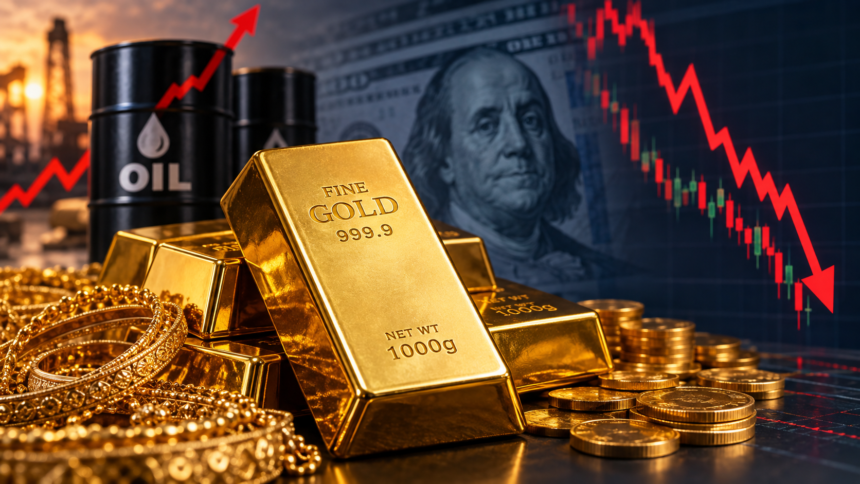
Gold prices are facing fresh selling pressure as rising crude oil prices, driven by intensifying US-Iran tensions, have renewed concerns over inflation. At the same time, a stronger US dollar and elevated US Treasury yields are making gold less attractive to investors.
The rise in energy prices has also increased expectations that the US Federal Reserve could consider a rate hike at its September 15-16 meeting, adding another challenge for the precious metal in the near term.
Gold Prices Under Pressure
Gold has come under pressure in global markets as the latest geopolitical developments between the US and Iran push oil prices higher. The combination of higher energy costs, rising Treasury yields and dollar strength has created a difficult environment for bullion.
In the international market, COMEX gold ended about 1.50% lower at $4,408.90 per ounce. In India, MCX gold had gained marginally last week and closed at ₹1,52,784 per 10 grams. However, the domestic benchmark remained below its 20-day exponential moving average, indicating continued technical weakness.
According to Ponmudi R, CEO at Enrich Money, the latest jump in crude prices has intensified inflation expectations and significantly increased market expectations of a possible US Fed rate hike next week.
He noted that the pressure on precious metals resulted in gold and silver recording their third straight weekly decline, even though both metals recovered strongly on Friday following a hotter-than-expected headline inflation reading.
Why US-Iran Tensions Matter for Gold
The latest escalation in US-Iran tensions has become an important factor for gold investors because a prolonged increase in crude oil prices could make the Federal Reserve’s inflation battle more difficult.
Higher fuel and energy costs can push overall inflation higher. If inflation remains elevated, the US central bank may have less flexibility to cut interest rates and could instead maintain a tighter monetary policy.
Higher interest rates and real bond yields typically hurt gold because the precious metal does not generate interest income. When yields rise, investors may prefer interest-bearing assets over bullion.
A stronger US dollar adds another layer of pressure. Since gold is priced in dollars globally, a rising dollar makes the metal relatively more expensive for buyers using other currencies.
Gold Retains Strong Long-Term Support
Despite the recent weakness, gold continues to receive support from strong structural demand.
The Gold Market Monthly Note highlighted that gold’s rally in August was supported by more than just expectations surrounding US monetary policy. The metal climbed from roughly $4,000 an ounce at the start of August to nearly $4,650, representing an increase of around 14% during the month.
Central-bank buying and demand from Asian consumers have remained important pillars for the gold market.
China’s central bank purchased another 20 tonnes of gold in July, extending its buying streak to 21 consecutive months. Chinese gold exchange-traded funds also reported strong inflows during the period.
India has also continued to see healthy demand. The country’s gold imports almost doubled in value to $4.16 billion in July, as manufacturers and retailers increased purchases ahead of the festive season.
Domestic gold ETFs also continued to attract investor money in August, providing additional support to prices.
September Fed Meeting Could Set the Next Direction
The upcoming September 16 FOMC decision is expected to be a major catalyst for gold prices.
According to the report, market expectations for a September rate hike had climbed to around 40%, while the likelihood of another rate increase in December had also risen.
For gold investors, the key issue will be whether the recent jump in crude oil prices results in persistent inflation. If higher oil prices push inflation and real yields higher while supporting the US dollar, gold could remain volatile and face additional selling pressure.
However, the precious metal still has several long-term factors working in its favour. Continued central-bank purchases, concerns over government finances and steady physical as well as investment demand could help limit any significant decline.
As a result, while gold may experience short-term volatility due to oil prices and changing Fed expectations, its broader long-term outlook could remain constructive.