
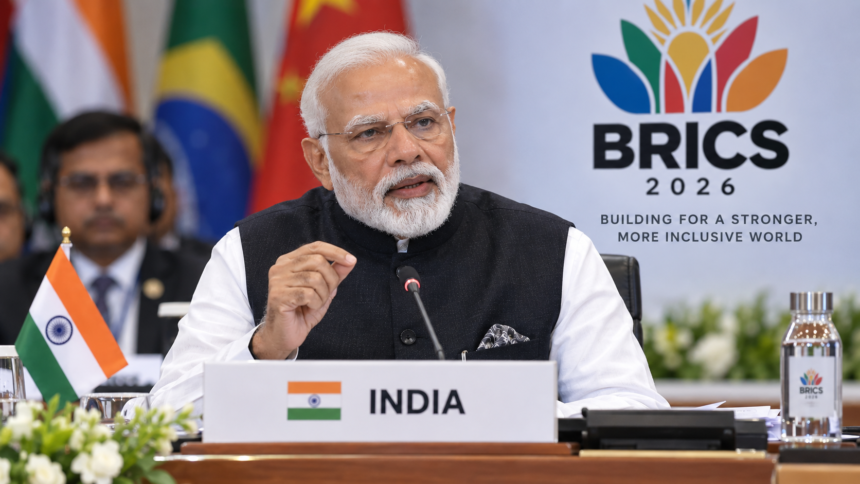
The BRICS Finance Track has outlined several initiatives aimed at strengthening economic and financial cooperation among member countries. The latest discussions focused on cross-border payments, local-currency transactions, development finance, infrastructure, trade facilitation, taxation and emerging technologies.
The BRICS Finance Ministers and Central Bank Governors discussed these priorities during their meeting in Mumbai on September 10. The outcomes were detailed in a Joint Statement issued under India’s 2026 BRICS chairship, which is centred on the theme “Building for Resilience, Innovation, Cooperation and Sustainability.”
The measures are aimed at making financial cooperation more efficient while creating greater opportunities for trade, investment and development across BRICS and the wider Global South.
BRICS Pushes for Better Cross-Border Payment Systems
Improving cross-border payments emerged as one of the key priorities of the BRICS Finance Track.
The BRICS Payment Task Force (BPTF) has been examining ways to improve interoperability between payment and financial messaging systems used by member countries. The group is also discussing greater use of local currencies for trade settlements and investments.
BRICS members acknowledged the progress made so far and asked the task force to continue working towards practical payment solutions.
The objective is to develop cross-border payment arrangements that are faster, more affordable, accessible, efficient, transparent and secure, while recognising that each member country has different national priorities and regulatory requirements.
Discussions on the use of local currencies for trade and investment will also continue.
New Development Bank Set for a Bigger Development Role
The New Development Bank (NDB) is expected to play a larger role in financing infrastructure and development projects across BRICS nations and other emerging economies in the Global South.
Finance ministers and central bank governors encouraged the NDB to increase its mobilisation of financial resources and expand local-currency financing.
They also called for stronger project-preparation facilities, greater diversification of funding sources and increased support for projects capable of delivering inclusive and sustainable economic growth.
BRICS members recognised the NDB as an important strategic institution for development and modernisation across BRICS and the Global South.
BRICS Multilateral Guarantees Could Attract Private Investment
The meeting also welcomed progress on the BRICS Multilateral Guarantees (BMG) initiative being developed by the NDB.
The proposed mechanism is intended to support sustainable development and resilient infrastructure projects. By providing guarantees, the initiative could help improve project creditworthiness, lower financing costs and encourage greater participation from private investors.
The BMG initiative is being developed in line with guidance issued by BRICS leaders in 2025, with preparations underway for a pilot phase under the NDB’s existing guarantee policy.
Member countries called for further technical work and pilot transactions. Successful pilot projects could eventually provide the foundation for expanding the programme.
New BRICS Investment Platform Discussions Continue
BRICS members have also made progress on discussions surrounding a proposed New Investment Platform (NIP).
The Finance Track agreed to continue technical work through a dedicated Study Group. The proposed platform is expected to follow a phased, consensus-driven and member-led approach, while respecting national sovereignty and differences between regulatory systems.
The latest discussions build on guidelines developed during Brazil’s BRICS chairship.
If eventually established, the platform could provide businesses and investors with another channel for cooperation and investment among BRICS economies. However, its detailed structure and operating arrangements are still being discussed.
BRICS Calls for IMF and World Bank Reforms
Reforming the global financial system was another major issue on the Finance Track agenda.
BRICS countries reiterated their demand for greater representation of emerging markets and developing economies (EMDEs) within institutions such as the International Monetary Fund (IMF) and the World Bank.
The grouping argued that the governance structures of the Bretton Woods Institutions should better reflect the changing balance of the global economy and give developing countries a stronger voice.
BRICS also called for more inclusive, transparent and merit-based procedures for selecting senior leadership at the IMF and World Bank, along with greater regional diversity.
On IMF quotas, the group urged the implementation of increases agreed under the 16th General Review of Quotas without further delay. It also called for progress towards meaningful quota realignment as part of the 17th General Review of Quotas.
Customs Cooperation to Make BRICS Trade Easier
Trade facilitation is another important component of the BRICS Finance Track.
During India’s 2026 chairship, member countries began the first BRICS Joint Customs Enforcement Operation. They are also working towards a Customs Mutual Administrative Assistance Agreement.
The proposed agreement would strengthen cooperation between customs administrations by enabling timely information exchange, mutual assistance and closer coordination. This could support both smoother trade and stronger customs enforcement.
BRICS countries have also agreed to enhance cooperation involving Authorised Economic Operator (AEO) programmes.
The planned areas of cooperation include:
- Exchange of customs-related information
- Capacity-building programmes
- Sharing of best practices
- Cooperation on AEO systems
- Mutual recognition, where appropriate
- Greater coordination between customs authorities
For importers and exporters, stronger customs cooperation could eventually improve information flows and make international trade procedures more predictable.
GIFT City May Host BRICS Risk Lab
India has proposed establishing a BRICS Risk Lab at GIFT City International Financial Services Centre (IFSC) in Gujarat.
BRICS members have expressed interest in continuing discussions on the proposal.
The proposed Risk Lab could provide a platform for cooperation on risk modelling, insurance, reinsurance and the exchange of industry best practices.
The broader objective is to develop a more self-reliant BRICS insurance ecosystem capable of supporting trade and economic activity between member countries.
Further discussions are expected to examine ways to strengthen reinsurance capacity across BRICS. Participation would be voluntary and could include regulators, reinsurance companies and other relevant stakeholders from member nations.
AI, Quantum Computing and Fintech Added to Finance Agenda
Emerging technologies are becoming an increasingly important part of BRICS financial cooperation.
The Finance Track examined both the potential benefits and risks associated with artificial intelligence (AI) and quantum computing in financial services.
BRICS has adopted an EMDE-focused approach to studying these technologies, taking into account the specific opportunities and challenges faced by emerging markets and developing economies.
The group welcomed several initiatives, including an Approach Paper on AI in Finance, an AI Governance and Enablement Toolkit, and a study examining the opportunities and risks quantum computing could create for the financial sector.
The BRICS Fintech Working Group will continue discussions on policy and knowledge sharing. At the same time, member countries stressed the importance of appropriate regulation and the ethical and responsible use of emerging technologies.
Infrastructure Financing and PPPs Remain a Priority
Infrastructure development remains central to the BRICS economic agenda.
The BRICS Task Force on Public-Private Partnerships (PPPs) and Infrastructure has continued work on PPP models, project de-risking and strategies to make infrastructure more resilient against disasters.
The initiative could help member countries strengthen their PPP ecosystems and improve how risks are allocated between public authorities and private-sector participants.
BRICS also emphasised the need to create a strong pipeline of infrastructure projects and increase private-sector participation in financing and development.
BRICS Strengthens Tax Cooperation
The Finance Track also placed greater emphasis on cooperation between tax authorities.
BRICS countries reaffirmed their commitment to addressing issues such as tax evasion, tax avoidance and illicit financial flows.
Under India’s chairship, working groups were established to address international taxation and transfer pricing, as well as revenue statistics.
Other initiatives include the BRICS Tax Support Network and the Tax Cross-Learning Lab, which are intended to encourage the exchange of knowledge, expertise and best practices among member countries.
BRICS Expansion Strengthens Its Global Economic Influence
BRICS has evolved significantly since it was initially formed by Brazil, Russia, India, China and South Africa.
The grouping expanded in 2024 with the addition of Egypt, Ethiopia, Iran, the United Arab Emirates and Saudi Arabia, while Indonesia joined in 2025.
The group also added partner countries, including Belarus, Bolivia, Kazakhstan, Cuba, Malaysia, Nigeria, Thailand, Uganda, Uzbekistan and Vietnam, in 2025.
Today, BRICS brings together 11 major emerging economies, representing approximately 49.5% of the global population, around 40% of global GDP and about 26% of global trade.
With its expanding membership and growing economic weight, BRICS is seeking to strengthen cooperation in areas ranging from payments and investment to infrastructure, technology and taxation.
The latest Finance Track initiatives under India’s 2026 chairship reflect the group’s broader effort to build more resilient financial systems, stronger trade connections and greater development opportunities across emerging economies and the Global South.