
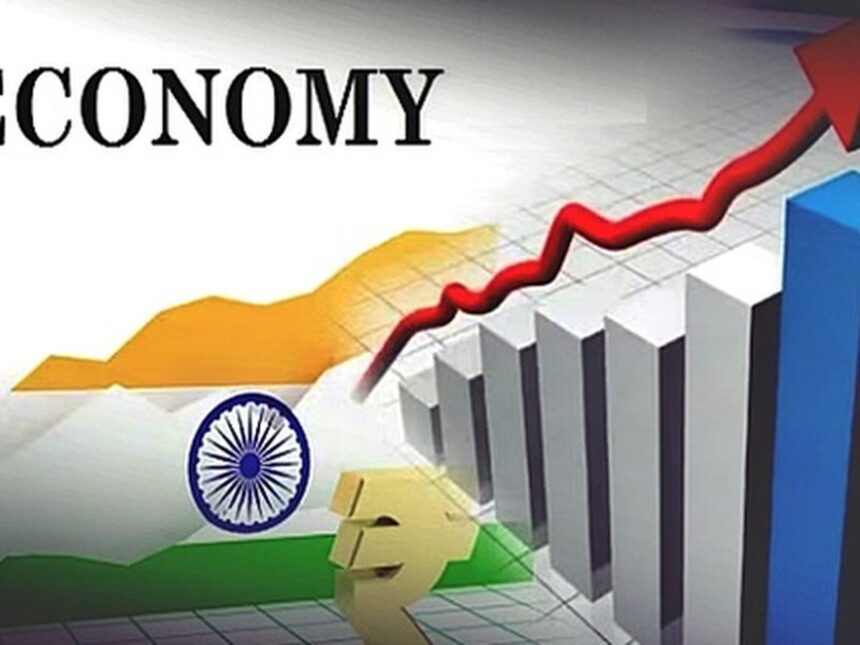
India could be entering a fresh phase of industrial expansion, with private companies increasingly moving into sectors that were once driven largely by government entities or dependent on imports. According to global brokerage Jefferies, industries such as space, semiconductors, electronics, data centres, solar manufacturing and aerospace are emerging as important engines of the country’s next growth cycle.
In its latest India Equity Strategy report, Jefferies said a combination of a large domestic market, government incentives and policies encouraging local manufacturing is prompting businesses to invest heavily in these emerging areas.
The brokerage has identified six sectors that could become major contributors to India’s next industrial growth phase.
1. Space Economy Could Expand Nearly Fivefold
India’s space industry is rapidly opening up to private companies following the government’s decision to allow greater private participation in 2020.
Jefferies believes India already possesses globally competitive space capabilities and could see its space economy grow nearly five times between 2023 and 2030, reaching an estimated $40 billion-$45 billion.
The sector is also witnessing a transition from experimental projects to commercial operations, with several startups developing technologies for launch vehicles, satellites and space-based applications.
Companies highlighted by Jefferies include Skyroot Aerospace, which carried out an orbital launch in July; Pixxel, which is working on high-resolution Earth-observation satellites; Agnikul Cosmos, focused on 3D-printed rocket engines; and Digantara, which is developing satellite-based surveillance capabilities.
2. Semiconductor Industry Moves Towards Execution
India’s semiconductor ambitions are increasingly shifting from policy announcements to actual manufacturing activity.
Jefferies estimates that approximately $20 billion worth of semiconductor investments are already in the pipeline. Several outsourced semiconductor assembly and test (OSAT) facilities are also moving towards production.
The brokerage said a proposed $13 billion semiconductor incentive programme could provide an additional boost to the domestic ecosystem. Such investments could help India increase its local value addition and reduce dependence on overseas supply chains.
However, challenges remain. Building a deeper semiconductor supply chain, developing a sufficiently skilled workforce and competing with established global manufacturing hubs will be crucial for the sector’s long-term success.
3. Data Centres Could See Another Fivefold Capacity Jump
India’s data-centre sector is gaining strategic importance as cloud computing, digitisation and data-localisation requirements continue to expand.
According to Jefferies, India’s colocation data-centre capacity has already increased roughly fivefold over the past five years to around 2GW.
The brokerage expects another fivefold expansion during the next five years, potentially taking capacity to approximately 10GW.
Such growth could generate an estimated $9 billion revenue opportunity for data-centre operators. Beyond the operators themselves, Jefferies sees around $45 billion of investment potential across related infrastructure, including electricity, cooling systems, construction and network connectivity.
4. Electronics Manufacturing Is Moving Beyond Assembly
India’s electronics industry is gradually shifting from basic assembly towards greater domestic manufacturing and value creation.
Electronics exports have increased significantly, while government programmes such as the Electronics Component Manufacturing Scheme (ECMS) and Mobile 2.0 are designed to strengthen the domestic supply chain and reduce reliance on imported components.
Jefferies expects ECMS to potentially cover around 50% of the mobile phone bill of materials within the next six years, compared with less than 20% currently.
Printed circuit boards, or PCBs, could offer another significant opportunity. The brokerage estimates India’s PCB market at approximately $5 billion, while around 85%-90% of current demand is still fulfilled through imports.
This large import dependence leaves substantial room for local manufacturers to expand production.
5. Solar Manufacturing Could Localise 90% of the Value Chain
India has rapidly strengthened its position in global solar manufacturing and is now the world’s second-largest solar PV manufacturing country, according to Jefferies.
The brokerage estimates that approximately 35GW of solar-cell manufacturing capacity is already operational, with another roughly 100GW under construction.
Several policy measures are supporting the shift towards domestic production. These include the Approved List of Models and Manufacturers (ALMM), quality-related regulations, domestic-content requirements and production-linked incentive schemes.
Jefferies expects India could localise around 90% of the solar manufacturing value chain by 2030. This would create opportunities not only for solar-cell and module manufacturers but across the wider domestic supply chain.
6. Aerospace Could Benefit From Global Supply-Chain Shifts
Aerospace is another industry where Jefferies sees considerable potential for Indian companies.
The brokerage believes India can benefit from the gap between global aerospace demand and available manufacturing capacity. Its relatively competitive production costs, combined with a strong engineering talent pool, could help Indian suppliers secure a larger role as global aerospace companies diversify and expand their supplier networks.
India’s aerospace exports to Boeing and Airbus are estimated at around $1.4 billion-$1.6 billion annually.
Companies such as Azad Engineering, Bharat Forge, Dynamatic Technologies, Rane and Sansera Engineering are already supplying global original equipment manufacturers and Tier-1 aerospace companies.
Jefferies expects these businesses to continue expanding their capabilities and strengthening their participation in the global aerospace supply chain.
India’s Industrial Story Is Entering a New Phase
The common thread across these six sectors is a combination of domestic demand, government support, localisation and increasing private-sector participation.
From rockets and semiconductors to solar cells, electronics, data centres and aircraft components, India is gradually building capabilities in industries that could have a significant impact on its future manufacturing and technology landscape.
If the investment pipeline translates into operational capacity as expected, these sectors could become important pillars of India’s next industrial growth cycle while also helping the country reduce import dependence and integrate more deeply into global supply chains.