
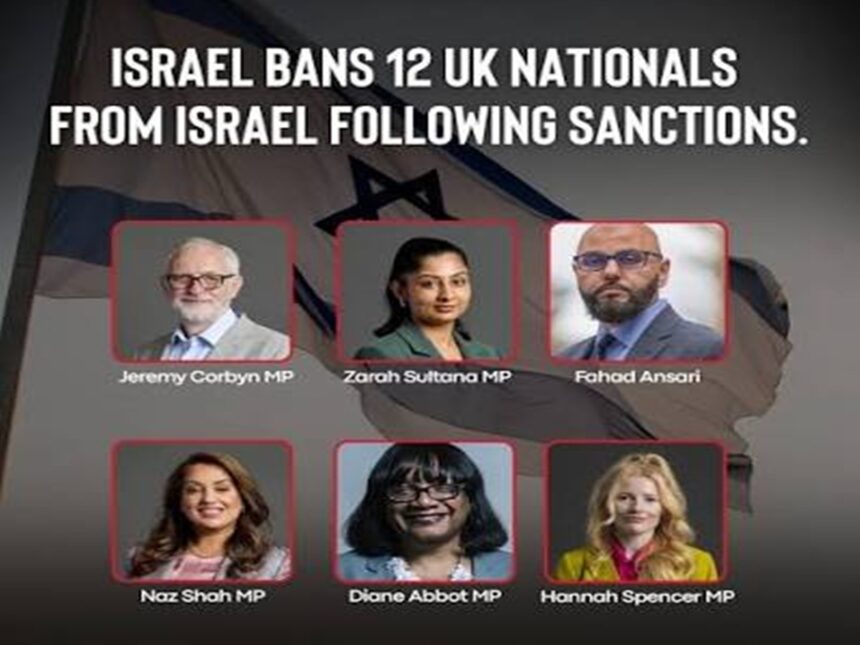
Israel has announced retaliatory measures against the UK, including barring 12 British nationals from entering the country and closing the British consulate in Jerusalem, amid growing tensions over Israeli settlements and settler violence in the occupied West Bank.
Israel on Tuesday announced a series of measures against the United Kingdom following sanctions backed by London and other Western countries targeting trade with Israeli settlements in the occupied West Bank.
The measures include a ban on 12 British nationals and the closure of the British consulate in East Jerusalem. Israel has also said Britain will no longer be permitted to take part in the US-led coordination mechanism for Gaza.
Israel Accuses UK of Interfering in Its Affairs
Israeli Foreign Minister Gideon Saar sharply criticised the British government following comments made by UK Foreign Secretary Ed Miliband in Parliament.
Miliband had accused Israeli settlers of carrying out what he described as “ethnic cleansing” in the West Bank. Saar rejected the allegations and called the British government’s position unacceptable.
Saar accused London of attempting to interfere in Israel’s domestic affairs and electoral process, particularly with the country’s October 27 election approaching.
He described the British government’s action as politically motivated and said the measures represented interference in the affairs of a sovereign state.
British Consulate in East Jerusalem to Be Closed
As part of Israel’s response, Saar announced that the British consulate in East Jerusalem would be shut down.
The consulate is accredited to the Palestinian Authority and operates in an area that Palestinians claim as part of their historic territory.
Israel captured East Jerusalem during the 1967 Six-Day War and subsequently annexed the area, considering the whole of Jerusalem to be its capital. However, most countries, including the UK, do not recognise Israeli sovereignty over the entire city.
The United States remains an exception. During Donald Trump’s presidency, Washington moved its embassy from Tel Aviv to Jerusalem.
Britain and most other countries that maintain diplomatic relations with Israel continue to keep their embassies in Tel Aviv.
Jeremy Corbyn Among 12 British Nationals Barred
The list of British nationals prohibited from entering Israel includes former Labour Party leader Jeremy Corbyn, who has long been a prominent supporter of the Palestinian cause.
Most of those affected are members of the UK Parliament. The list also includes Zarah Sultana, who recently left the Labour Party along with Corbyn and joined efforts to establish the left-wing Your Party.
Israel’s decision to target British politicians comes against the backdrop of increasingly strained relations between London and the Israeli government over the situation in the West Bank and Gaza.
West Bank Settlement Sanctions Fuel Diplomatic Dispute
The latest confrontation follows a decision by 12 countries, including the UK, Canada and France, to impose sanctions on trade involving Israeli settlements in the occupied West Bank.
The move came after an increase in attacks by Israeli settlers against Palestinians in the territory.
The timing has added to the political sensitivity of the dispute, with Israel’s October 27 election approaching. Prime Minister Benjamin Netanyahu has continued to campaign while maintaining his support for Jewish settlements in the West Bank.
Israel’s Response Adds to UK-Israel Tensions
Israel’s decision to bar British nationals and close the consulate represents a significant escalation in the diplomatic dispute with London.
Saar’s announcement also included removing the UK’s participation in the US-led coordination mission for Gaza, further widening the disagreement between the two governments.
At the centre of the dispute are broader disagreements over Israeli settlements, Palestinian rights, the status of East Jerusalem and the international community’s response to developments in the occupied West Bank.
The latest measures highlight how tensions between Israel and the UK have increasingly moved beyond political statements and into diplomatic and economic measures.