
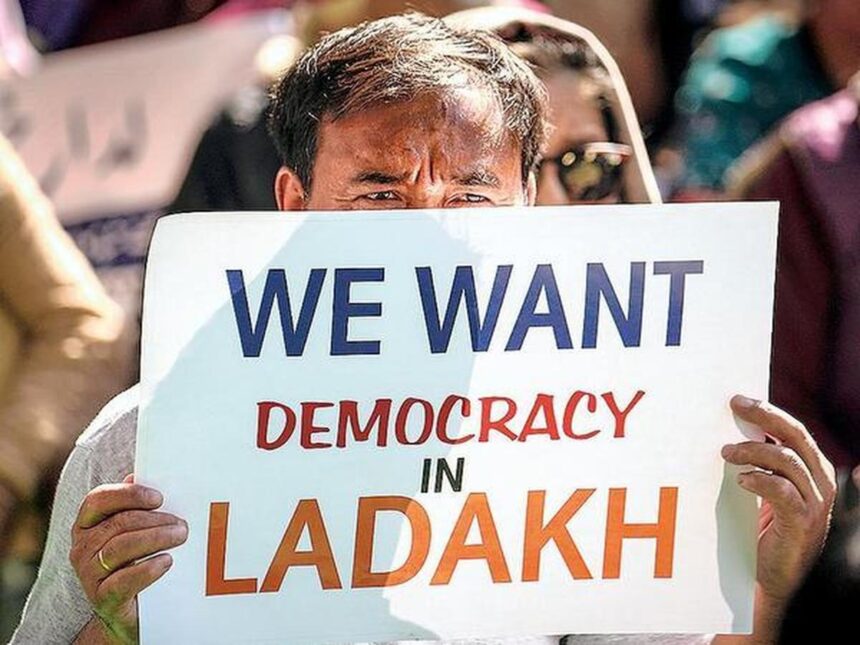
Ladakh may be offered special constitutional protection through a proposed Article 371(K), potentially giving an elected Union Territory-level body greater authority over land, culture, forests and natural resources. However, major questions over legislative powers and the role of the Lieutenant Governor remain unresolved.
For years, the political debate in Ladakh has centred on a fundamental issue: how much control should the people of the region have over their land, employment, natural resources and governance after Ladakh became a Union Territory in 2019?
Recent discussions between Ladakh’s representatives and the Centre suggest that the long-running standoff could be moving towards a possible compromise.
According to reports cited in the original account, the Ministry of Home Affairs (MHA) has proposed introducing a new constitutional provision, Article 371(K), specifically for Ladakh. The proposed framework could provide constitutional safeguards and allow an elected Union Territory-level institution to exercise legislative authority over selected matters such as land, culture and language, forests, environment and natural resources.
However, the proposal does not resolve every issue. The precise scope of the proposed body’s powers, its relationship with the Lieutenant Governor (LG), and the division of authority between Ladakh and the Union government are still being discussed.
That makes the proposal potentially significant, but not yet a final political settlement.
What Has the Centre Proposed for Ladakh?
The Centre has reportedly offered to create a special constitutional provision for Ladakh as part of ongoing negotiations with representatives of the Union Territory.
The proposed Article 371(K) is intended to provide safeguards for issues that Ladakh’s political groups have considered particularly important since the region was separated from Jammu and Kashmir in 2019.
These include:
- Protection of land
- Employment opportunities
- Culture and language
- Forests and the environment
- Natural resources
- Greater participation in local decision-making
Reports have suggested that the proposed arrangement could establish a directly elected UT-level body with legislative powers over specified subjects.
Representatives of the Leh Apex Body and the Kargil Democratic Alliance have reportedly viewed progress on areas such as land, culture, language, forests and natural resources as an important development in the negotiations.
However, one distinction is crucial: Article 371(K) does not currently exist in the Constitution.
The Constitution has special provisions ranging from Article 371 to Article 371J for different states. If the proposed Ladakh-specific provision is eventually agreed upon, it would require the necessary constitutional amendment and parliamentary process before becoming law.
Why Is Ladakh Seeking Constitutional Safeguards?
The roots of the current dispute go back to the Jammu and Kashmir Reorganisation Act, 2019.
The legislation reorganised the former state of Jammu and Kashmir into two Union Territories—Jammu and Kashmir, which was given a legislature, and Ladakh, which was created without a legislative assembly.
The law was enacted on August 9, 2019, and the two Union Territories came into existence on October 31, 2019.
This marked a major change in Ladakh’s governance structure.
Before the reorganisation, Ladakh was part of Jammu and Kashmir and had representation within the state’s political system. After 2019, it became a Union Territory administered without an elected legislative assembly.
The administration is headed by the Lieutenant Governor, with the administrative machinery operating under the UT framework.
For Ladakh’s political groups, this has raised concerns about how decisions concerning land, employment, development and natural resources are made and how much direct influence local representatives have over them.
What Are Ladakh’s Main Demands?
Although the demands have developed over time, four issues have remained particularly prominent.
1. Statehood
Some political groups in Ladakh have demanded that the Union Territory be granted full statehood.
Statehood would mean having an elected government and legislature with constitutionally defined powers.
2. Sixth Schedule Protection
Another major demand has been inclusion under the Sixth Schedule of the Constitution, which provides autonomous administrative arrangements for specified tribal areas.
Ladakh’s groups have argued that such protection could help preserve local identity, land rights and traditional governance.
3. Safeguards for Land, Jobs and Culture
Ladakh’s political representatives have also sought stronger protections against possible changes affecting land ownership and employment opportunities.
Alongside these economic concerns are demands to preserve the region’s distinctive cultural and linguistic heritage.
4. Stronger Local Representation
The demand goes beyond cultural safeguards.
Political groups have also called for an institution through which elected representatives from Ladakh can play a meaningful role in decisions affecting the territory.
The MHA has been conducting discussions with the Leh Apex Body and the Kargil Democratic Alliance over these issues, including statehood, Sixth Schedule protection and reservation.
What Could Article 371(K) Mean for Ladakh?
The significance of the latest proposal lies in the possibility of giving Ladakh special constitutional protection without necessarily granting it statehood.
Article 371 is not a uniform autonomy formula. Different provisions have been created for different states based on their specific political, social and historical circumstances.
For instance, Article 371A provides special safeguards for Nagaland in areas including customary law, social and religious practices, administration of justice involving customary law, and ownership and transfer of land and its resources.
Similarly, Article 371G gives Mizoram special constitutional protection concerning matters such as customary law, social and religious practices and ownership and transfer of land.
The important takeaway is that having an Article 371 provision does not automatically mean that a region receives statehood or a completely independent government.
Everything depends on the exact constitutional language.
Therefore, if Article 371(K) is introduced for Ladakh, the precise wording will determine what powers and safeguards it actually provides.
Article 371(K) vs Sixth Schedule: What Is the Difference?
This distinction is central to Ladakh’s political debate.
The Sixth Schedule provides for autonomous district and regional councils in specified tribal areas. These councils receive constitutionally defined administrative, legislative and financial powers.
Among other responsibilities, such councils can exercise authority over aspects of administration, land-related matters and taxation within the constitutional framework.
An Article 371 provision works differently.
Rather than applying a standard model, it can be drafted specifically for the circumstances of a particular state or territory. The extent of protection and autonomy therefore depends on the provision itself.
In simple terms, the Sixth Schedule is based around constitutionally recognised autonomous councils, while an Article 371-type arrangement can create a customised set of protections and powers.
Why Is the Proposed Elected Body Important?
If implemented, the proposal could introduce something Ladakh currently lacks—a constitutionally backed elected institution with legislative authority over important local subjects.
Reports have indicated that the proposed body could have powers involving:
- Land
- Culture
- Language
- Forests
- Environment
- Natural resources
These areas have direct implications for Ladakh.
Land is closely connected to concerns over demographic and economic change. Culture and language are central to the region’s identity. Forests, water and other natural resources are particularly important in a fragile Himalayan ecosystem.
Environmental regulation has also become increasingly significant as tourism, infrastructure and other forms of development expand.
A stronger role for elected representatives could therefore alter the balance between local decision-making and administration by the Centre.
The Biggest Question: How Much Authority Will It Have?
This remains one of the biggest unresolved aspects of the proposal.
Creating an elected institution is one thing. Determining what that institution can actually do is another.
Several questions remain:
- Will it have the power to independently legislate on the subjects assigned to it?
- What happens if its decisions clash with the Union government’s position?
- How much authority will remain with the Lieutenant Governor?
- How will subjects under the Union List and Concurrent List be handled?
- What will be the arrangement for sensitive areas such as policing and law and order?
These details are critical because political representation does not necessarily translate into the same level of authority enjoyed by a state government.
Previous discussions over the Sixth Schedule and statehood have already demonstrated disagreements about the degree of autonomy Ladakh should receive.
Why Not Give Ladakh a Legislative Assembly?
The answer lies partly in the structure created by the 2019 reorganisation.
Jammu and Kashmir was made a Union Territory with a legislature, while Ladakh became a Union Territory without one.
A legislative assembly has constitutional authority to make laws on specified subjects. Ladakh currently does not have such an institution.
The proposed elected UT-level body could therefore represent a middle path.
Instead of immediately converting Ladakh into a state or creating a conventional legislative assembly, the Centre could establish a representative institution with defined legislative authority over selected local matters.
That could place the proposal somewhere between the present administrative arrangement and Ladakh’s broader demand for statehood.
What Role Will the Hill Councils Play?
Ladakh already has autonomous hill development councils in Leh and Kargil.
These councils provide local administrative representation, but their powers are not equivalent to those of a state legislature.
The Centre has also moved towards establishing autonomous hill development councils across all districts of Ladakh.
This could create a multi-level governance structure involving district-level hill councils, a proposed elected UT-level institution and the existing Lieutenant Governor-led administration.
That makes the division of responsibilities particularly important.
If Article 371(K) eventually becomes law, policymakers will have to clearly establish how the proposed elected body interacts with the Hill Councils, the LG and the Union government.
Why Has the Issue Become So Sensitive?
The dispute is about much more than administrative arrangements.
At its core is a larger question about Ladakh’s political future following the 2019 reorganisation.
The region has witnessed sustained political mobilisation around demands for statehood, constitutional safeguards and greater local control.
Tensions escalated further when protests in 2025 turned violent, underscoring the frustration among sections of the population over the progress of negotiations.
Ahead of the latest discussions, the Leh Apex Body reportedly deferred planned protest marches, expressing hope that talks with the Centre would result in meaningful progress while keeping open the possibility of renewed agitation if expectations were not met.
The timing of the Article 371(K) proposal therefore makes it particularly significant.
Could Article 371(K) Become a Compromise Formula?
Potentially, yes.
The proposal can be viewed as an attempt to bridge two very different positions.
At one end is the current system, under which Ladakh remains a Union Territory without a legislative assembly and administration is centred around the Lieutenant Governor and the Union government.
At the other end is the demand for full statehood, which would bring an elected state government and legislature.
A Ladakh-specific Article 371(K) could potentially occupy the middle ground—keeping Ladakh within the Union Territory framework while providing constitutional safeguards and greater legislative authority to an elected local institution.
Whether political groups accept that arrangement, however, will depend on the final details.
What Happens Next?
The next phase of negotiations will focus on turning the broad proposal into a clearly defined constitutional and administrative framework.
Several issues will need to be settled, including:
- The exact wording and scope of Article 371(K)
- The composition and powers of the proposed elected UT-level body
- Its relationship with the Lieutenant Governor
- The subjects on which it can legislate
- Its authority over land, employment, forests, environment and natural resources
- The division of responsibilities between the elected institution and the Union government
- The future role of the Leh and Kargil Hill Councils
- Whether the proposed safeguards are sufficient to address Ladakh’s concerns
Ultimately, the biggest political test will be whether Ladakh’s representatives consider the proposed constitutional arrangement a credible alternative to their longstanding demands for statehood and Sixth Schedule protection.
If the Centre and Ladakh’s political groups can bridge that gap, Article 371(K) could mark a major change in the Union Territory’s governance. If not, the proposal may become another chapter in a prolonged negotiation over Ladakh’s political future.