
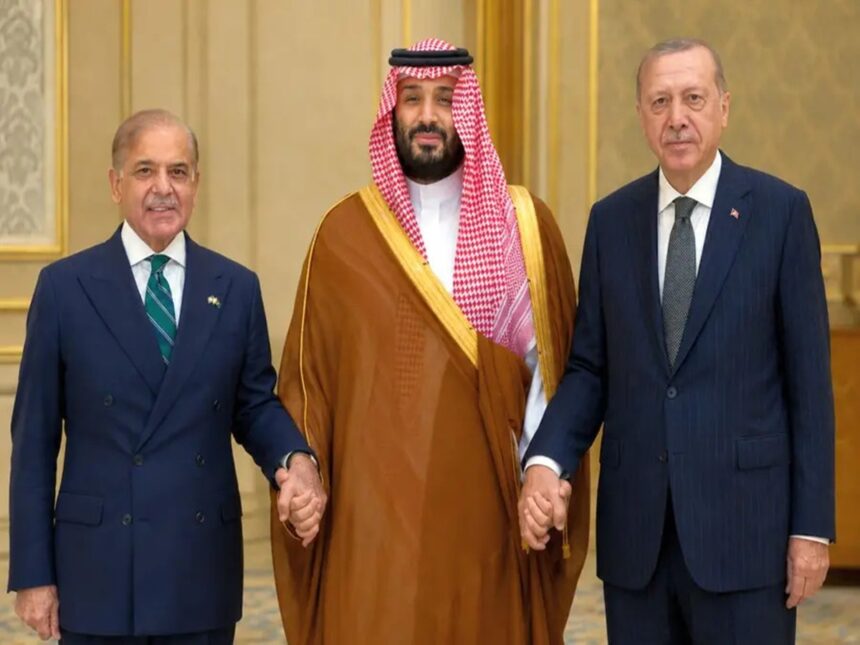
The formalisation of the Mecca Joint Defence Agreement involving Saudi Arabia, Turkey and Pakistan could mark an important shift in the regional security landscape. The proposed collective defence arrangement brings together three countries with very different strategic strengths—Saudi Arabia’s financial resources, Turkey’s rapidly growing defence industry and Pakistan’s large military establishment.
The agreement is based on the principle of collective security, under which an attack on one member could be treated as an attack on the others. Its geopolitical significance grew after Pakistan Defence Minister Khawaja Asif called for the grouping, often described as an “Islamic NATO”, to take a united approach to external threats. His remarks reportedly referred directly to Israel and also contained indirect references to India.
For New Delhi, the emerging security partnership could create new diplomatic, military and intelligence challenges, particularly along India’s western strategic environment.
What Does the New Defence Alliance Mean for India?
Although the main drivers behind the agreement are linked to security concerns in West Asia, closer defence coordination between Saudi Arabia, Turkey and Pakistan could have wider implications for South Asia.
Greater Access to Turkish Defence Technology
One of the most important benefits for Pakistan could be deeper access to Turkey’s expanding defence sector. Ankara has made significant progress in areas such as combat drones, naval systems and electronic warfare technology.
A stronger trilateral partnership could potentially give Pakistan additional opportunities for defence cooperation and technology sharing beyond its traditional international suppliers.
Stronger Intelligence and Military Coordination
The alliance could also lead to greater military interoperability through joint committees, intelligence-sharing arrangements and coordinated operations.
If cooperation extends to maritime security, it could have strategic relevance for the Arabian Sea, an area of major importance to India because of its trade routes, energy supplies and naval interests.
Such arrangements could improve Pakistan’s strategic flexibility and strengthen its ability to coordinate with other regional militaries during a crisis.
Could India Face More Complex Strategic Pressure?
The collective defence framework may also complicate India’s calculations during periods of regional tension.
Saudi Arabia and Turkey maintain their own separate diplomatic and economic relationships with India. However, their formal security partnership with Pakistan could add another layer of complexity if Islamabad attempts to bring its disputes with New Delhi into the alliance’s broader security discussions.
That possibility, rather than an immediate military threat, could become a key diplomatic concern for India.
Pakistan’s Push to Internationalise Its Disputes With India
Over the past decade, India has significantly strengthened its engagement with the Gulf, particularly Saudi Arabia. Trade, investment, energy cooperation and strategic engagement have transformed New Delhi’s ties with Riyadh into an important pillar of India’s West Asia policy.
Pakistan’s efforts to connect its bilateral disputes with India to a wider pan-Islamic security narrative could test this diplomatic balance.
Saudi Arabia’s main security concerns are believed to centre on protecting its territory, infrastructure and interests from regional instability and other security threats. However, if Pakistan succeeds in placing India-related issues within the agenda of a broader defence grouping, it could create new diplomatic friction.
For India, the challenge will be to ensure that its bilateral partnerships with Gulf nations are not influenced by Pakistan’s attempts to widen the scope of its rivalry with New Delhi.
Why Pakistan Is Linking India With Israel
Pakistani leaders have also attempted to frame their security concerns by drawing parallels between India and Israel.
This approach could be aimed at using wider public sentiment across parts of the Muslim world to strengthen support for Pakistan’s geopolitical position.
India faces a particularly complex balancing act in West Asia. New Delhi has a strong strategic and defence technology relationship with Israel while also maintaining close economic, political and diplomatic ties with Saudi Arabia, the UAE and other Arab countries.
By placing India and Israel within the same broader security narrative, Pakistan may hope to increase political pressure on New Delhi’s relationships in the region.
However, India’s growing economic importance and independent bilateral ties with Gulf countries give it significant room to resist such efforts.
How India Could Respond
New Delhi has several diplomatic and strategic options to limit the impact of the emerging Saudi Arabia-Turkey-Pakistan defence partnership.
Deepen Cooperation With Other Gulf Partners
India could further strengthen maritime security, intelligence and strategic cooperation with countries such as the United Arab Emirates and Oman.
Both nations have their own regional security priorities and maintain important independent relationships with New Delhi, making bilateral engagement a key part of India’s strategy.
Expand Strategic Partnerships in Europe and the Mediterranean
India could also deepen defence and diplomatic cooperation with countries including France, Greece and Cyprus.
Stronger engagement in the Mediterranean region could help New Delhi balance Turkey’s expanding geopolitical and military influence.
Use India’s Economic Strength
India’s position as one of the world’s largest and fastest-growing major economies gives it considerable diplomatic leverage.
As a major energy consumer, trading partner, investment destination and technology market, India has strong economic relationships with Gulf countries. New Delhi can use these deep commercial links to encourage regional partners to keep economic cooperation separate from Pakistan’s political agenda.
Will the ‘Islamic NATO’ Become a Major Military Force?
The biggest question remains how deeply Saudi Arabia, Turkey and Pakistan will integrate their military structures in practice.
A collective defence agreement on paper does not automatically translate into a unified military command or guaranteed intervention during every conflict. The three countries have different foreign policy interests, strategic priorities and relationships with other global powers.
For now, the actual level of military integration, intelligence cooperation and joint operational planning remains to be seen.
Still, the agreement signals a potentially important shift in regional security architecture. If the partnership develops into a more structured and operational defence bloc, West Asian security politics could play a larger role in India’s long-term strategic calculations.
The Bottom Line
The Saudi Arabia-Turkey-Pakistan defence partnership does not immediately create a direct military threat to India. However, Pakistan’s efforts to use a wider Islamic security framework to internationalise its disputes with New Delhi could create new diplomatic and strategic challenges.
India’s response is likely to focus on strengthening its independent partnerships across the Gulf, expanding defence cooperation with other regional powers and leveraging its growing economic influence.
The real significance of the Mecca Joint Defence Agreement will ultimately depend on how far the three countries are willing to move from political declarations to genuine military integration. But its emergence makes one thing clear: developments in West Asian security are likely to become increasingly important to India’s future defence and foreign policy planning.