
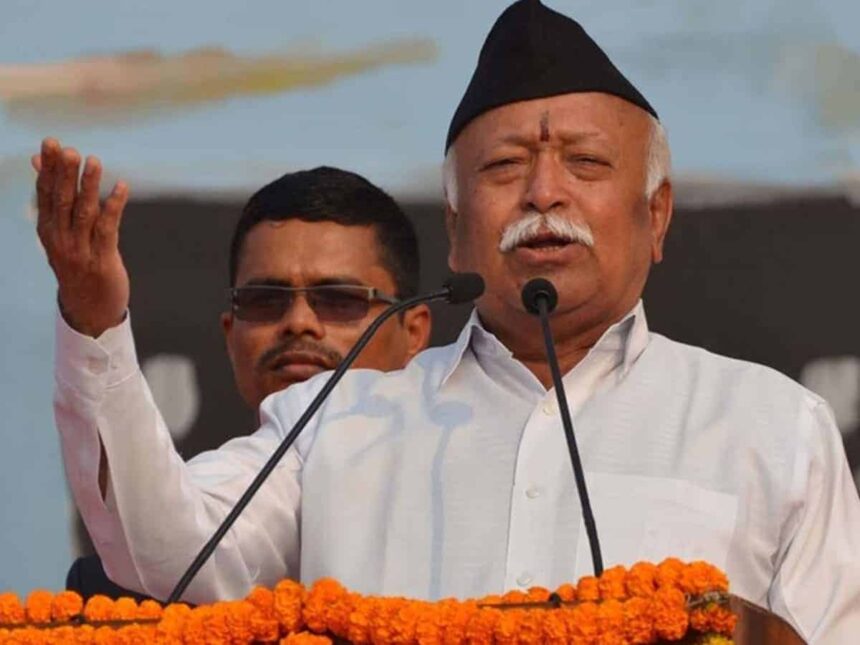
RSS Chief Mohan Bhagwat on Gen Z: In a significant shift in tone, Rashtriya Swayamsevak Sangh (RSS) chief Mohan Bhagwat has presented a more nuanced view of youth protests, describing dissent as a legitimate part of democracy rather than an act of disloyalty. His remarks signal an evolving approach towards India’s younger generation, especially Gen Z and Gen Alpha, who increasingly expect dialogue, participation and transparency from institutions.
For an organisation long associated with discipline, nationalism and social order, Bhagwat’s comments mark an important change in public messaging.
Protest Is Part of Democracy, Says Bhagwat
Addressing young people, Bhagwat emphasised that peaceful protest has a place in a democratic society.
According to him, demonstrations become a constitutional option when dialogue fails. However, he stressed that the objective of any movement should be to build consensus, not deepen divisions.
By making this distinction, Bhagwat attempted to redefine protests as a democratic process aimed at finding solutions rather than creating conflict.
Separating Dissent From Disloyalty
One of the most striking aspects of Bhagwat’s remarks was his effort to separate protest from anti-nationalism.
At a time when student movements and youth-led agitations often become politically polarised, he suggested that young people who participate in protests should not automatically be viewed as acting against the nation.
Instead, he argued that their concerns deserve attention and that meaningful engagement through dialogue is essential.
The message reflects a willingness to acknowledge the frustrations and aspirations of a generation facing rapid social, economic and technological change.
Understanding How Gen Z Thinks
Bhagwat also highlighted the differences between earlier generations and today’s youth.
He observed that previous generations were generally more accepting of the views of elders, whereas Gen Z prefers to question, debate and seek logical explanations before accepting an idea.
Rather than criticising this mindset, he described it as being consistent with India’s long tradition of intellectual debate and discussion, often referred to as shastrarth.
His remarks suggest that questioning authority should be viewed as part of constructive dialogue rather than confrontation.
A Remark That Drew Attention
During the interaction, Bhagwat was asked about allegations relating to police action against protesters, including claims of force being used during demonstrations.
While he declined to comment on specific incidents without complete information, he made a notable observation by saying that if asked to believe one side without evidence, he would place his trust in Gen Z.
The statement was widely interpreted as an expression of empathy towards young citizens while avoiding direct criticism of governments or law enforcement agencies.
A Broader Outreach to Young India
Bhagwat’s comments also reflect a broader strategy as India moves toward the next electoral cycle.
With first-time voters and digitally connected citizens expected to play a major role in shaping the country’s future, the RSS appears to be recognising that traditional top-down communication may no longer be sufficient.
Today’s youth are influenced by social media, evolving career aspirations, competitive examinations, unemployment concerns and rapid access to information. They increasingly expect institutions to engage with them through conversation rather than authority.
By acknowledging these changing expectations, Bhagwat’s message appears aimed at building stronger engagement with younger generations.
Nationalism Through Dialogue, Not Confrontation
Importantly, Bhagwat did not endorse every protest unconditionally.
He reiterated that constitutional methods should always guide public movements and that dialogue should remain the preferred path before any agitation.
However, by recognising that grievances can be genuine and that peaceful protest has democratic legitimacy, he sought to position dissent within the framework of nationalism rather than outside it.
The remarks suggest an attempt to reclaim democratic dialogue as an essential part of nation-building rather than allowing it to become a source of political division.
Why Bhagwat’s Remarks Matter
The RSS has traditionally projected discipline, unity and social cohesion as its core values. Bhagwat’s latest intervention expands that message by placing greater emphasis on listening to young voices.
His comments indicate an understanding that India’s younger generations value participation, transparency and reasoned discussion as much as discipline and patriotism.
Whether this shift in messaging influences political discourse or policymaking remains to be seen. However, Bhagwat’s remarks represent a notable evolution in how one of India’s most influential organisations is choosing to engage with Gen Z.
For many young Indians who often feel misunderstood or labelled for expressing their views, the message was clear: questioning is not disloyalty, peaceful protest has a place in democracy, and meaningful dialogue remains the foundation of a healthy nation.