
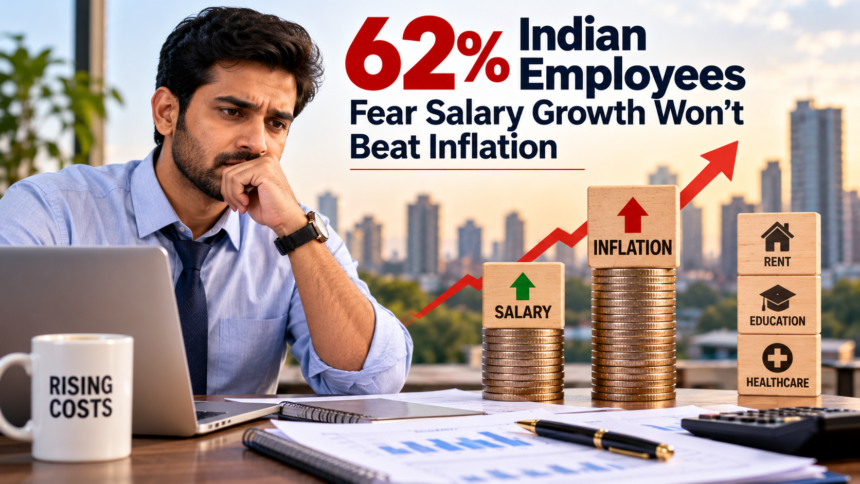
Annual salary increments may increase employees’ bank balances, but many Indian professionals remain concerned about whether their earnings can keep pace with rising living costs. Higher expenses on rent, education and healthcare are putting pressure on household budgets, raising questions about the real value of salary growth.
According to Grant Thornton Bharat’s India’s Financial Resilience Report 2026, 62% of salaried respondents believe their income growth will not be sufficient to match future inflation. The concern is particularly pronounced among younger employees, with 70% of respondents aged 25–34 expressing the same view.
Salary Growth Concerns Across Indian Cities
The report highlights concerns across different city categories. Around 71% of respondents living in Tier 2 cities and 70% in Tier 3 cities said their income growth was unlikely to offset inflation. In Tier 1 cities, approximately 61% shared this concern.
Ramkumar Subramanian, a partner at Grant Thornton Bharat, told NDTV that the gap between wage growth and living expenses is placing considerable pressure on middle-class households.
He explained that although salaries may rise in nominal terms, increasing urban expenses—particularly housing rents, education and healthcare—have reduced purchasing power. As a result, some employees find it difficult to maintain their standard of living despite receiving annual increments.
Most Employees Earn Less Than ₹15 Lakh Annually
The report is based on 528 responses collected between November 2025 and February 2026. Its findings show that a large share of respondents fall into the lower salary brackets.
Around 58% of surveyed employees earn less than ₹15 lakh a year, while 30% report annual earnings between ₹15 lakh and ₹40 lakh. Only 12% earn more than ₹40 lakh annually.
Salary increments also remain relatively modest for many respondents. Approximately 62% said their annual income growth falls between 4% and 12%, while just 6% reported increases exceeding 20%.
The pressure appears greater among younger professionals. According to the report, 77% of respondents under the age of 34 earn less than ₹15 lakh annually, potentially leaving them with limited room to manage rising expenses and build long-term savings.
Emergency Savings May Not Cover a Year Without Income
The survey also points to concerns about financial preparedness during periods of unemployment or other unexpected setbacks.
Around 84% of respondents said they had either full or partial emergency savings. However, 83% reported that their savings would last for less than a year if their income stopped.
These findings suggest that having some emergency funds does not necessarily mean households can manage an extended interruption in earnings. The length of time savings can cover essential expenses remains an important consideration in financial planning.
Retirement Planning Remains a Major Challenge
Preparing for retirement emerged as another significant concern in the report. Approximately 83% of respondents said they were not financially prepared for retirement or had not accumulated sufficient savings for it.
Younger employees reported particularly high levels of concern. Among respondents under 34, 92% said they were not financially ready for retirement. The figure stood at 77% among those aged 35–54.
The findings highlight the financial challenges facing salaried employees, from keeping up with everyday expenses to building emergency reserves and preparing for retirement. The report indicates that concerns about future inflation extend beyond monthly budgets to longer-term financial security.
Disclaimer: This article is based on the findings attributed to Grant Thornton Bharat’s India’s Financial Resilience Report 2026 and is intended for general informational purposes. Survey results reflect the responses collected from the participants and may not represent every salaried employee in India. Readers should consult the original report for further details about the methodology and findings.