
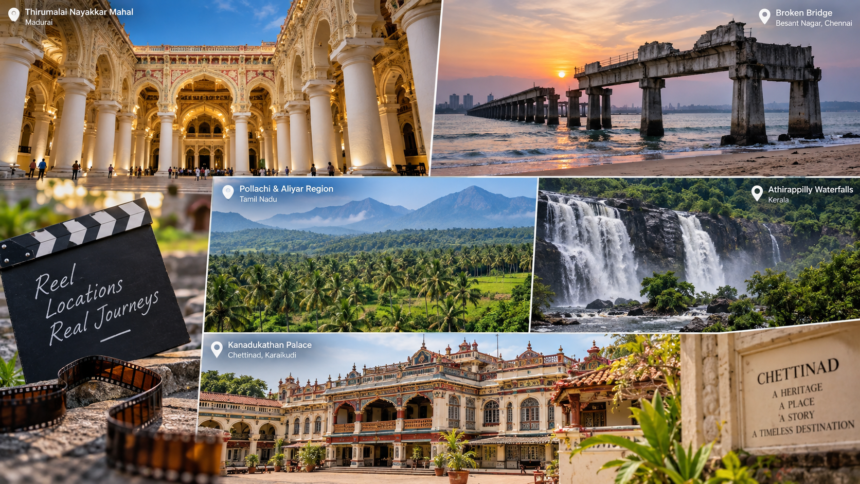
Tamil cinema has often transformed beautiful heritage sites, waterfalls and landscapes into memorable parts of its stories. Over the years, several locations featured in popular Tamil films have attracted visitors who wanted to experience the places they had seen on screen.
From grand palace interiors to scenic waterfalls and coastal landmarks, these five destinations have developed a strong connection with Tamil cinema and continue to attract film enthusiasts and tourists.
1. Thirumalai Nayakkar Mahal, Madurai
The historic Thirumalai Nayakkar Mahal in Madurai has appeared in several well-known films, including Iruvar, Bombay, Guru and Bheema.
One of its most memorable cinematic appearances came in Mani Ratnam’s Bombay, particularly during the song Kannalane. The palace’s enormous pillars and distinctive Indo-Saracenic architecture provided a striking backdrop for the film.
The location is maintained by the Tamil Nadu Archaeology Department and also hosts an evening Light and Sound Show. Its combination of history and cinematic associations continues to make it a popular stop for visitors.
2. Broken Bridge, Besant Nagar, Chennai
Chennai’s Broken Bridge at Besant Nagar is another location that gained attention through Tamil films. Movies such as Aayutha Ezhuthu, Vaali and Chennai 600028 have featured the area.
The bridge became particularly memorable after Mani Ratnam used it for the major climax fight between Madhavan’s Inba and Suriya’s Michael in Aayutha Ezhuthu.
Located near the Adyar estuary, the partially damaged bridge has become closely associated with Chennai’s youth culture, photography and cinema. Public access is now heavily restricted for safety reasons, but the location remains recognizable to movie fans.
3. Pollachi and the Aliyar Region
Pollachi and the surrounding Aliyar region have been among the most frequently used locations for Tamil films, particularly movies requiring rural and village settings.
Films including Kadhalikka Neramillai, Winner, Chinna Thambi, Thevar Magan, Suryavamsam and Amaidhi Padai have been shot in and around the region.
The area’s coconut groves, greenery and rural landscapes made Pollachi a popular choice for filmmakers, especially during the 1990s. The Aliyar Government Guest House and its surroundings have also appeared in films, including Chinna Thambi.
The region continues to have an important connection with Tamil filmmaking and remains a familiar destination for those interested in cinema and countryside landscapes.
4. Athirappilly Waterfalls, Kerala
Athirappilly Waterfalls in Kerala has provided the backdrop for several major Indian films, including Tamil movies such as Punnagai Mannan, Raavanan, Rhythm and Paiyaa. The location was also featured in Baahubali.
The waterfall became especially associated with Punnagai Mannan after Kamal Haasan and Rekha appeared in the film’s memorable cliff-jumping sequence. The location later gained further recognition through songs such as Usure Pogudhey from Raavanan and Nadhiye Nadhiye from Rhythm.
Its dramatic waterfall and surrounding greenery have made Athirappilly a major tourism destination in South India, attracting visitors interested in both nature and cinema.
5. Kanadukathan Palace, Chettinad
The historic palaces of Kanadukathan in the Chettinad region have also featured prominently in Tamil cinema. Movies such as Kandukondain Kandukondain, Saamy, Pirivom Santhippom and Sandakozhi have used locations in the area.
In Kandukondain Kandukondain, director Rajiv Menon presented the traditional palace setting as the home of the families played by Tabu and Aishwarya Rai. The property’s detailed teak woodwork and distinctive Athangudi-style flooring added to the visual character of the film.
Filmmakers have been using these heritage properties since the 1980s, and their architectural appeal continues to attract film productions. The heritage property is controlled by the Chettiar family, while visitors can view the exteriors and take photographs. Paid stays are also available, allowing guests to experience traditional Chettinad hospitality and cuisine.
Together, these locations show how Tamil cinema has helped audiences discover historic buildings, natural landscapes and lesser-known destinations beyond the theatre screen.