
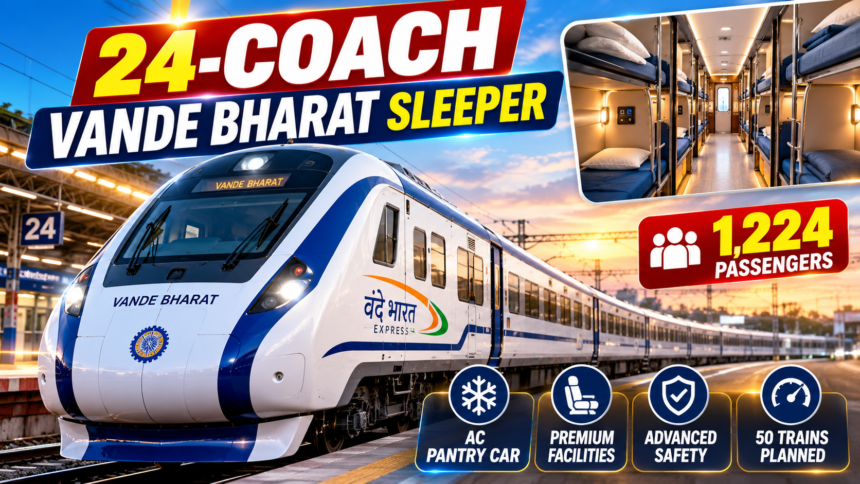
Indian Railways is preparing to develop a larger 24-coach version of the Vande Bharat Sleeper train, expanding on the existing 16-coach design. The proposed model is expected to offer greater passenger capacity, an air-conditioned pantry car and upgraded onboard facilities aimed at improving comfort during long-distance journeys.
The Integral Coach Factory (ICF) in Chennai and BEML in Bengaluru are collaborating on the new train. According to the information provided, the first prototype is expected to be completed by the end of the year. The upgraded train is being designed for busy, long-distance routes and is expected to offer facilities comparable to premium services such as the Rajdhani Express.
24-Coach Vande Bharat Sleeper: Capacity and Coach Configuration
The existing 16-coach Vande Bharat Sleeper configuration accommodates 823 passengers. The proposed 24-coach version is expected to increase capacity to 1,224 passengers, allowing Indian Railways to carry more travellers on heavily used routes.
The new train is planned with the following coach arrangement:
- 17 AC 3-tier coaches
- 5 AC 2-tier coaches
- 1 AC First Class coach
- 1 fully air-conditioned pantry coach
The pantry car is intended to support meal services throughout longer journeys. Each coach is also expected to have a mini-pantry, along with designated areas for storing and distributing linens and towels.
Indian Railways plans to deploy 50 trains of this high-capacity design on some of the country’s busiest and longest routes.
New Features Designed to Improve Passenger Comfort
The proposed 24-coach Vande Bharat Sleeper will include several features intended to make overnight travel more comfortable. Advanced suspension technology is expected to provide a smoother ride by reducing the impact of track vibrations.
The train is also planned to feature sensor-operated sliding doors and intercom facilities. Individual reading and viewing lights, USB charging outlets and personal cushions are among the amenities described for passengers.
First Class AC accommodation is expected to include hot shower facilities. Safety provisions are also planned, including a crash-resistant protective structure, surveillance cameras, fire safety equipment and crash buffers.
With these features, the train is intended to provide a modern travel experience for passengers undertaking journeys of approximately 1,500 to 2,000 kilometres.
When Did India’s First Vande Bharat Sleeper Train Begin Operations?
According to the supplied information, India’s first Vande Bharat Sleeper train began operating on January 17 between Howrah in West Bengal and Kamakhya in Guwahati. The 968-kilometre journey takes approximately 14 hours, compared with around 17 to 18 hours on a typical train service.
Other routes being considered for Vande Bharat Sleeper services include Delhi–Patna, Delhi–Guwahati and Delhi–Varanasi.
The supplied information also lists the following indicative fares:
| Accommodation | Fare |
|---|---|
| AC 3-tier | ₹2,300 |
| AC 2-tier | ₹3,000 |
| AC First Class | ₹3,600 |
These fares should be verified against the applicable train service and official railway fare information.
How Is Vande Bharat Different from Rajdhani Express?
One of the main differences between Vande Bharat and conventional locomotive-hauled trains is its trainset design. Instead of relying on a separate heavy locomotive, Vande Bharat uses a distributed propulsion system, allowing it to accelerate more quickly.
The train also incorporates modern passenger facilities, including automatic doors, vacuum toilets and cushioned seating, depending on the train variant. These features are intended to improve convenience and reduce travel time on suitable routes.
The first semi-high-speed Vande Bharat train was launched on February 15, 2019, when Prime Minister Narendra Modi flagged off the New Delhi–Varanasi service. The supplied information states that 79 Vande Bharat trains are operating across the country, including chair-car and sleeper variants.
The planned 24-coach sleeper model represents a further expansion of the service, with increased capacity and additional facilities designed for long-distance overnight travel.
Disclaimer: This article is intended for general informational purposes only. Details regarding the 24-coach train, prototype timeline, planned routes, passenger capacity, facilities and fares are based on the information provided and may change as the project develops. Readers should check official Indian Railways announcements for the latest confirmed specifications, operational dates, routes and ticket prices.