
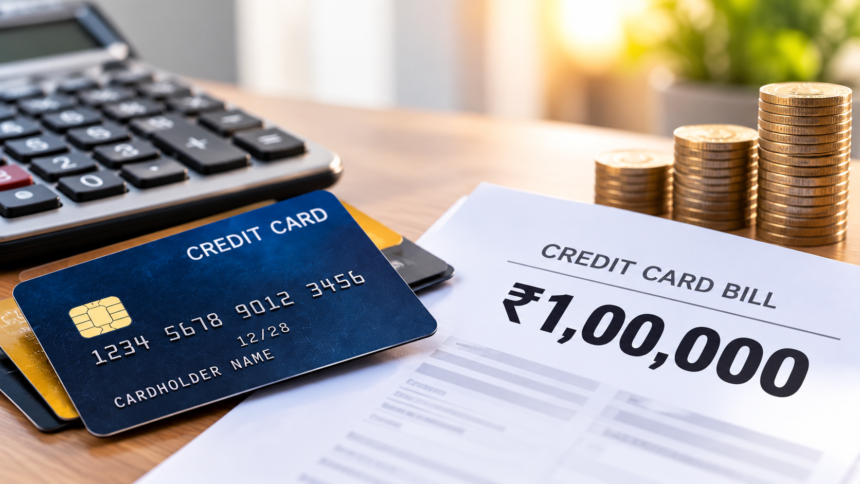
A ₹1 lakh credit-card bill can become difficult to manage if the entire amount cannot be paid by the due date. Converting the outstanding balance into an EMI may make repayment easier, but a smaller monthly instalment does not automatically mean that the borrowing will cost less.
Before choosing an EMI option, consumers should look at the total amount they will repay, along with interest, processing fees, GST and any applicable pre-closure charges.
₹1 Lakh Bill: Revolving Credit vs 9-Month EMI
If a ₹1 lakh balance is carried as revolving credit at a finance charge of 3.75% per month, the finance charge in the first month could be around ₹3,750. The actual amount will depend on the card issuer’s terms and applicable taxes.
A nine-month EMI at 1.75% per month on a reducing balance would result in an estimated monthly instalment of around ₹12,106. The total repayment would be approximately ₹1.09 lakh, before processing fees and applicable taxes.
| Particulars | Revolving Credit | 9-Month EMI |
|---|---|---|
| Outstanding amount | ₹1,00,000 | ₹1,00,000 |
| Monthly rate | 3.75% | 1.75% |
| Repayment period | Varies | 9 months |
| First-month interest / EMI | ~₹3,750 | ~₹12,106 |
| Total repayment | Depends on repayment | ~₹1.09 lakh* |
| Processing fee | As per card issuer | Additional |
| GST / taxes | As applicable | Additional |
| Pre-closure charges | As applicable | As applicable |
*The EMI figure and total repayment are illustrative and can vary according to the card issuer’s terms. Processing fees and applicable taxes are not included.
Don’t Judge an EMI Only by the Monthly Rate
Consumers should avoid comparing credit options solely on the basis of the monthly interest rate. Kumar Binit, CEO of airpay money, said borrowers should first check whether the quoted rate is calculated on a reducing balance and then consider the overall annualised cost.
The total expense should include the principal, interest, processing charges, GST and other applicable fees. Pre-closure conditions also need to be checked, as a longer repayment period can reduce the monthly instalment but increase the overall amount paid.
Before converting a credit-card balance into EMI, consumers should therefore check six important factors: interest rate, processing fee, GST, tenure, pre-closure or foreclosure charges and the total repayment amount. It is also important to check whether the EMI will block part of the available credit limit.
Partial Payment Can Reduce the Interest Burden
Paying part of the credit-card bill upfront can reduce the amount that needs to be converted into an EMI. For example, if ₹40,000 is paid immediately from a ₹1 lakh bill, only ₹60,000 needs to be converted into EMI.
| Scenario | Amount Converted to EMI | Upfront Payment |
|---|---|---|
| Full bill converted | ₹1,00,000 | Nil |
| Partial payment | ₹60,000 | ₹40,000 |
With a smaller principal amount, the interest burden can also come down, assuming the same interest rate and repayment period.
Ankita Patel, CFP and Founder of Wealtheria, said reducing the amount converted into EMI can make a noticeable difference to the overall borrowing cost.
She also said a credit-card EMI may be suitable for a one-time planned expense when the borrower has sufficient income to repay the debt within six to 12 months. However, repeatedly converting bills into EMIs while continuing to make fresh purchases can simply delay the underlying debt problem.
For example, on a ₹1 lakh bill converted at 16% annually for 12 months, with a 1.5% processing fee and applicable GST, the total cost is estimated at around ₹12,245. If ₹40,000 is paid upfront and only ₹60,000 is converted into EMI, the cost could fall to approximately ₹7,347 — a difference of nearly ₹4,900.
Credit Card EMI vs Personal Loan
Before selecting a credit-card EMI or personal loan, borrowers should compare the effective annual borrowing cost rather than focusing only on the advertised or quoted rate.
Processing fees, GST, prepayment or foreclosure charges, repayment tenure and the total amount payable should all be considered. Consumers should also check the applicable GST on credit-card EMI interest and whether the EMI reduces their available credit limit.
The key is to choose borrowing based on the total cost and repayment ability, rather than simply selecting the option with the smallest monthly instalment.
Disclaimer: This article is intended for general financial information only and should not be considered investment, credit or financial advice. Interest rates, fees, taxes, EMI calculations and repayment conditions can vary between lenders and card issuers. Consumers should check the latest terms and conditions with their financial institution before making a borrowing decision.