
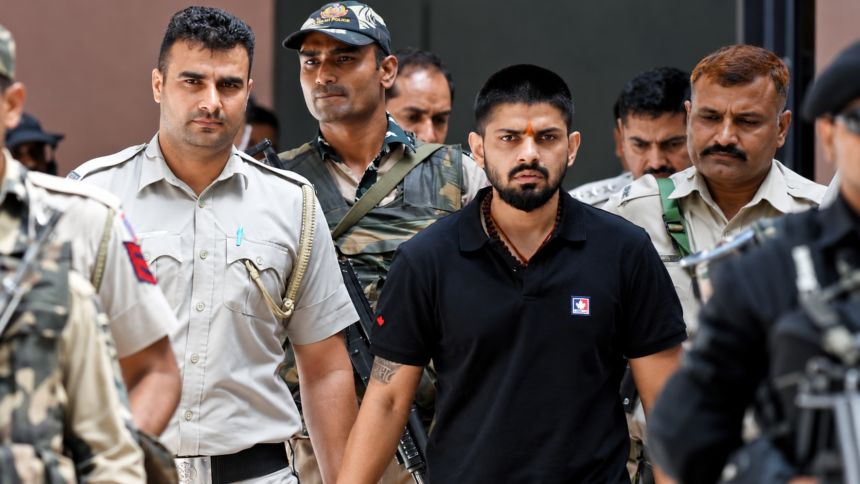
Mumbai Police have been unable to take gangster Lawrence Bishnoi into custody for questioning in several high-profile criminal investigations allegedly linked to his gang, including the firing incident involving actor Tiger Shroff’s car on October 18. A Union Home Ministry order restricting his transfer from Gujarat’s Sabarmati Jail has prevented investigating agencies from bringing him out of prison for interrogation.
The restriction was initially imposed in August 2023 under Section 268 of the Criminal Procedure Code (CrPC). It has since been renewed under Section 303 of the Bharatiya Nagarik Suraksha Sanhita (BNSS). The order cites concerns about public order and the possibility of violence during his transportation.
As a result, agencies seeking to question Bishnoi must follow the permitted legal procedures, which include interrogation through video conferencing or within the jail premises, subject to the relevant court’s directions.
What Is Lawrence Bishnoi’s Alleged Connection to the Tiger Shroff Firing Case?
On Sunday, October 18, three assailants allegedly opened fire at actor Tiger Shroff’s car in Mumbai’s Juhu area. The Lawrence Bishnoi gang reportedly claimed responsibility for the attack in a social media post, citing Shroff’s alleged connections with actor Salman Khan.
On Monday, police arrested three suspects at Rajasthan’s Kota railway station. Investigators reportedly linked them to gangster Anil Pandit, who is alleged to be associated with Bishnoi. The suspects were reportedly planning to escape to Nepal.
Pandit, who is reportedly based in the United States, also issued a voice note claiming responsibility for the attack.
The incident has brought renewed attention to the restrictions that prevent Mumbai Police from directly taking Bishnoi into custody for questioning as part of the investigation.
Why Is Lawrence Bishnoi Being Held in Sabarmati Jail?
Bishnoi has been lodged at Sabarmati Jail in Ahmedabad since 2023 while facing investigations and criminal cases across several jurisdictions, including Punjab, Rajasthan and Maharashtra.
Mumbai Police began focusing particularly on his alleged gang connections following the April 2024 firing outside Salman Khan’s Galaxy Apartments residence in Bandra. Investigators alleged that members of Bishnoi’s gang were involved in a conspiracy to kill the actor.
In October 2024, Bishnoi was also named as an accused in the murder of Nationalist Congress Party (NCP) leader Baba Siddique in Bandra. Subsequently, filmmaker Rohit Shetty received an extortion threat allegedly linked to the gang.
Despite these developments, Mumbai Police have been unable to secure Bishnoi’s custody for interrogation in the cases.
Can Mumbai Police Question Bishnoi Inside Jail?
Under the existing restrictions, Mumbai Police and other investigating agencies cannot bring Bishnoi out of Sabarmati Jail for questioning through standard production warrants. Instead, investigators must seek the necessary judicial permission to question him through video conferencing or inside the prison.
Police officers have maintained that custodial interrogation can be important in organised crime investigations. It may help establish the alleged roles of different conspirators, trace financial transactions, identify weapons and uncover wider criminal networks.
Without direct access to Bishnoi in police custody, investigators have largely concentrated on questioning and investigating alleged shooters, financial intermediaries and individuals suspected of arranging weapons.
What Has the Maharashtra Government Said?
The firing incident has prompted political reactions in Maharashtra. The BJP-Shiv Sena-NCP government has stated that those responsible for the attack will not be spared.
Maharashtra Congress president Harshwardhan Sapkal has urged Chief Minister Devendra Fadnavis to seek the withdrawal of the protection granted to Bishnoi under the BNSS.
The controversy has renewed debate over how authorities should balance prison security and public order with the investigative requirements of state police forces. The issue is particularly significant in cases involving alleged criminal networks that operate across state and national borders.