
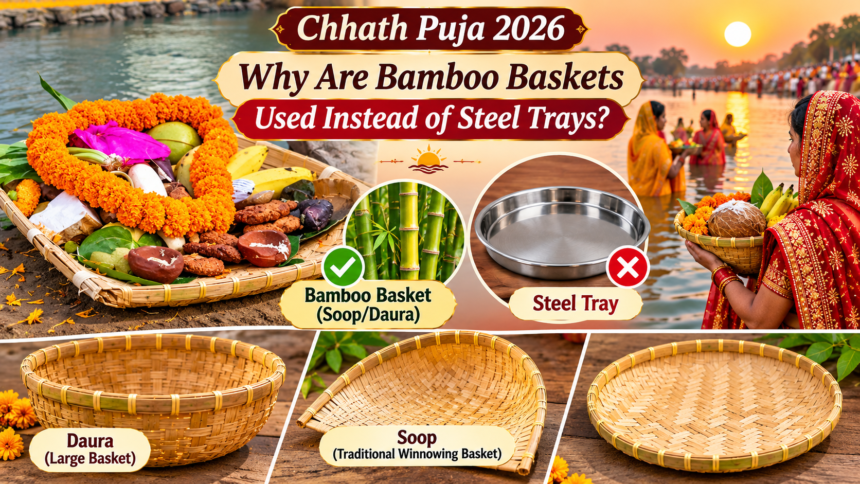
Chhath Puja 2026 has begun, bringing devotees together to worship the Sun God and Chhathi Maiya. Celebrated with great devotion, the festival involves several traditional rituals and offerings that hold deep cultural and religious significance.
One interesting aspect of Chhath Puja is the use of traditional bamboo baskets instead of steel trays to carry offerings. While these baskets are an essential part of the celebrations, their use is connected to religious beliefs, cultural traditions and respect for nature. Here is a closer look at why bamboo baskets are preferred during Chhath Puja and the significance of the four-day festival.
Why Are Bamboo Baskets Used Instead of Steel Trays During Chhath Puja?
Bamboo baskets, commonly known as soops and dauras, play an important role in Chhath Puja rituals. According to traditional beliefs, bamboo represents continuous growth, prosperity and the expansion of family lineage. Its use during the festival symbolises prayers for the well-being, good health and long life of family members.
Steel, on the other hand, is an alloy primarily made from iron. In certain traditional astrological beliefs, iron is associated with planets such as Saturn (Shani) and Rahu. This is one of the reasons bamboo is preferred over metal utensils for carrying religious offerings.
Apart from its religious significance, bamboo is also considered an environmentally friendly material. It is biodegradable and sustainable, making it a natural choice for a festival that celebrates the connection between human life and nature.
Bamboo soops and large dauras are also practical for carrying traditional Chhath offerings, including coconuts, bananas, sugarcane and thekua. Devotees transport these baskets to riverbanks and ghats, often carrying them on their heads or in their hands as part of the traditional rituals.
Why Is Chhath Puja Celebrated?
Chhath Puja is primarily dedicated to Surya Dev, the Sun God, who is worshipped as the source of energy and life on Earth. Since sunlight is essential for the survival of all living beings, devotees express their gratitude to the Sun God through prayers and offerings.
Chhathi Maiya is also worshipped during the festival. According to religious beliefs and Vedic astrology, she protects children from illnesses and blesses them with good health and a long life. Parents observe the rituals with devotion while praying for the happiness, safety and prosperity of their families.
The festival continues for four days, beginning on Kartik Shukla Chaturthi and concluding on Kartik Shukla Saptami. Each day has its own rituals and religious importance.
Four Days of Chhath Puja and Their Rituals
Day 1: Nahay Khay
The festival begins with Nahay Khay, during which devotees, particularly the parvaitin (the person observing the fast), take a holy bath and prepare for the upcoming rituals. The house, surrounding areas and pathways leading to the riverbank or ghat are thoroughly cleaned. Special attention is given to maintaining cleanliness and purity throughout the household.
Day 2: Kharna or Lohanda
The second day is observed as Kharna, also known as Lohanda. Devotees observe a strict fast throughout the day without consuming food or even drinking water. In the evening, the fast is broken after offering prayers and preparing traditional gur ki kheer (jaggery-based rice pudding) as prasad.
Day 3: Sandhya Arghya
The third day is dedicated to Sandhya Arghya, when devotees prepare traditional offerings at home while maintaining the purity of the food. In the evening, they gather at riverbanks, ponds or other water bodies to offer arghya to the setting Sun. This ritual is one of the most important parts of Chhath Puja.
Day 4: Usha Arghya
The final day is known as Usha Arghya. Devotees visit the riverbank early in the morning to offer prayers and arghya to the rising Sun. After completing the ritual, they seek the blessings of Chhathi Maiya for their children’s protection, good health and long life, along with happiness, peace and prosperity for the entire family.
Conclusion
Chhath Puja is a festival that combines religious devotion, family traditions and respect for nature. The use of bamboo baskets instead of steel trays reflects traditional beliefs about prosperity, family well-being and the importance of natural materials.
From Nahay Khay to Usha Arghya, every ritual carries a special meaning and strengthens the cultural significance of this four-day celebration dedicated to the Sun God and Chhathi Maiya.