
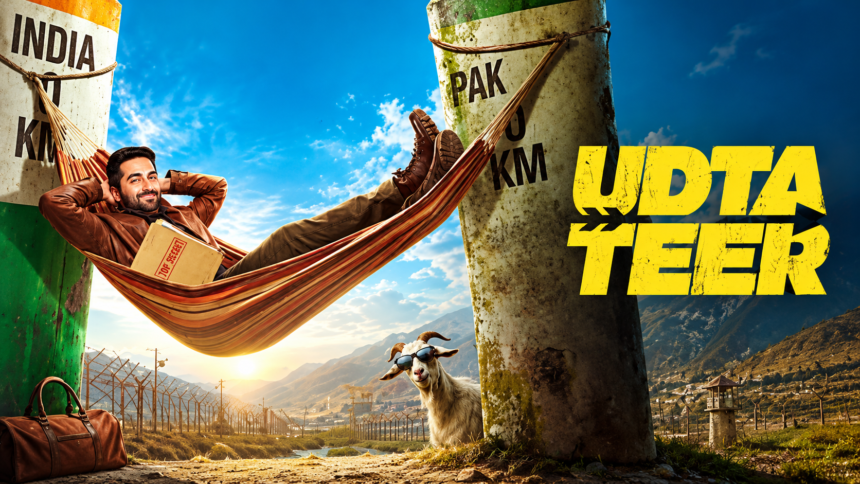
Udta Teer, starring Ayushmann Khurrana and Sara Ali Khan, brings a refreshing mix of espionage, situational humour and political satire to the screen. Marking the feature directorial debut of screenwriter Akash Kaushik, the film delivers several genuine laughs without depending heavily on double-meaning dialogues or cheap innuendos.
Described as a reverse version of Ranveer Singh and Aditya Dhar’s blockbuster espionage film Dhurandhar, the story revolves around Bilal, also known as Vikrant, played by Ayushmann Khurrana. He is a Pakistani spy operating within India’s counter-terrorism unit. However, an unexpected accident causes him to lose his memory, leading him to switch sides unknowingly and begin dismantling Pakistan’s terror network from within.
Udta Teer Review: A Strong First Half Packed With Humour
Akash Kaushik makes a confident directorial debut, particularly in the film’s first half. The screenplay moves at a brisk pace, supported by sharp punchlines, amusing situations and clever political commentary.
Rather than relying on excessive patriotic drama, Udta Teer uses humour and self-awareness to explore its espionage premise. Its ability to find comedy in unexpected situations gives the film a distinctive identity and explains why it is being compared to Dhurandhar in reverse.
The first half establishes an engaging rhythm, with the writing doing much of the heavy lifting. The comedy feels natural for the most part, making the film an enjoyable watch during its stronger stretches.
Ayushmann Khurrana, Sara Ali Khan and Supporting Cast Deliver
Ayushmann Khurrana is well suited to the role of Bilal/Vikrant. He effectively portrays a spy struggling with memory loss, balancing his character’s confusion with understated humour. His deadpan delivery adds to several of the film’s funniest moments.
Sara Ali Khan plays Yamini, Bilal’s wife, and makes a positive impression. However, her character could have benefited from greater depth and a more developed storyline.
The supporting cast is one of the film’s biggest strengths. The late Mukul Dev, who plays Pakistani terrorist Azhar Maqsood, delivers a particularly memorable performance. His effortless screen presence adds considerable weight to the film, making his contribution stand out among the ensemble.
Gulshan Grover is entertaining as General Mir, the Pakistan Army chief who bows before the Chinese President. Rahul Bose and Brijendra Kala add to the bureaucratic and military confusion through their quirky characters, while Ram Kapoor contributes to the situational comedy.
Sandeep Anand, playing Bilal’s cook, and Suhail Nayyar, who portrays Bilal’s best friend, perform their roles effectively. Veteran actor Raghubir Yadav also adds to the ensemble.
Udta Teer Music: Suitable for the Story but Not Memorable
Composed by Sachin-Jigar with lyrics by Amitabh Bhattacharya, the film’s soundtrack complements its mix of comedy, action and patriotism. However, the songs do not leave a particularly lasting impression.
The title track, Udta Teer, sung by Raghav Chaitanya and Simran Choudhary, combines electronic dance music with Punjabi folk influences. Choozay, featuring vocals by Jigar Saraiya and Emiway Bantai, brings high energy to the album.
Arijit Singh’s Chann offers a more emotional and melodic contrast to the film’s fast-paced comedy. Meanwhile, Bhootni Ka, sung by Kaka, Twinkle Aggarwal and Amitabh Bhattacharya, features heavy beats and playful lyrics.
The album also includes Jai Hind, performed by Siddharth Mahadevan and Shivam Mahadevan, which takes a patriotic approach with a rock-inspired sound. Although the tracks fit the film’s requirements, the music does little to elevate the overall experience.
Udta Teer Verdict: An Enjoyable Comedy Despite a Slower Second Half
The film’s biggest challenge is maintaining the momentum established in its first half. As the story progresses, the second half adopts a more serious tone to resolve its remaining plot points. This shift reduces the comic energy that initially makes the film so engaging.
The inclusion of romantic and patriotic songs at certain points also affects the pacing, making parts of the narrative feel slower than necessary.
Despite these shortcomings, Udta Teer remains an entertaining spy comedy with a clever premise, strong performances and moments of genuinely funny writing. Although it loses some of its initial spark toward the conclusion, the film demonstrates how effective sharp humour and thoughtful satire can be when supported by a well-cast ensemble.
Final Verdict: Udta Teer is a worthwhile watch for viewers who enjoy espionage stories with a comedic twist. Its uneven second half prevents it from fully capitalising on its promising start, but the film leaves enough of an impression to make audiences hope for a potential franchise.