
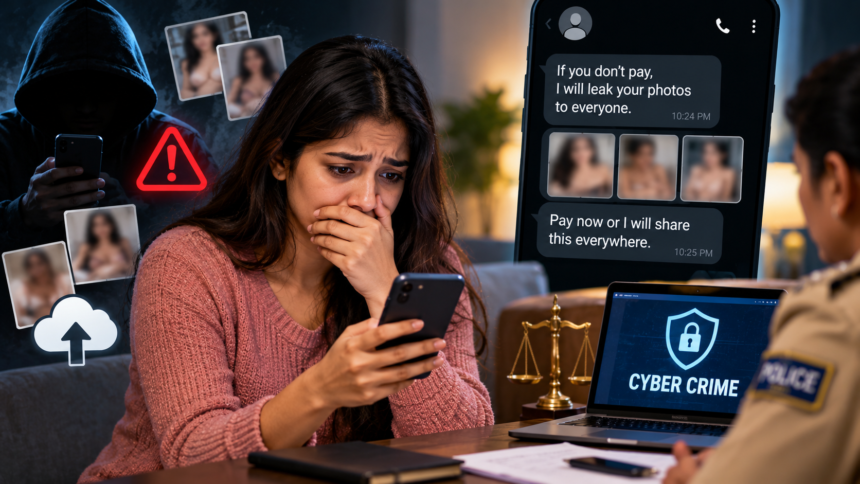
Receiving a threat that someone will share your private photographs or videos without permission can be an extremely distressing experience. However, it is important to remember that you are not powerless. Such threats are commonly associated with sextortion, a form of online blackmail in which criminals try to exploit fear, embarrassment and emotional distress to demand money, additional photographs or other forms of cooperation.
Blackmailers often rely on victims feeling isolated and afraid to seek help. However, taking the right steps at the earliest stage can help protect your privacy, preserve important digital evidence and reduce the risk of intimate content being circulated online. Here is what you should do if someone threatens to expose your private images or videos.
1. Immediate Steps: What Not to Do When Someone Threatens You
Your first reaction to an online blackmail threat can make a difference. Avoid responding emotionally or taking actions that could give the perpetrator more control over the situation.
Do not pay the blackmailer: Sending money does not guarantee that the person will delete your photographs or stop threatening you. Instead, payment may encourage further financial demands.
Avoid pleading or arguing: Do not send emotional voice messages, apologies or threatening replies. Avoid getting involved in lengthy conversations that could give the blackmailer more opportunities to manipulate you.
Never share additional photographs or videos: Criminals may claim that they will delete the existing material if you send another photograph or video. Such promises should not be trusted, as additional content can become another tool for blackmail.
Do not immediately delete conversations: Your chats, messages and other digital records may serve as important evidence during a police investigation. Preserve them before blocking or reporting the account.
2. How to Preserve Digital Evidence Before Blocking the Blackmailer
Collecting and securely storing evidence is an important step when dealing with sextortion. Before ending communication with the person, preserve as much relevant information as possible.
Start by taking full-screen screenshots of the threatening messages. Make sure the captures include the person’s profile name, username, user ID, profile link, phone number and timestamps wherever available.
If the threats were made through messaging platforms such as WhatsApp or Telegram, consider exporting the complete chat history along with relevant media files. Store these records securely on an external drive or in protected cloud storage.
You should also save any financial details shared by the blackmailer. These may include UPI IDs, bank account numbers, cryptocurrency wallet addresses and contact numbers.
Keep the original files unchanged wherever possible so that their available metadata and other digital details remain intact. Once the necessary evidence has been secured, you can block and report the account through the relevant platform.
3. How to Prevent Private Images From Spreading Online
Certain online tools can help adults and minors prevent intimate images from being shared across participating digital platforms. These services use digital fingerprinting, also known as hashing, to identify matching images without requiring users to upload the original photographs.
Two important services are available for this purpose:
StopNCII (for adults aged 18 and above): StopNCII is a service supported by participating technology companies, including Meta, TikTok and Reddit. It creates a unique digital hash of an intimate image directly on the user’s device. The hash, rather than the original photograph, is shared with participating platforms to help identify and prevent the circulation of matching content.
Take It Down (for individuals under 18): Developed by the National Center for Missing and Exploited Children (NCMEC), Take It Down uses a similar hashing process to help prevent the online distribution of child sexual abuse material (CSAM).
These services can provide an additional layer of protection, although their effectiveness depends on participating platforms and their ability to identify matching content.
4. How to Report Sextortion to the Cyber Cell and Police in India
Reporting online blackmail to the appropriate authorities is an important step towards addressing the threat and initiating legal action.
Victims in India can contact the National Cyber Crime Helpline at 1930 to report cyber financial fraud and seek assistance. If money has been transferred, reporting the incident promptly can help authorities take steps to trace the transaction and potentially prevent further financial loss.
You can also register a complaint through the National Cyber Crime Reporting Portal. Depending on the nature of the incident, complaints can be submitted under the ‘Women/Child Related Crime’ or ‘Other Cyber Crimes’ categories.
Another option is to approach the cyber cell or your local police station with a written complaint. Carry copies of relevant chat messages, screenshots, transaction records and information about the suspected account.
Depending on the circumstances, the following legal provisions may be relevant:
- Section 66E of the Information Technology Act, 2000: Deals with the violation of privacy through capturing, publishing or transmitting images of a person’s private areas without consent.
- Sections 67 and 67A of the Information Technology Act, 2000: Deal with publishing or transmitting obscene material and sexually explicit material in electronic form, respectively.
- Bharatiya Nyaya Sanhita (BNS): Relevant provisions concerning criminal intimidation and extortion may apply depending on the nature of the threats and demands.
Victims should provide accurate details of the incident when filing a complaint. The appropriate legal provisions will depend on the specific facts and evidence.
5. AI Deepfakes and Morphed Images: What If the Photos Are Fake?
Online blackmail has also become a concern with the misuse of artificial intelligence. Criminals may take ordinary photographs from social media accounts and manipulate them using AI-based nudification tools to create fake explicit images.
Even when the photographs are not genuine, such threats can cause serious distress and damage a person’s privacy and reputation.
If you become a victim of this type of harassment, clearly mention in your police complaint that the images are fabricated, morphed or AI-generated. This distinction is important when authorities examine the evidence.
You can also report the content directly to the platform where it has been shared. Use the available reporting options for non-consensual intimate imagery or synthetic sexual content and provide the relevant links and supporting information.
Creating, sharing or possessing certain forms of non-consensual intimate deepfake content may also attract legal consequences, depending on the circumstances and applicable laws.
Being threatened with the release of private photographs or videos can be frightening, but victims should not feel pressured to pay or remain silent. Preserving evidence, reporting the incident and using available image-protection services are important steps towards protecting personal privacy and seeking legal assistance.