
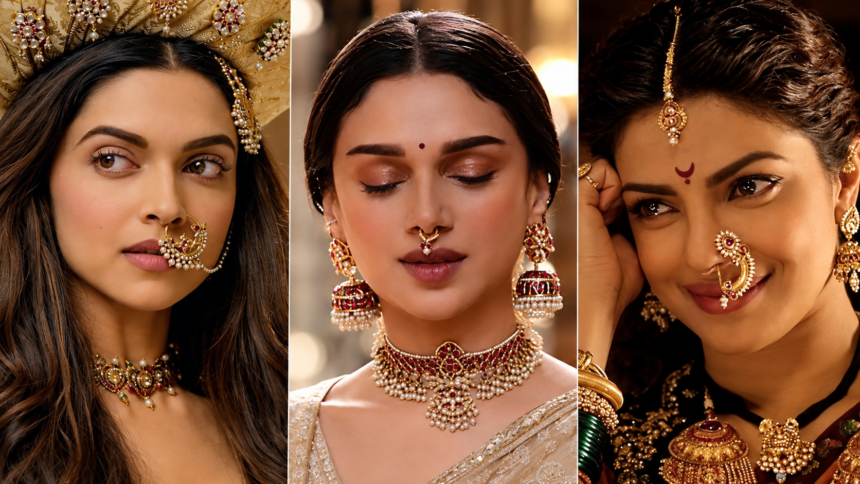
In India, a nose ring is far more than a piece of jewellery. Across different regions, its design and style are closely connected with local traditions, customs and cultural identity. From the elaborate Pahadi Nathuli associated with Himachal Pradesh and Uttarakhand to the pearl-adorned Maharashtrian Nath, the ornament takes on a distinct form and meaning across the country.
Pahadi Nathuli: A Traditional Himalayan Ornament
The term Pahadi Nath broadly includes the traditional nose rings worn in Uttarakhand and Himachal Pradesh. While the two styles share similarities, they also have distinct features.
The Uttarakhandi Nathuli is typically large and circular, with some designs extending across a significant part of the cheek. It can feature colourful Meenakari work in shades of red, green and blue, along with rows of pearls and gold beads around the outer ring. The Nathuli is traditionally gifted to a bride by her maternal uncle.
The Himachali Nath has a similar appearance but differs in shape and detailing. It is generally smaller and often designed in a crescent form rather than the perfectly circular shape associated with the Uttarakhandi version. Floral motifs and bird-inspired patterns are also common. Bollywood actress Yami Gautam highlighted her Himachali heritage at her wedding by wearing a traditional nath with her bridal outfit.
Rajputana Nathuri: Rajasthan’s Royal Nose Ring
The Rajputana Nathuri, also known as Rajputi Nath or Rajasthani Nath, is one of the traditional nose rings associated with Rajasthan. It has an important place in bridal jewellery and is linked with marital traditions.
The elaborate ornament is often decorated with Kundan stones, Meenakari work, pearls and rubies. Peacock and floral motifs are also incorporated into its designs. The distinctive Rajputana nath has appeared in Bollywood films, particularly in period dramas such as Padmaavat and Jodhaa Akbar.
Maharashtrian Nath and Its Distinct Styles
The Maharashtrian Nath has a distinctive appearance that separates it from many other traditional Indian nose rings. Generally smaller in size, it often has a crescent or oval shape and is decorated with pearls and precious stones.
There are several varieties of Maharashtrian Nath, including Peshwai Nath, Banu Nath, Gondhal Nath and Moti Nath.
The Peshwai Nath is associated with Marathi culture and dates back to the Peshwa era. It features strands of silver beads combined with colourful glass beads and gemstones.
Gondhal Nath takes inspiration from Gondhal traditions and incorporates coloured glass, silver beads and precious stones arranged in religious motifs. Moti Nath is known for floral and geometric designs and features small white motis and pearls. Banu Nath resembles the Peshwai Nath but offers a comparatively more subtle and smaller design.
South Indian Mookuthi: Simple and Elegant
The Mookuthi is a traditional South Indian nose pin or stud, commonly worn on the right nostril. Unlike the larger nose rings and chains often associated with North Indian bridal jewellery, the Mookuthi has a much more understated appearance.
It is traditionally worn in states including Tamil Nadu, Kerala and Karnataka and is often gifted to young girls. Mookuthi designs vary widely, with gold being a common choice of material. Some pieces are also decorated with precious stones such as diamonds and rubies.
Bengali Nath: A Classic Bridal Tradition
The Bengali Nath is a traditional gold nose ring that forms part of the classic bridal look in Bengal. Usually crafted from yellow gold, it features a circular design that may include floral or geometric motifs and delicate filigree work.
Some designs are embellished with small seed pearls, Kundan details or tiny hanging latkans attached to a fine chain, adding to the ornament’s traditional appearance.
Despite changing jewellery trends, the Nath continues to hold a place in Indian fashion and tradition. Across regions, its different shapes, materials and designs reflect the country’s diverse cultural heritage, making the nose ring not just an ornament but also an expression of identity and tradition.