
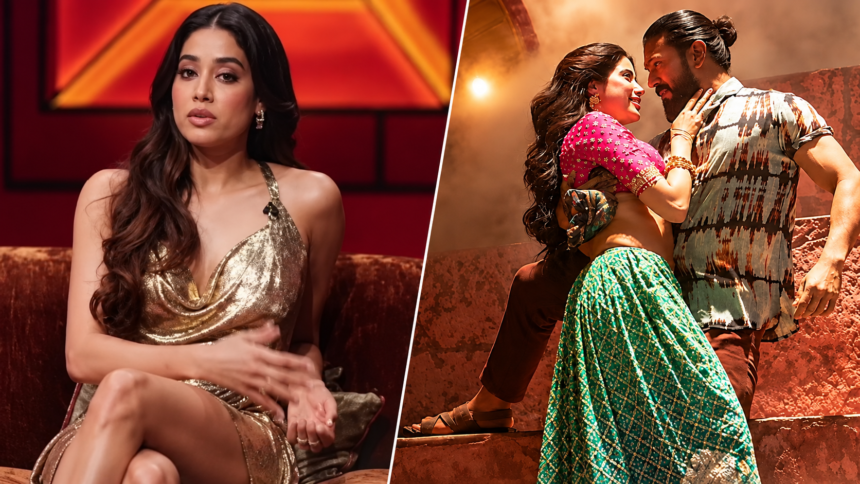
Actor Janhvi Kapoor has acknowledged that she could have taken a stronger stand against the portrayal of her character in Peddi, following criticism that the film objectified women. Speaking about the controversy, the actress accepted responsibility for her role in the situation and said she would make sure similar concerns are addressed in the future.
Janhvi discussed the issue during an appearance on Koffee With Karan Season 9, where she shared the screen with actor Varun Dhawan. Host Karan Johar asked her about the backlash surrounding her character, Achiyamma, in the sports drama directed by Buchi Babu Sana and featuring Ram Charan.
Janhvi Kapoor Reflects on the Criticism Around Peddi
Addressing the controversy, Janhvi said the potential social impact of the film’s portrayal continued to trouble her. She acknowledged that the depiction of her character had raised valid concerns and admitted that she could have been more alert to the way certain scenes were presented.
“It weighs heavily on my conscience the sort of negative impact a narrative like that can have on our society. Specific to my gender. That shame I will always carry with me. Could I have done more? Could I have been more vigilant? 100% yes. Was it problematic, was it extreme objectification? Did it even propagate sexual assault narratively? Yes. But the only thing I can do is ensure that it doesn’t happen again,” she said.
Her remarks reflected her recognition of the criticism surrounding Achiyamma’s portrayal and her commitment to preventing similar concerns from arising in her future projects.
Actress Explains Challenges of Working Without a Bound Script
Janhvi also spoke about the challenges actors can face when navigating creative decisions during a film’s production. She explained that performers do not always receive a complete, detailed script in advance, including information about camera angles and how particular scenes will be filmed.
She said she had tried to address problematic elements as more details became available to her, while also acknowledging the influence a director has over the filmmaking process.
“And yaa I don’t like saying this because it sounds like i am shifting blame but its like you listen to the director and what he says. I was navigating how to make things less problematic as and when information was becoming available to me because you know this, I can just say that very rarely is there a bound script. And very rarely in those scripts do you see where the camera angles are. In the south, very rarely there is a bound script. very rarely do u see where the camera angles are,” she added.
However, Janhvi made it clear that these challenges did not remove her own responsibility. She said she should have used her position in the industry more effectively to voice her concerns.
“But having said that, I need to also take responsibility for my half of it. I do come from a place of privilege. I should have taken advantage of that because I’m going to get the sh** for being privileged anyway. So I might as well have leveraged it.”
Peddi Controversy and Director’s Response
The controversy surrounding Peddi began after viewers criticised the presentation of Achiyamma, arguing that the character’s sexuality received excessive attention. Some scenes also drew criticism over concerns that their narrative treatment could be interpreted as promoting or normalising sexual assault.
Following the backlash, director Buchi Babu Sana issued a public apology, stating that the team had no intention of disrespecting or objectifying women. Scenes that attracted criticism were subsequently removed or edited for the film’s theatrical version.
Janhvi’s latest comments have brought renewed attention to the debate over the portrayal of women in cinema. Her statement also highlights her acknowledgment that she could have raised concerns more firmly and used her position to push for changes during the filmmaking process.