
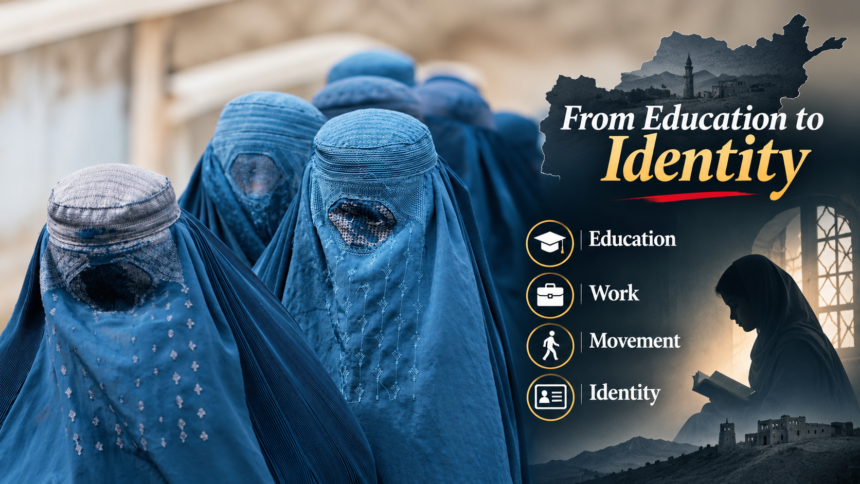
Five years ago, many young girls in Afghanistan hoped to become doctors, teachers, journalists and professionals. Today, those ambitions have become increasingly difficult to achieve as restrictions continue to limit women’s opportunities and freedoms.
Since 2021, Afghan women have experienced a significant decline in their basic rights. Through a series of bans, regulations and restrictions, their access to education, employment, freedom of movement and personal identity has been progressively reduced. What was once a normal part of everyday life has become increasingly difficult for millions of women and girls across the country.
Education: A Future Taken Away
Access to education has become one of the biggest challenges for girls in Afghanistan. Following the developments in 2021, secondary schools for girls were closed, and restrictions were subsequently extended to universities.
Several private educational courses and vocational training centres also faced restrictions, further reducing opportunities for women to continue their studies or develop professional skills.
For countless Afghan girls, pursuing higher education or choosing a career has become an uncertain future rather than an achievable ambition.
Employment and Freedom of Movement
Before these restrictions, Afghan women were employed in several important professions, including medicine, teaching, journalism, law and government services. However, their participation in the workforce has been severely affected.
Women are now prohibited from working in most government offices, non-governmental organisations (NGOs) and many private-sector positions. Those who are still permitted to work must also navigate strict dress requirements, male guardian regulations and travel restrictions.
Their freedom of movement has also been significantly restricted. Women face limitations on travelling independently, visiting public parks and even going outside for a walk without a male guardian. These restrictions have made everyday activities increasingly difficult and limited women’s ability to participate in public life.
Identity: Even Their Names Under Threat
Among the reported restrictions, one particularly concerning development involves women’s right to be identified by their own names.
According to reports, authorities in Balkh province in northern Afghanistan have issued a decree prohibiting women’s names from being recorded on official documents. The restriction reportedly applies particularly to medical records, requiring hospitals, doctors’ offices and clinics to identify every female patient using the nickname “Bibi”.
Traditionally, the word “Bibi” is used as a respectful form of address and can mean “granny” or “older woman”. However, activists argue that this measure is not simply a matter of respect. It raises serious concerns about women’s personal identity and their recognition as individuals.
The reported restriction adds another dimension to the challenges Afghan women face, extending beyond education, employment and mobility to the basic right to be recognised by their own names.
Afghan Women Continue to Resist
Despite years of restrictions, Afghan women continue to stand up for their fundamental rights. Their struggle is not limited to accessing classrooms or returning to workplaces. It is also about retaining their identity, dignity and independence.
Their demands remain fundamental: the freedom to use their own names, receive an education, pursue careers and participate in society without unnecessary restrictions.
Over the past five years, Afghan women have lost access to opportunities that were once part of their everyday lives. Yet, their continued resistance reflects their determination to reclaim their rights and live with the dignity and freedom every human being deserves.